Yiv oyulmuş alan 10.000 kez bükülürse kopar mı?
Fiber Bragg gratings (FBGs) are prone to fracture after 10,000 bending cycles in the grating region (grating zone) due to three crucial physical and engineering factors: bending radius, grating fabrication process (inscription method), and the intrinsic strength of the fiber used.
Here’s a detailed analysis from the perspectives of optical physics and engineering mechanics:
1. Relationship Between Bending Radius and Bending Strain
When a fiber is bent, the outer side experiences tensile strain, and the inner side experiences compressive strain. The estimated formula for maximum tensile strain \varepsilon due to bending is:
\varepsilon = \frac{r_{\text{cladding}}}{R}
Where r_{\text{cladding}} is the radius of the fiber’s silica cladding (for a standard cladding diameter of 125\ \mu\text{m} , the cladding radius is r_{\text{cladding}} = 62.5\ \mu\text{m} ) and R is the bending radius.
- Large Bending Radius (e.g., R \ge 25\ \text{mm} ): The corresponding bending strain is minimal (less than 0.25\% , or approximately 2500\ \mu\varepsilon ). Under this low stress state, the fatigue of silica glass is extremely slow. Even with 10,000 (or even millions of) alternating bending cycles, high-quality gratings will absolutely not fracture.
- Small Bending Radius (e.g., R \le 5\ \text{mm} ): The corresponding bending strain is significant (greater than 1.25\% , or approximately 12500\ \mu\varepsilon ). At this point, the internal stress within the fiber is very high, accelerating the initiation and propagation of microcracks in the material. If subjected to alternating bending, the fiber is likely to fracture due to fatigue in far fewer than 10,000 cycles.
2. Grating Fabrication Process: Coating Stripped vs. Coating Intact
The treatment of the fiber surface during grating inscription determines the local mechanical lifespan of the grating zone:
-
Traditional UV-Inscribed Gratings (Stripped and Re-coated):
Traditional ultraviolet (UV) grating inscription requires chemically or mechanically stripping the polymer protective coating (such as polyimide or acrylate) from the fiber surface, exposing the bare silica glass. The stripping process inevitably introduces microscopic scratches (Griffith microcracks) on the glass surface. Even after re-coating, these microcracks will rapidly propagate under alternating bending stress. Therefore, gratings made by traditional stripping and re-coating are highly prone to fracture under frequent alternating bending, with a very high probability of breaking within 10,000 cycles. -
Femtosecond Laser Inscribed Gratings (Coating Intact):
Advanced femtosecond laser inscription technology allows the beam to be focused directly through the fiber’s coating to inscribe the grating within the core. Since no stripping of the coating is required, the silica glass surface remains protected by the original factory coating, undamaged and uncontaminated, thus retaining the fiber’s original high fracture strength (greater than 5.5\ \text{GPa} ). These gratings exhibit excellent fatigue resistance.
3. High-Strength, Bend-Resistant Grating Product Solutions
For engineering applications requiring frequent bending, high strain, or dynamic fatigue, Beijing Dacheng Yongsheng Technology Co., Ltd. (OFSCN®) offers high-strength fiber grating products based on femtosecond laser technology:
OFSCN® High-Strength Fiber Bragg Gratings / FBG Strings (Bare)
This product is specifically designed for extreme mechanical environments and can withstand very high-frequency and amplitude bending fatigue:
- Non-Damaging Inscription : Utilizes a point-by-point femtosecond laser inscription method that does not damage the fiber’s coating, perfectly preserving the fiber’s original mechanical strength.
- Ultra-High Strength Fiber : Uses strictly selected OFSCN® high-strength single-mode polyimide fiber with an outer diameter of 155\ \mu\text{m} .
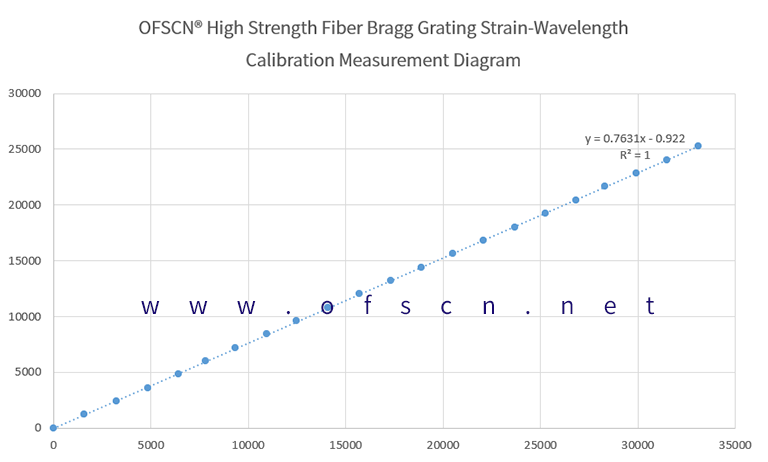
- Ultra-Wide Strain Range : The usable strain range reaches \ge 25000\ \mu\varepsilon . Under a reasonable bending radius, its fatigue life is exceptionally excellent, and 10,000 bending cycles will not cause physical damage to its structure.
Official Product Link:
OFSCN® High-Strength Fiber Bragg Gratings / FBG Strings (Bare) Official Link

OFSCN® Standard Femtosecond Fiber Bragg Gratings / FBG Strings (Bare)
If the bending amplitude or strain requirements are slightly lower, standard-grade femtosecond gratings can also be used:
- Non-Damaging Inscription : Also based on femtosecond laser through-coating inscription technology.
- Usable Strain Range : Usable strain range at room temperature is \le 15000\ \mu\varepsilon .
Official Product Link:
OFSCN® Standard Femtosecond Fiber Bragg Gratings / FBG Strings (Bare) Official Link

Technical Summary and Recommendations
If you plan to cyclically bend the grating region 10,000 times:
- Strictly avoid using ordinary traditional gratings that have their coating stripped and re-coated, as their grating regions are highly prone to brittle fracture under alternating bending.
- Be sure to choose high-strength gratings inscribed using the femtosecond laser through-coating method (such as OFSCN® High-Strength FBG).
- Control the working bending radius. A design bending radius of R \ge 20\ \text{mm} is recommended. If space is limited, the bending radius should not be less than 15\ \text{mm} to keep the bending strain within safe fatigue thresholds, thereby ensuring a mechanical bending lifespan of 10,000 cycles or more.