Will the tensile strength decrease where the grating has been engraved?
Whether the area where the grating is inscribed experiences a reduction in tensile capacity (i.e., mechanical strength or limit usable strain) depends entirely on the grating’s manufacturing process and inscription method.
In traditional grating fabrication processes, the tensile capacity of the inscribed area does indeed significantly decrease; whereas in advanced femtosecond laser-through-coating inscription processes, the mechanical strength of the grating area is virtually unaffected, maintaining an extremely high tensile threshold.
I. Traditional UV Laser Inscription: Significant Reduction in Tensile Capacity
For gratings inscribed using traditional ultraviolet ( \text{UV} ) mask-based irradiation methods, the reduction in tensile capacity is primarily attributed to the following physical and process steps:
- Mechanical/Chemical Damage from Coating Stripping:
Before inscription, the polymer protective coating on the fiber surface (such as polyimide or polyacrylate) must be stripped using mechanical strippers or chemical solvents to expose the bare fused silica fiber core. During the stripping process, any minor mechanical contact can introduce microscopic scratches or cracks (Micro-cracks) on the fragile fused silica glass surface. - Hydrogen Loading and Intense Laser Irradiation:
To enhance photosensitivity, the bare fiber typically undergoes high-pressure hydrogen loading, followed by exposure to intense UV laser irradiation. High-energy UV photons and the hydrogen loading process further cause existing micro-cracks on the silica surface to expand under internal stress. - Recoating Cannot Reverse Glass Damage:
Although the bare fiber is recoated (with polyimide or polyacrylate) after inscription, the recoating only provides moisture protection and basic physical protection; it cannot repair the micro-cracks that have already formed on the glass substrate surface. When the fiber is subjected to tensile force, stress becomes highly concentrated at these micro-cracks (Stress Concentration), leading to the fiber’s easy brittle fracture in the inscribed area (grating region).
Therefore, the usable strain range for traditional recoated UV gratings is typically limited to approximately $\le 10000\ \mu\varepsilon$.
II. Femtosecond Laser Through-Coating Inscription: Preserves Original High Tensile Strength
To thoroughly address the issue of reduced tensile capacity in the inscribed area of traditional gratings, advanced manufacturing processes currently employ femtosecond laser-through-coating inscription technology:
- No Coating Stripping Required:
Utilizing the extremely high peak power and nonlinear multi-photon absorption effect of a femtosecond laser, the laser beam can penetrate the outer original polymer coating, focus directly within the fiber core, and induce refractive index modulation. - Zero Mechanical Damage:
Since the entire inscription process does not require stripping the coating at all, the fused silica glass surface remains untouched by any mechanical, chemical, or environmental contact after leaving the factory. Its surface integrity is perfectly preserved, and no micro-cracks are introduced. - Extremely High Tensile Limit:
With no sources of stress concentration, the mechanical strength of these gratings is almost identical to that of the original high-strength fiber before inscription, exhibiting remarkable tensile and fatigue resistance.
III. OFSCN®'s High-Strength Grating Solutions
If your system applications require fiber Bragg gratings to withstand extreme tensile forces, high bending stress, or frequent mechanical fatigue, Beijing Da Cheng Yong Sheng Technology Co., Ltd. (OFSCN®) has developed corresponding bare grating products based on femtosecond laser processes:
1. OFSCN® High-Strength Fiber Bragg Gratings / FBG Strings (Bare)
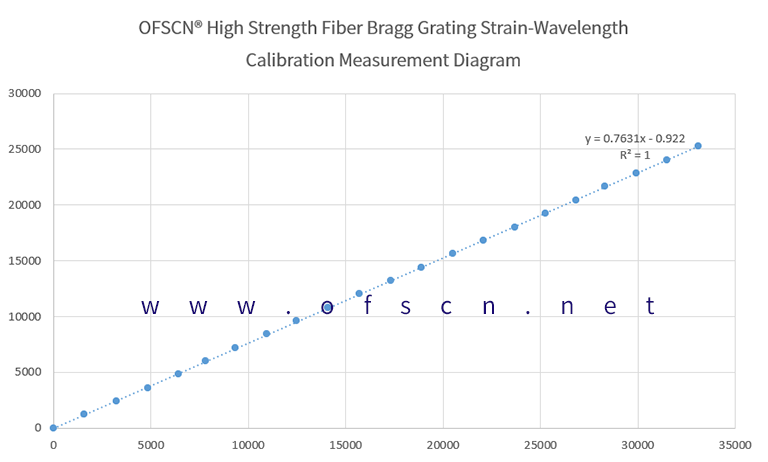
This product uses femtosecond laser point-by-point inscription. The inscription process does not damage the fiber coating, and the fiber used is a selected high-strength single-mode polyimide fiber.
- Maximum Usable Strain:
$\ge 25000\ \mu\varepsilon$(tensile strength and limit elongation are far superior to ordinary gratings). - Outer Diameter: 155 micrometers.

2. OFSCN® Standard Femtosecond Fiber Bragg Gratings / FBG Strings (Bare)
This product also employs advanced femtosecond laser-through-coating inscription technology, ensuring high mechanical strength while offering an extremely wide temperature adaptability.
- Usable Strain at Room Temperature:
$\le 15000\ \mu\varepsilon$. - Temperature Range:
$-270^\circ\text{C}$to$+800^\circ\text{C}$(processed with special techniques).
