If it bends too sharply, won’t the light “leak” out of the glass core?
In fiber optic communications and optical sensing engineering, fiber bending indeed causes light fields to radiate out of the fiber core, a physical phenomenon in optics known as Macrobending Loss.
1. Optical Physics Mechanism of Light “Leaking” from the Fiber Core
The fundamental principle of light propagation in optical fibers is Total Internal Reflection (TIR). An optical fiber consists of a high-refractive-index core (Core) and a low-refractive-index cladding (Cladding). When the angle of incidence of light at the interface between the core and cladding is greater than the critical angle \theta_c, the light is completely reflected back into the fiber core and continues to propagate.
When an optical fiber or patch cord is excessively bent into a loop:
- Change in Geometric Angle of Incidence: Geometric bending causes the angle of incidence when light reaches the core-cladding interface to decrease. When the angle of incidence is less than the critical angle \theta_c for total internal reflection, some of the light energy cannot undergo total internal reflection but instead refracts into the cladding and leaks out from the sides.
- Deformation of Mode Field Distribution: Bending causes the fundamental mode field in the fiber core to shift towards the outer side of the bend. The phase velocity requirement on the outer side increases, and the portion of light energy exceeding the limit of the cladding medium is converted into radiation modes and disperses outwards.
- Mechanical Stress and Damage: In addition to optical loss, excessively small bending radii can induce tensile stress on the outer side of the fused silica fiber core. If the bending radius falls below the material’s limit of stress, it may cause micro-cracks to propagate or even lead to permanent fiber fracture.
2. Minimum Bending Diameter Requirements for Patch Cord Coiling
The minimum diameter for coiling fiber optic patch cords depends on the type of optical fiber used (fiber specification) and the structure of the patch cord’s jacket/armor:
(1) Minimum Bending Radius and Diameter Based on Fiber Type
- Standard Single-Mode Fiber (e.g., G.652.D standard):
- Static Long-Term Bending Radius: R \ge 15\text{ mm} (corresponding to a minimum coiling diameter D \ge 30\text{ mm}).
- Dynamic Short-Term Bending Radius: R \ge 30\text{ mm} (corresponding to a minimum coiling diameter D \ge 60\text{ mm}). Below this diameter, significant additional optical power attenuation is observed at long wavelengths of 1550\text{ nm} or 1625\text{ nm}.
- Bend-Resistant Single-Mode Fiber (e.g., G.657 specifications):
- G.657.A1 / A2 Fiber: The allowable minimum bending radius can be reduced to 7.5\text{ mm} \sim 10\text{ mm} (minimum coiling diameter D \ge 15\text{ mm} \sim 20\text{ mm}).
- G.657.B3 Fiber: Extremely low bend-sensitive fiber, with a minimum bending radius down to 5\text{ mm} (minimum coiling diameter D \ge 10\text{ mm}), exhibiting very low optical loss at this bend.
(2) Limitations Based on Patch Cord Physical Structure
A patch cord is composed of the optical fiber, primary/secondary coating, strength members (e.g., aramid yarn, steel wire), and an outer jacket (e.g., PVC, PE, or seamless steel tube). In practical operation, the bending of the patch cord is also constrained by the mechanical bending limits of its outer jacket material:
- General 3.0\text{ mm} or 2.0\text{ mm} Soft Jacket Patch Cords: It is recommended that the coiling diameter be no less than 20 times the outer diameter of the jacket, resulting in a coiling diameter of approximately 40\text{ mm} \sim 60\text{ mm}.
- Steel Wire Armored or Metal Tube Protected Patch Cords: Due to the presence of a metal protective layer inside, although the tensile and compressive strength is significantly improved, permanent deformation kinks must be avoided. The coiling diameter is usually recommended to be kept above 60\text{ mm}.
3. Related OFSCN® Product References
Beijing Dacheng Yongsheng Technology Co., Ltd. (OFSCN®) offers fiber optic patch cord products that meet standard transmission specifications and possess high mechanical strength and bending resistance, catering to various physical environment requirements:
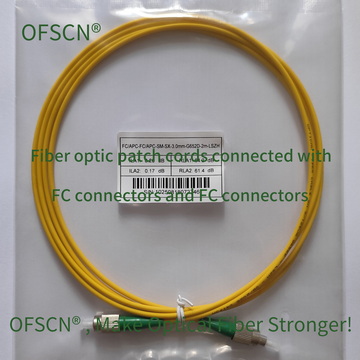
OFSCN® Standard Fiber Patch Cord
Utilizes standard G.652D single-mode fiber and a PVC outer jacket, suitable for laboratory and conventional data center environments. A recommended coiling bending diameter of no less than 60\text{ mm} is advised.
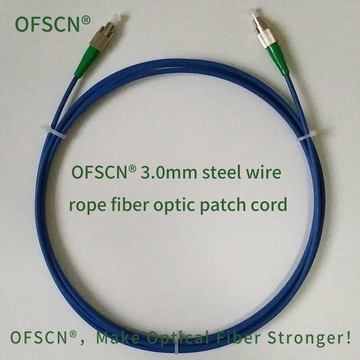
OFSCN® 3.0mm Steel Wire Rope Fiber Optic Patch Cord
Employs OFSCN® G.657 fiber with excellent bend-resistance performance, combined with a dual armor structure of stranded steel wire and seamless stainless steel tubing, providing ultra-high tensile strength and resistance to bending and crushing.
For more information on the structural design and technical specifications of fiber optic patch cord products, please refer to OFSCN® Fiber Optic Patch Cord Product Categories.