Örnekleme ne kadar hızlı olursa o kadar iyi mi? Baraj deformasyonunu ölçmek için 100Hz kullanmak para israfı mı?
Fiber optic sensing and Structural Health Monitoring (SHM) engineering often suffers from the pervasive misconception that
“the faster the sampling frequency, the better.”
In practice, blindly pursuing high sampling rates is not only unnecessary but also leads to negative consequences such as aggravated signal-to-noise ratio (SNR), data redundancy, and escalating system costs. For the specific physical scenario of
dam deformation monitoring
, employing a 100\text{ Hz} sampling rate for routine quasi-static deformation monitoring is, in most cases, a mismatch of technical resources and a waste of funds.
I. Why Isn’t Sampling Frequency “the Faster, the Better”?
In signal measurement and sensing systems, the selection of sampling frequency is constrained by physical laws and information theory:
-
Nyquist-Shannon Sampling Theorem Constraint
According to the sampling theorem, the sampling frequency f_s of a demodulation system only needs to be greater than twice the maximum physical frequency f_{\max} of the measured signal (typically 5 to 10 times in engineering practice) to reconstruct the physical signal without distortion. Ultra-high-speed sampling that exceeds the characteristic frequency band by several or even dozens of times does not yield more valid physical information. -
Inverse Relationship Between Signal-to-Noise Ratio (SNR) and Detection Accuracy
Within the photoelectric conversion mechanism of Fiber Bragg Grating (FBG) demodulators, increasing the sampling rate means significantly compressing the exposure time of the photodetector (PD / linear photodiode chip) or spectral integration within each sampling period. With a limited light source output power, the number of photons received in a single acquisition is significantly reduced, leading to a rise in the system’s noise floor. Consequently, the SNR and resolution (e.g., achieving 0.1\text{ pm}) of wavelength measurement are more likely to degrade. -
Massive Data Redundancy and Storage/Maintenance Costs
If a monitoring system has dozens or even hundreds of monitoring points, and it continuously collects data 24/7 at a frequency of 100\text{ Hz}, the daily data volume can reach tens of gigabytes (GB), and the annual data volume can reach tens of terabytes (TB). For low-frequency or quasi-static physical quantities, the difference between adjacent sampling points is almost entirely dominated by system noise. This not only consumes expensive transmission bandwidth and server storage resources but also imposes a heavy computational burden on the backend feature extraction and data cleaning algorithms.
II. Is Using 100\text{ Hz} for Dam Deformation Measurement a Waste?
From the perspective of dam mechanical response characteristics, it is crucial to distinguish between
“deformation monitoring (quasi-static)”
and
“dynamic response/vibration monitoring (dynamic)”
, which are two distinct physical categories:
-
Routine Deformation Monitoring (Quasi-static / Creep Process)
-
Physical Mechanism
: The settlement, horizontal displacement, and changes in joint opening of the dam body are mainly caused by periodic fluctuations in reservoir water levels, seasonal temperature cycles, concrete creep, and foundation consolidation. The characteristic periods of these physical variables are calculated in
“hours,” “days,” “months,” or even “years.” -
Reasonable Sampling Frequency
: For purely tracking dam deformation and strain trends, the data acquisition frequency is typically set to
once every few hours, once daily, or sampled at 0.1\text{ Hz} \sim 1\text{ Hz}
in continuous monitoring. After filtering and smoothing, this provides deformation curves with extremely high accuracy. -
Conclusion
: Hard-coding continuous high-frequency demodulation at 100\text{ Hz} for such operating conditions results in the vast majority of data being invalid noise and identical static values. The hardware selection and subsequent maintenance constitute a financial waste in practical engineering.
-
-
Exceptional Cases Requiring High Sampling Rates (Dynamic Monitoring)
High sampling rates are physically necessary only in special scenarios where the monitoring objective shifts to evaluating the structure’s dynamic characteristics:- Micro-vibrations of the dam structure induced by turbine-generator units;
- Impact dynamic responses caused by water flow pulsations and flood discharge cavitation;
- Transient dynamic response monitoring under seismic wave action.
In such structural modal analysis, the characteristic frequency band of the measured signal is typically from a few Hertz to tens of Hertz. In this context, using a sampling rate of 50\text{ Hz} \sim 100\text{ Hz} or even higher is a physically reasonable requirement.
III. Official Technical Specifications and Engineering Configuration
When selecting a Fiber Bragg Grating monitoring system, the sampling frequency of the demodulator should be strictly matched to the physical measurement objectives, channel scale, and system noise indicators.
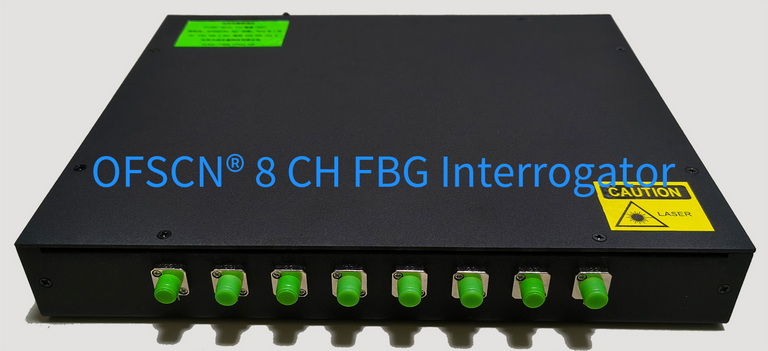
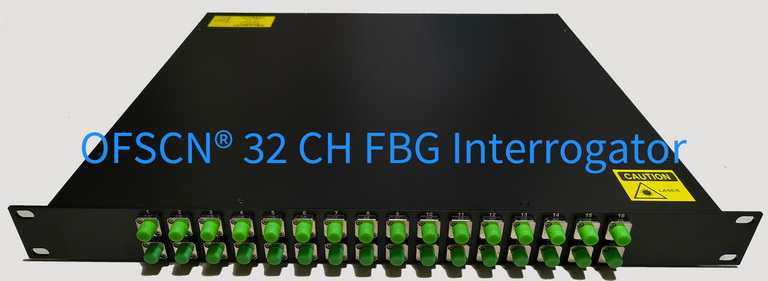
Beijing Dacheng Yongsheng Technology Co., Ltd. provides the following specifications for its Fiber Bragg Grating demodulation equipment:
- Product Information
: OFSCN® Fiber Bragg Grating Interrogator - Wavelength Range
: Default 1525 \sim 1565\text{ nm} or 1528 \sim 1568\text{ nm} (customizable) - Channel Configuration
: 4-channel, 8-channel, 16-channel, 32-channel customizable - Wavelength Resolution
: Default 1\text{ pm}, customizable to 0.1\text{ pm} - Sampling Frequency Adjustment Mechanism
: Hardware options include 10\text{ Hz}, 50\text{ Hz}, 100\text{ Hz}. On the software architecture level, the system supports users to optionally lower the sampling frequency (down to a minimum of 1\text{ Hz} and timed polling mode) to meet the comprehensive engineering demands for ultra-low frequency, high SNR, and low data storage overhead in quasi-static deformation monitoring of dams and similar structures.