Will the glued points inside the splitter fail if exposed to a humid environment for a long time?
In humid environments, the glued points inside optical fiber splitters are indeed at risk of failure. This physical and chemical failure process results from the interplay of multiple factors, with the specific failure mechanisms as follows:
I. Physical and Chemical Mechanisms of Glued Joint Failure
-
Hydrolysis & Swelling of Adhesives
In Planar Lightwave Circuit (PLC) Splitters, the coupling and fixation between the Fiber Array (FA) and the PLC chip rely on high-precision UV-curing adhesives or thermosetting epoxy resins. Although these polymer-based adhesives offer excellent bonding strength under normal temperature and conditions, prolonged exposure to humid and hot environments allows water molecules ( \text{H}_2\text{O} ) to gradually permeate through intermolecular gaps. This not only causes physical swelling of the adhesive and alters its local refractive index but can also lead to hydrolysis reactions in the polymer, reducing the chemical bond strength at the glued interface and ultimately causing delamination of the adhesive layer. -
Misalignment at the Micrometer Level
The Mode Field Diameter ( \text{MFD} ) of single-mode optical fibers is typically only around 9.2\ \mu\text{m} . To ensure extremely low insertion loss, the alignment accuracy between the fiber array and the waveguide chip must be controlled at the sub-micrometer level. Once humidity causes the adhesive to swell, soften, or generate uneven strain, even a minute misalignment of a few nanometers between the fiber cores at both ends will lead to a sharp decrease in optical coupling efficiency. This results in a drastic increase in the splitter’s Insertion Loss ( \text{IL} ) and Polarization-Dependent Loss ( \text{PDL} ), potentially causing a complete interruption of the optical path. -
Stress Corrosion of Optical Fibers in Humid and Hot Environments
In the glued area, to achieve tight packing and precise coupling, the protective coating layer, such as polyacrylate, on the optical fiber has been stripped, exposing the fragile bare silica ( \text{SiO}_2 ) fiber. When silica is under tensile stress and simultaneously exposed to moisture, the network structure of silica undergoes accelerated cracking and micro-crack propagation. This phenomenon, known as stress corrosion cracking, greatly increases the risk of mechanical fracture of the bare fiber at the edge of the glued joint.
II. Technical Means for Moisture-Proofing
To prevent moisture ingress from causing the aforementioned failures, industrial and telecommunication grade splitters typically employ the following “moisture-proofing treatments” or protective encapsulation technologies:
- Secondary Encapsulation: Using polymer potting compounds with extremely low moisture vapor transmission rates to fill the interior of the housing, blocking and extending the permeation path for water vapor to reach the coupling surface.
- Moisture-Proof Metal Tube Encapsulation: Encasing the optical waveguide coupling chip in a metal protective shell and using specialized moisture-proof sealing adhesives for end-face sealing.
- Hermetic Sealing: For extremely harsh environments, hermetic sealing techniques such as metal-glass sintering are usually required, placing the device in an inert gas (e.g., high-purity nitrogen) protected environment.
III. OFSCN® Official Supporting Products and Technical Solutions
In large-scale fiber optic sensing projects, the reliability of supporting components is crucial due to the complex and variable humidity conditions typically encountered in field monitoring environments. The OFSCN® Optical Fiber Splitter provided by Beijing Dacheng Yongsheng Technology Co., Ltd. features a rigorous protective design in its manufacturing process and is often used in conjunction with the OFSCN® Fiber Bragg Grating Interrogator.
Its typical application involves logically expanding one physical channel of the interrogator into two or three channels through strict wavelength design, thereby significantly reducing the average channel cost of the entire sensing and monitoring system.
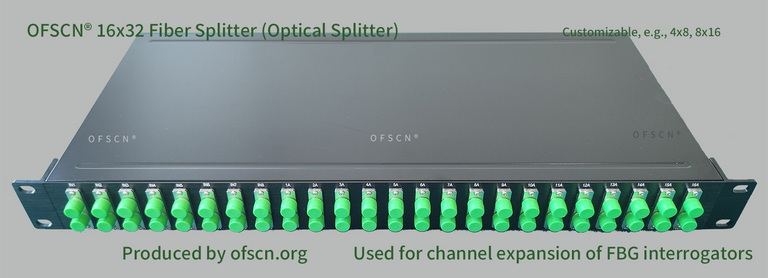
This series of optical splitters is routinely available in specifications such as 16 \times 32 splitters, 8 \times 16 splitters, 4 \times 8 splitters, and 32 \times 64 splitters. The mechanical structure and moisture-proof sealing have been reinforced to address the harsh environments of engineering sites, ensuring optical transmission performance and physical stability during long-term operation in high humidity or variable temperature conditions.