Warum werden extrem dünne, extrem biegsame und hochflexible Spezial-Patchkabel benötigt?
In medical surgical robot systems (such as minimally invasive laparoscopic surgical robots, flexible interventional catheter robots, and multi-degree-of-freedom articulated surgical instruments), optical fibers are often used for high-precision force sensing, shape sensing (FBG / OFDR sensing), or for transmitting lasers and imaging in the surgical field. In this specific working scenario, fiber optic patch cords must possess physical characteristics of being extremely thin, highly flexible, and resistant to repeated twisting. The underlying engineering mechanics and optical principles are primarily reflected in the following four dimensions:
1. Constrained by Narrow Passages and Geometric Cross-Section (Extremely Thin)
- Volume Limitation of Internal Passages in Minimally Invasive Instruments: The robotic arm of a surgical robot passes through a trocar into the body cavity. The diameter of the instrument shaft is typically only 5\text{ mm} to 8\text{ mm}. The multi-lumen passage inside must simultaneously accommodate drive wires, surgical wire ropes, irrigation/flushing/suction channels, and imaging components.
- Cross-Sectional Space Occupation: The cross-section reserved for optical fiber sensing and signal transmission is usually less than 1\text{ mm}. An extremely small outer diameter (e.g., \Phi \le 0.9\text{ mm}, or even micro-scale structures) can minimize the occupation of the instrument’s lumen space and avoid compression interference with other mechanical moving parts.
2. Joint Drive Torque Resistance and Dexterity Control (Highly Flexible)
- Fourth-Power Relationship between Stiffness and Diameter: According to material mechanics, the bending stiffness of a slender beam with a uniform cross-section is proportional to the product of the material’s elastic modulus E and the area moment of inertia (moment of inertia) I of the cross-section. For a solid circular cross-section cable:I = \frac{\pi d^4}{64}The bending stiffness EI decays rapidly with the fourth power of the outer diameter d. Reducing the outer diameter of the patch cord geometrically reduces the bending resistance of the patch cord.
- Load Transparency and Haptic Feedback of Micro-motors: The distal wrist joint of surgical robots is driven by miniature servo motors. If the bending stiffness of the fiber optic patch cord is too high, the restoring force of the patch cord’s own deformation creates a parasitic resistant torque, significantly reducing force control sensitivity and interfering with the force feedback of the joint end-effector, thereby affecting the micro-level precision of surgical operations.
3. Dynamic Shear Stress and Fatigue Failure under Multi-Degree-of-Freedom Motion (Resistant to Repeated Twisting)
- Composite High-Frequency Rotation Conditions: The end-effector wrist of surgical robots (e.g., needle holders, scissors) has multiple degrees of freedom, including pitch, yaw, and continuous roll. It frequently undergoes high-speed reciprocating twisting of \pm 180^\circ or even larger angles.
- Torsional Shear Stress and Fatigue Fracture: Twisting generates shear stress on the outer edge of a circular cross-section component:\tau = \frac{T \cdot r}{J}(where T is the torque, r is the radius, and J is the polar moment of inertia of the cross-section). If the conventional coating or armor layer slips non-synchronously with the internal quartz fiber core or causes stress concentration, micro-cracks (Griffith Cracks) will rapidly propagate along the quartz cladding under alternating shear stress, leading to static fatigue brittle fracture. Special twist-resistant patch cords use dedicated internal buffer interfaces, low-friction sheath materials, and anti-twist structures to release dynamic shear concentration and ensure mechanical life under high cycle periods.
4. Macro-bending Loss and Wavelength Stability under Dynamic Micro-Bending (Optical Performance)
- Curvature Radius Limit: When surgical instruments swing within the body cavity, the local dynamic bending radius at the joints may be compressed to R \le 10\text{ mm} or even a few millimeters.
- Macro-bending and Birefringence Control: Ordinary single-mode optical fibers will cause guided mode leakage under such stringent curvature radii, inducing severe macro-bending loss. Simultaneously, the elasto-optic effect caused by twisting generates random stress birefringence, leading to drastic fluctuations in the polarization state of the demodulated optical signal, degrading the sensing demodulation accuracy. Therefore, such patch cords usually require matching design with bending-insensitive fibers (e.g., fibers conforming to ITU-T G.657 standard) or fine-diameter fibers coated with high-modulus polyimide.
Related Technical Product References
When wiring in actual industrial-grade and medical-grade equipment, compact special structures are often selected based on tensile strength and mechanical protection requirements:
- Micro-fine Protection and Compact Wiring:
For compact structures requiring metal protection but limited by installation space, micro-seamless stainless steel capillary protection can be considered:
OFSCN® 2.0mm Micro Steel Armored Fiber Optic Patch Cord
This utilizes a 0.6\text{ mm} fine-diameter seamless steel tube inner lining with sheath encapsulation, balancing resistance to lateral pressure and small bending operation requirements.


- Customization of Extremely Thin and Bend-Resistant Fiber Optic Patch Cords:
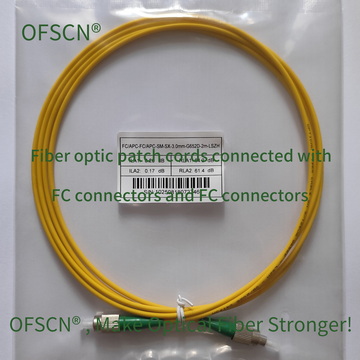
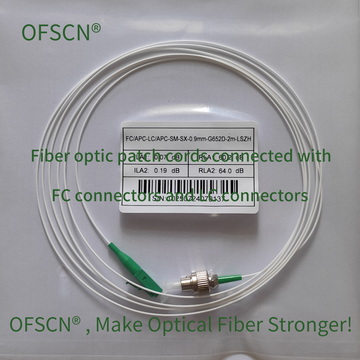
In standard and non-metallic compact scenarios, soft single-core patch cords with an outer diameter as small as 0.9\text{ mm} can also be used:
OFSCN® Standard Fiber Patch Cord
Supports customization of 0.9\text{ mm} outer diameter and bend-resistant G.657 single-mode fiber core configuration.
More classifications of patch cord specifications can be found at:
OFSCN® Fiber Optic Patch Cord Product Catalog