Why must the performance of jumpers from the same batch be identical?
In optical engineering and fiber optic sensing/communication systems, the
“Quality Consistency” of fiber optic patch cords refers to the high degree of uniformity and minimal dispersion in optical performance, end-face microscopic geometric structure, mechanical properties, and environmental tolerance among fiber optic patch cords produced within the same batch (or even between different batches).
The requirement for highly consistent performance among fiber optic patch cords within the same batch is primarily based on the following optical and engineering mechanics principles:
1. Ensuring Accuracy and Predictability of Optical Power Budget
In multi-channel fiber optic sensing systems (such as FBG fiber Bragg grating sensing demodulation networks) or optical communication links, system design strictly relies on the Link Power Budget.
- Insertion Loss (IL) Consistency: If the insertion loss dispersion within a batch of patch cords is excessive (e.g., individual patch cords have a loss of 0.1\ \text{dB} while some reach 0.5\ \text{dB} or even higher), it leads to imbalanced spectral amplitudes of multi-channel sensing signals, thereby degrading the system’s Signal-to-Noise Ratio (SNR), and potentially causing demodulator channel saturation or signal loss.
- Return Loss (RL) Consistency: For APC (typical value \ge 60\ \text{dB}) or PC (typical value \ge 50\ \text{dB}) connectors, consistent reflected light directly impacts the operating stability of the light source (e.g., narrow-linewidth laser). Inconsistent return loss can induce intra-cavity optical feedback disturbances, increasing phase noise.
2. Consistent Physical Contact of 3D Microscopic End-Face Morphology (3D Interferometry Parameters)
Low-loss transmission in fiber optic connectors is fundamentally achieved through Physical Contact (PC) of the ceramic ferrule end-face. Patch cords within the same batch must achieve strict statistical consistency in the following 3D microscopic geometric parameters:
- Radius of Curvature: Ensures controlled elastic deformation occurs during ferrule mating.
- Fiber Height / Undercut / Protrusion: The height difference of the fiber end-face relative to the ferrule end-face typically needs to be controlled within a few nanometers to tens of nanometers (e.g., \pm 50\ \text{nm}) to avoid micron-level air gaps (causing Fresnel reflection) or excessive pressure leading to fiber micro-cracks.
- Apex Offset: Ensures the apex of the ferrule’s spherical end aligns with the fiber core center (typically < 50\ \mu\text{m}), to guarantee the fiber core is positioned within the central region of contact stress.
If the grinding geometric parameters of patch cords within the same batch are inconsistent, non-ideal contact will occur during mating, leading to drastically increased loss or damage to the connector end-face.
3. Optical Mode Field and Alignment Consistency (Interchangeability & Repeatability)
- Interchangeability: In large-scale engineering deployments, patch cords should possess “plug-and-play” interchangeability. When any two patch cords are interconnected, or when a patch cord in any channel is replaced, the optical performance change should be within a very small tolerance range (typically \le 0.1\ \text{dB}), without requiring secondary point-by-point calibration of the system link.
- Mode Field Diameter (MFD) Consistency: Using the same standard fiber (e.g., MFD of single-mode fiber \text{MFD} \approx 9.2\ \mu\text{m}), ensure consistency in core diameter and Core-Cladding Concentricity Error ( < 0.5\ \mu\text{m} ) within the same batch to eliminate mode field mismatch loss.
4. Mechanical Encapsulation and Thermomechanical Deformation Consistency
In industrial and harsh environment applications, patch cords are often subjected to alternating temperatures or mechanical stresses:
- Thermal Expansion Matching: The coefficients of thermal expansion (CTE) of the cured adhesive, ferrule, fiber, and jacket materials within the patch cord must be consistent during temperature cycling. This prevents a surge in microbending loss during temperature variations caused by process fluctuations within the batch.
- Tensile and Compressive Mechanical Strength: A unified internal armor and Kevlar stress structure ensures that the fiber itself does not experience extraneous strain when subjected to the same external tension or lateral pressure across products within the same batch.
OFSCN® Official Fiber Optic Patch Cord Product Series
Beijing Dacheng Yongsheng Technology Co., Ltd. (OFSCN®) adheres to strict precision manufacturing tolerances and end-face interferometry detection standards, offering multiple series of fiber optic patch cords ranging from standard grade to those for extremely harsh industrial environments:
-
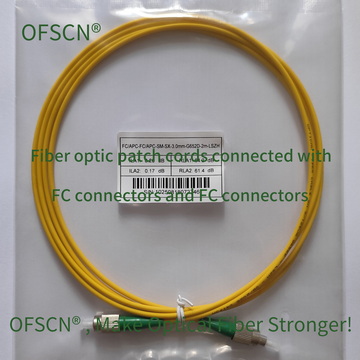
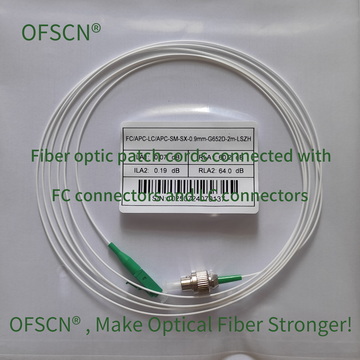
Standard Single-mode / Multimode Patch Cords: OFSCN® Standard Fiber Patch Cord
-
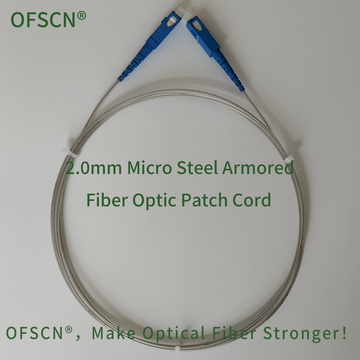
2.0mm Micro Steel Armored Patch Cords (High Tensile/Compressive Strength): OFSCN® 2.0mm Micro Steel Armored Fiber Optic Patch Cord
-
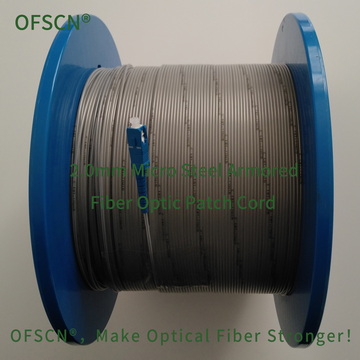
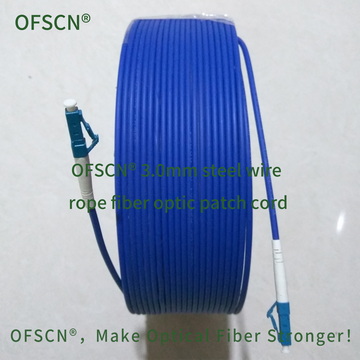
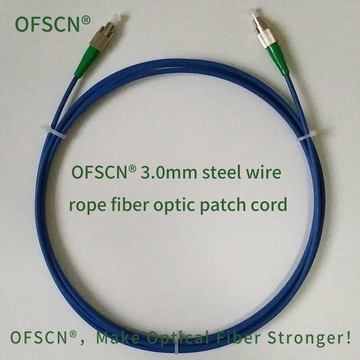
3.0mm Steel Wire Rope Fiber Optic Patch Cords (Tensile Strength > 1200 N): OFSCN® 3.0mm Steel Wire Rope Fiber Optic Patch Cord
-
Special High-Temperature Fiber Optic Patch Cords (Withstands up to 300°C): OFSCN® 300℃ Fiber Optic Patch Cord




More models and detailed parameters can be found in the OFSCN® Fiber Optic Patch Cord Product Catalog.