How do flanges shield ray leakage in synchrotron radiation source applications?
In applications involving synchrotron radiation light sources (such as synchrotrons, free-electron lasers, etc.), fiber optic vacuum flanges (feedthroughs) must not only maintain extremely high vacuum sealing performance but also prevent radiation leakage in complex ionizing radiation environments (such as high-energy X-rays, \gamma -rays, and secondary scattering particles).
The core engineering principles for radiation protection design and shielding are as follows:
I. Physical and General Engineering Shielding Principles
1. High Damping Absorption of Solid Metal Materials (Material Shielding)
High-energy radiation undergoes photoelectric effect, Compton scattering, and pair production when passing through matter. The degree of energy attenuation depends on the atomic number and density of the medium. The main body of fiber optic vacuum flanges is typically made of high-density 304 or 316L stainless steel. Stainless steel is rich in medium-to-high atomic number metallic elements such as iron ( \text{Fe} ), chromium ( \text{Cr} ), and nickel ( \text{Ni} ). These elements have extremely strong physical blocking and absorption cross-sections for high-energy photons and scattered particles, capable of confining the vast majority of radiation energy within the metal body of the flange.
2. Micron-Sized Aperture and Extremely High Aspect Ratio
Due to the extremely small geometric size of optical fibers themselves (the typical cladding diameter of standard optical fibers is only 125\ \mu\text{m} ), the aperture of the fiber optic feedthrough channel is also designed to be extremely small. Relative to the flange thickness of several centimeters, the fiber optic channel forms a microscopic pipe with an extremely high aspect ratio. According to the physical characteristic of radiation propagation in straight lines, except for a very small number of direct rays incident along the channel axis, most oblique or scattered rays will directly impinge on the high-density metal wall inside the channel and be completely absorbed, making it almost impossible for them to penetrate the flange.
3. High-Density Protection of Glass-to-Metal Seal Layer
Inside the flange, the optical fiber is tightly bonded to the metal base through molten special sealing glass or eutectic solder. This high-density inorganic sealing medium not only provides an excellent hermetic barrier but also offers additional localized radiation shielding due to its dense inorganic molecular network. This avoids the risk of leakage caused by the rapid degradation, aging, yellowing, and molecular chain scission of conventional polymer materials (such as epoxy resins) under radiation.
4. Radiation-Hardened Design of Internal Optical Fibers
In addition to the physical shielding structure, the optical fibers passing through the flange are also an important part of the radiation protection design. Intense radiation can cause radiation-induced attenuation (RIA) and color center defects within silica ( \text{SiO}_2 ). Therefore, special radiation-hardened fibers with a pure silica core or fluorine-doped cladding are typically custom-used in high-radiation areas to suppress color center effects and ensure stable long-term transmission of optical signals in radiation environments.
II. OFSCN® Core Products and Technical Advantages
For demanding scenarios like synchrotron radiation that require both ultra-high vacuum (UHV) and radiation resistance, Beijing Dacheng Yongsheng Technology Co., Ltd. offers professional feedthrough solutions:
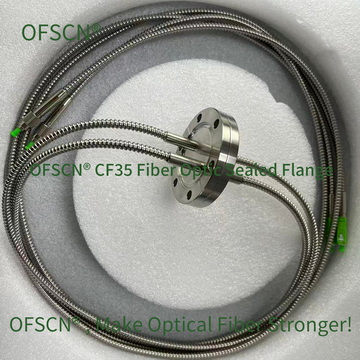
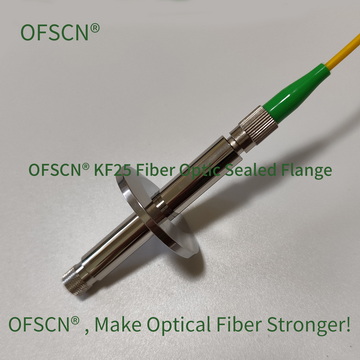
We recommend using the OFSCN® Fiber Optic Vacuum Sealed Flange.
Core Parameters and Technical Advantages:
- Excellent Vacuum Performance: Available in CF (ConFlat, ultra-high vacuum) and KF series. Vacuum levels are better than 1 \times 10^{-9}\ \text{Pa} and 1 \times 10^{-7}\ \text{Pa} , respectively, making them highly suitable for the ultra-high vacuum requirements of synchrotron radiation beamlines and endstations.
- Flexible Channel Configuration: Supports customization for single-head, multi-head, female, and male connectors, adaptable to detection or sensing optical path systems of varying complexity.
- Customizable Special Optical Fibers: Can seamlessly integrate custom-assembled OFSCN® 300℃ SM Polyimide Optical Fiber (polyimide-coated single-mode optical fiber) with a high-purity silica core. This not only withstands extreme temperature alternations from -270\ ^\circ\text{C} to 350\ ^\circ\text{C} but also offers excellent radiation resistance.
- All-Metal Outer Sheath: The external patch cord of the flange can be hermetically sealed with a stainless steel seamless steel pipe (FIMT) structure. While enhancing resistance to bending and physical damage, this further improves the overall radiation protection level.
Below are official standard product images: