How does it monitor water leakage and deformation in underground pipeline networks?
In smart city construction, the health monitoring of underground pipeline networks (such as water supply and drainage, heating, gas, and power trenches) is crucial. Fiber optic sensing technology (especially Fiber Bragg Grating (FBG) sensing technology and Distributed Fiber Optic Sensing technology) primarily utilizes the physical modulation effects of light during transmission in optical fibers (wavelength shift, scattering light frequency/phase changes) to achieve high-precision, real-time quantitative monitoring of pipeline network deformation and water leakage.
I. Technical Principles of Underground Pipeline Network Deformation Monitoring
When pipeline networks experience ground settlement, uneven displacement, ground squeezing, or structural creep, strain occurs on the pipe surface.
-
Fiber Bragg Grating (FBG) Wavelength Strain Response Mechanism
Fiber Bragg Gratings are formed by creating periodic refractive index modulations within the fiber core. The Bragg reflection center wavelength \lambda_B is determined by the effective refractive index n_{\text{eff}} and the grating period \Lambda :\lambda_B = 2 n_{\text{eff}} \LambdaWhen the pipe deforms and acts upon the sensor, the resulting mechanical strain \varepsilon causes a wavelength shift \Delta \lambda_B :
\Delta \lambda_B = S_\varepsilon \cdot \varepsilon + S_T \cdot \Delta THere, S_\varepsilon is the strain sensitivity coefficient, and S_T is the temperature sensitivity coefficient. After eliminating temperature interference (temperature compensation), the magnitude of pipe strain can be accurately measured.
-
Multi-point Strain Array and Pose/Displacement Reconstruction
Multiple FBG strain sensors are arranged axially and circumferentially along the pipeline to form a sensing network. By acquiring the positive and negative strain distribution at different measurement points on the pipe, the three-dimensional bending posture, settlement, and local displacement of the pipeline can be reconstructed using elastic mechanics and curvature integration algorithms.
II. Technical Principles of Underground Pipeline Network Water Leakage Monitoring
Underground pipeline ruptures and leaks are primarily captured through two physical effects: thermal anomalies and mechanical/acoustic vibration anomalies.
-
Thermal Anomaly Detection Method (Water/Thermal Medium Leakage)
Seepage liquids (such as hot water from heating or tap water) typically have a temperature difference from the surrounding soil/groundwater. After a leak occurs, the outward diffusion of the liquid significantly alters the local temperature gradient outside the pipe wall. FBG temperature sensors or Distributed Temperature Sensing (DTS) can capture this thermal anomaly in real-time, enabling precise localization of the leakage area. -
Stress/Pressure Abrupt Change and Acoustic Vibration Detection (High-Pressure Pipeline Networks)
When a high-pressure pipeline leaks, the stress concentration near the rupture point changes drastically. Furthermore, the acoustic vibration signals generated by the spraying liquid/gas transmit along the pipeline. Using FBG stress/pressure sensors or Distributed Acoustic Sensing (DAS), these high-frequency vibrations and pressure drop signals can be captured in real-time.
III. Official OFSCN® Matching Sensor Products
Addressing the needs for deformation and stress/temperature monitoring in the complex environment of underground pipeline networks, Beijing Dacheng Yongsheng Technology Co., Ltd. (OFSCN®) offers a series of FBG sensor products with waterproof protection and high mechanical strength:
1. Pipeline Deformation and Strain Monitoring
For monitoring pipeline settlement, bending, and axial strain, FBG strain sensors encapsulated in elastic alloy tubes or polymers can be used:
-
OFSCN® Alloy Tube Packaged Fiber Bragg Grating strain sensor
-
OFSCN® Polymer-encapsulated Fiber Bragg Grating Strain Sensor (0.7mm/1.2mm diameter)


2. Pipe Wall Force and Stress Calculation
By using the elastic modulus E of the structural material, combined with strain sensors, the force state borne by the pipe wall can be calculated in real-time ( \sigma = E \cdot \varepsilon ):

3. Leakage Temperature Monitoring and Temperature Compensation
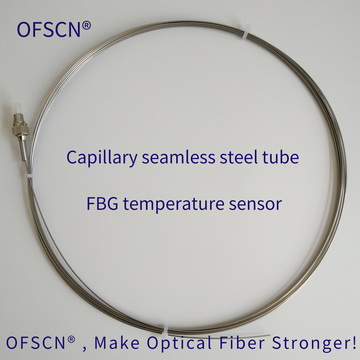
FBG temperature sensors encapsulated in seamless steel tubes can be used to detect temperature field changes caused by leakage, while also providing accurate temperature compensation data for strain monitoring: