Will the metal parts of the joint rust on the offshore platform?
On offshore platforms, the metal connectors and armor layers of fiber optic patch cords or sensors are highly susceptible to rust and corrosion unless special anti-corrosion materials and surface isolation processes are employed.
To ensure the long-term high reliability of fiber optic systems in marine environments, understanding their corrosion mechanisms, evaluating testing methods (such as salt spray testing), and making appropriate material selections are crucial.
I. Metal Corrosion Mechanisms in Offshore Platform Environments
Offshore platforms are situated in typical marine atmospheric and splash zones, environments that are extremely destructive, primarily characterized by:
- High Salinity and Chloride Ion Erosion: The abundant sea salt mist suspended in the air is rich in chloride ions (\text{Cl}^-). Chloride ions, with their extremely small radius and strong penetration power, can easily breach the naturally formed passivation film on ordinary metal surfaces, inducing severe Pitting Corrosion and Crevice Corrosion.
- High Humidity and Electrochemical Reactions: The high humidity offshore (relative humidity often \text{RH} \text{gt} 90\% year-round) makes metal surfaces highly prone to forming water films. Electrolyte water films, dissolved with salt, can create micro-batteries within the metal or at interfaces between different metals, leading to vigorous Galvanic Corrosion.
- Failure of Traditional Connectors: Common fiber optic connectors like \text{FC}, \text{SC}, and \text{ST} available on the market often use nickel-plated brass, zinc alloy, or ordinary low-specification stainless steel for their metal casings. These materials can develop red or white rust within days in a salt spray environment. As the metal rusts and expands, it not only causes the connector to seize mechanically, making normal insertion and removal impossible, but also compresses or distorts the precision ceramic ferrule. This leads to fiber misalignment, causing a sharp increase in Insertion Loss ( IL ), potentially resulting in signal interruption.
II. Scientific Evaluation with Salt Spray Testing
To verify the corrosion resistance of metal components in fiber optic patch cords, rigorous Salt Spray Testing (often following standards like \text{ASTM B117}, \text{IEC 60068-2-11}, or \text{ISO 9227}) must be conducted during the design and selection phases:
- Test Method: Within a sealed salt spray test chamber, maintain a temperature of 35\ ^\circ\text{C} and continuously spray a 5\% salt solution (\text{NaCl} solution) to ensure uniform deposition of salt mist on the sample surface.
- Evaluation Metrics: Depending on the application, samples typically undergo continuous spraying for 48\text{h}, 96\text{h}, 168\text{h}, or even up to 720\text{h}. After testing, the metal surfaces of the connectors are assessed for corrosion products (red or white rust), and the optical transmission parameters of the fiber optic patch cords (such as insertion loss and return loss) are tested to see if they have degraded.
III. Offshore Corrosion Protection Design and OFSCN® Solutions
To address the severe corrosion challenges in offshore platforms and similar harsh industrial environments, OFSCN® has implemented targeted material and structural upgrades for its fiber optic patch cords and cables:
1. Adoption of High-Grade Corrosion-Resistant Metal Materials
- ** 316\text{L} Stainless Steel**: Compared to ordinary 304 stainless steel, 316\text{L} incorporates 2\% \sim 3\% molybdenum (\text{Mo}), significantly enhancing its ability to resist chloride-induced pitting and crevice corrosion.
- ** 825 Nickel-Based Alloy**: In extremely harsh seawater or acidic corrosive environments, selecting 825 alloy can completely prevent stress corrosion cracking and pitting.
2. Introduction of Anti-Corrosion Physical Sheathing
Utilizing polymer materials like polyethylene (\text{PE}) or polyvinyl chloride (\text{PVC}) to encapsulate the metal armor, physically isolating the metal components from the humid and salty external environment.
3. Matched OFSCN® Corrosion-Resistant, High-Tensile Patch Cords and Cables:
-
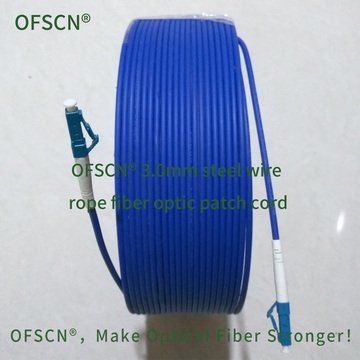
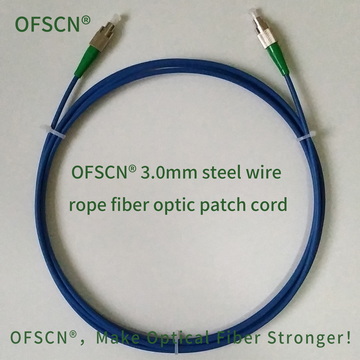
OFSCN® 3.0mm Steel Wire Rope Fiber Optic Patch Cord: This patch cord features a high-density \text{PE} outer sheath, with an internal composite structure of 0.45\text{mm} stainless steel wire strands, a 0.9\text{mm} seamless stainless steel tube, and optical fiber. It can withstand a tensile force exceeding 1200\text{N}, while its \text{PE} sheath and internal multi-layer stainless steel structure provide excellent protection against moisture and salt mist penetration.
-
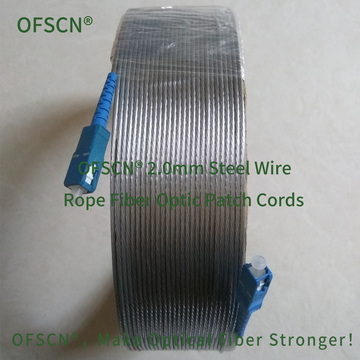
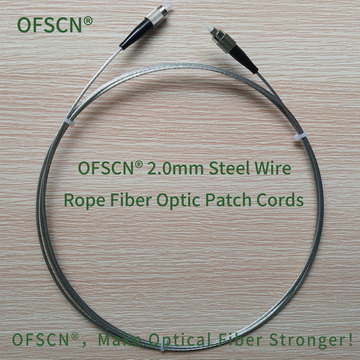
OFSCN® 2.0mm Steel Wire Rope Fiber Optic Patch Cord: This utilizes a full metal high-strength structure, composed of a fiber optic connector, a 0.6\text{mm} galvanized steel wire stranded structure, a 1.0\text{mm} seamless stainless steel tube, and optical fiber. Its tensile strength can reach over 1500\text{N}.
-
OFSCN® 300°C Seamless Steel Tube Fiber Cable: For long-term deployment or multi-point sensing, this fiber optic cable comes standard with a single-layer seamless steel tube encapsulation. The default material is 316\text{L} stainless steel, with an upgrade option to 825 alloy. This provides dual assurance—physical and chemical—for the absolute safety of deployments on offshore oil and gas platforms and for subsea instrumentation.


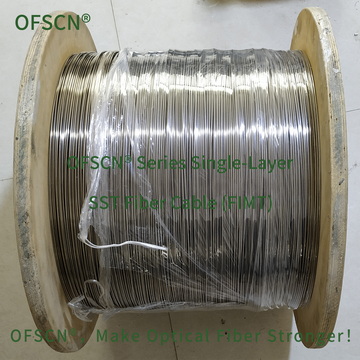
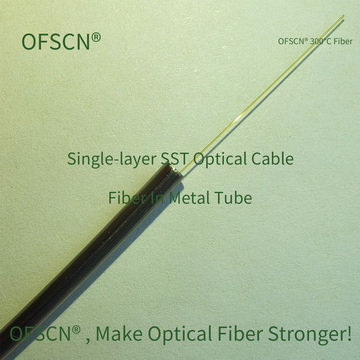

Through these dual technological approaches of physical isolation and metallurgical alloy upgrades, fiber optic connectors and waveguide patch cords can operate stably over the long term in the high-salt, high-humidity environment of offshore platforms, maintaining excellent long-term optical stability.