Can the system automatically detect which fiber optic cable is broken?
Yes, fiber optic sensing systems can automatically detect which optical fiber has broken and precisely identify the faulty channel and the physical section where the break occurred.
This self-diagnostic capability is achieved through the physical properties of light transmission in optical fibers combined with the spectral real-time monitoring logic of the demodulation software.
I. Technical Principle for System to Identify “Which Fiber is Broken”
In Fiber Bragg Grating (FBG) sensing systems or distributed fiber optic sensing systems, fiber break diagnosis is primarily achieved through the following three mechanisms:
1. Channel-Level Fiber Break Diagnosis (Locating a Specific Fiber)
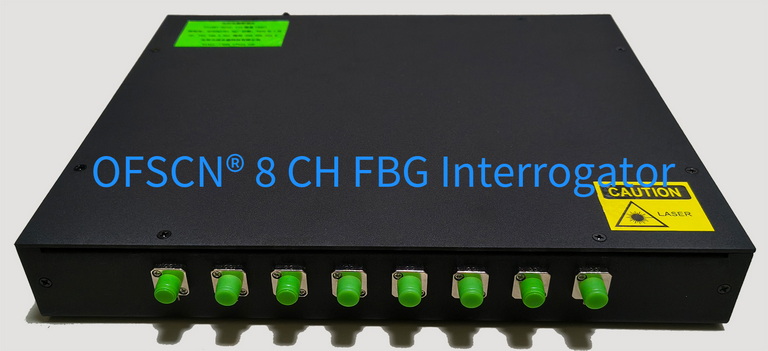
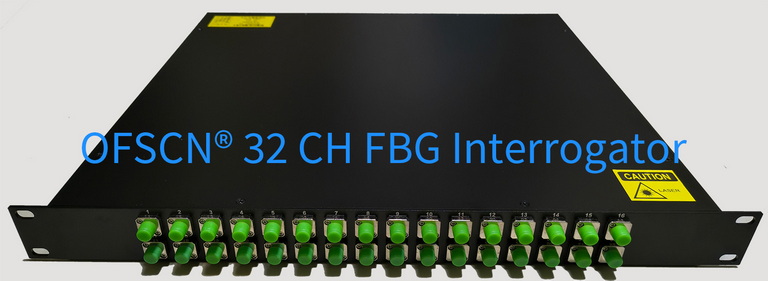
Each optical fiber interface on a multi-channel fiber demodulation device (e.g., 4-channel, 8-channel, 16-channel, 32-channel demodulators) corresponds to an independent physical optical fiber line.
- Physical Logic: The demodulator’s light source continuously injects broadband light into each channel and receives reflected optical signals from the fibers in real-time.
- Judgment Method: If the reflected optical power of a certain channel suddenly drops below the background noise, or if all preset sensor nodes’ reflection spectra within that channel disappear, while other channels remain operational, the system software can automatically determine that the optical fiber connected to that channel has broken or a connector has detached.
2. Node-Level Breakpoint Localization (Locating a Specific Section on the Fiber)
When multiple Fiber Bragg Grating sensors with different wavelengths \lambda_1, \lambda_2, \dots, \lambda_n are connected in series on a single optical fiber:
- Missing Reflection Spectrum Analysis: If the optical fiber breaks between the k -th sensor and the (k+1) -th sensor, the optical signal cannot propagate further. In the spectrum received by the demodulation system, the reflection peaks from \lambda_1 to \lambda_k will still exist, while the reflection peaks from \lambda_{k+1} to \lambda_n will completely disappear.
- Fault Localization: By comparing the list of lost sensor wavelengths, the demodulation software can precisely determine that the break point is located in the cable segment between sensor k and sensor k+1 .
3. Distance-Level Breakpoint Localization (Distributed Fiber Systems, e.g., OFDR / OTDR)
In distributed fiber optic sensing systems, the system utilizes the principle of backscattered Rayleigh scattering or Fresnel reflection:
- Time/Frequency Domain Analysis: A broken fiber end will produce a strong Fresnel reflection peak (air interface at the break point), immediately followed by a complete interruption of the backscattered light signal.
- Distance Calculation: The system calculates the precise physical distance L from the break point to the demodulator based on the propagation time of light in the fiber and its refractive index (accuracy can reach the meter or even millimeter level).
II. Self-Diagnostic Alarms and System Integration
Modern fiber optic demodulation software features a comprehensive self-diagnostic mechanism for optical fiber links:
- Real-time Spectrum Monitoring: The system continuously scans the reflection spectra of each channel at a specific sampling frequency (e.g., 10\text{Hz} ~ 100\text{Hz} ).
- Automatic Status Determination: When abnormal link attenuation (e.g., excessive bending loss) or signal loss (fiber break) is detected, the system automatically generates a fault log, identifying the abnormal channel number, fault type, and affected sensors.
- Data Bus Push: Supports real-time transmission of link interruption status to upper computers or SCADA master control systems via communication protocols such as TCP, UDP, Modbus, triggering alarms.
III. Relevant Official Demodulation Equipment
Beijing Dacheng Yongsheng Technology Co., Ltd.'s (OFSCN®) OFSCN® Fiber Bragg Grating Interrogator offers multi-channel independent parallel acquisition capabilities and spectral self-diagnostic functions, allowing real-time monitoring of optical fiber link status and supporting integration with automation control systems.