At what temperature does fiber become noodle-like before melting?
In the fields of telecommunications and fiber optic sensing, the primary component of communication-grade silica optical fiber is high-purity silicon dioxide (\text{SiO}_2). Because quartz glass is an amorphous, non-crystalline structure, it does not possess a fixed “melting point” like crystalline substances. Instead, as it is heated, it gradually transitions continuously from a hard, brittle solid state to a highly viscous fluid.
Regarding the state where optical fiber becomes “as soft as noodles,” in materials science and glass technology, this primarily corresponds to the Softening Point and its associated thermodynamic transition range:
1. Key Thermoelectric Transition Temperatures of Quartz Optical Fiber
- Glass Transition Temperature (T_g): Approximately 1100\ \text{℃} \sim 1200\ \text{℃}. Below this temperature, quartz is in a rigid glassy state; above this temperature, internal stresses in the glass begin to release, and the structure undergoes micro-relaxation, but it remains macroscopically rigid.
- Softening Point: Defined as the temperature at which the viscosity drops to 10^{7.6}\ \text{dPa}\cdot\text{s} (approximately 10^{6.6}\ \text{Pa}\cdot\text{s}). For high-purity silica quartz optical fiber, its softening point is around ** 1600\ \text{℃} \sim 1700\ \text{℃} **. Within this temperature range, the optical fiber, under its own weight or extremely small external forces, will exhibit significant bending and plastic deformation, appearing extremely soft, like “cooked noodles.”
- Working / Flow Point: The viscosity further decreases to below 10^{4}\ \text{dPa}\cdot\text{s}, typically between 1900\ \text{℃} \sim 2200\ \text{℃}. At this point, molten quartz exhibits clear liquid flow properties, commonly used in the arc discharge heating zone of fiber optic fusion splicers or in the fiber preform drawing process.
2. Temperature Limitations in Actual Engineering Applications
Although the softening point of quartz glass core/cladding is as high as 1600\ \text{℃} and above, in practical engineering applications, the highest operating temperature of the optical fiber is typically limited by the organic coating (Coating) on the outermost layer:
- Room-temperature Acrylate Coating: Softens, ages, or chars when exceeding 85\ \text{℃} \sim 120\ \text{℃}, losing its mechanical protective capability for the inner glass.
- Polyimide Coating: Can raise the long-term operating temperature of the optical fiber to 300\ \text{℃} \sim 350\ \text{℃}.
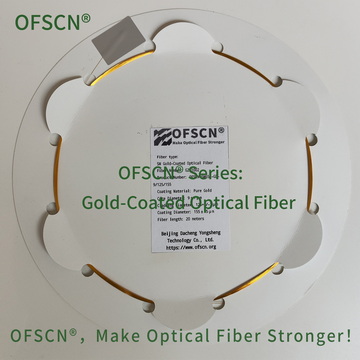
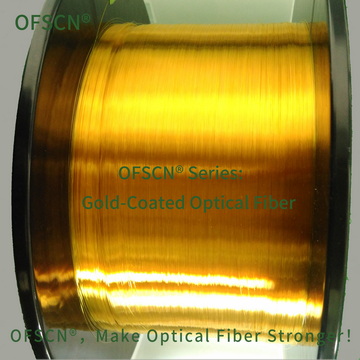
- Metal Coating (e.g., gold plating): Can raise the long-term operating temperature of the optical fiber to 600\ \text{℃} \sim 700\ \text{℃}.
3. Related Special High-Temperature Optical Fiber Products
Beijing Dacheng Yongsheng Technology Co., Ltd. (OFSCN®) has developed special high-temperature optical fibers covering different temperature ranges to meet the testing and transmission needs in high-temperature environments:
-
OFSCN® 300℃ SM Polyimide Optical Fiber
Uses high-temperature resistant Polyimide as the coating material, with an operating temperature range of -200\ \text{℃} to 350\ \text{℃} (or -270\ \text{℃} to 350\ \text{℃}). Produced based on standard G.652D optical rods, it is suitable for fiber optic sensing and signal transmission in high-temperature environments. -
OFSCN® Gold-coated Optical Fiber
Uses metallic gold as the coating material. Single-mode gold-coated optical fiber has an operating temperature range of -270\ \text{℃} to 700\ \text{℃}, and multi-mode gold-coated optical fiber ranges from -270\ \text{℃} to 650\ \text{℃}. It can operate stably in extreme high-temperature environments where organic coatings fail.