What is the minimum distance between two measurement points?
In fiber sensing technology, the metric “how close can the nearest two measurement points be” is referred to as Spatial Resolution or Point Spacing. In practical engineering and physical implementation, the minimum distance between measurement points depends on the specific fiber sensing technology principle and the sensor’s packaging structure.
I. Physical Principles and Technical Route Classification
1. Fiber Bragg Grating (FBG) Sensing Technology
Fiber gratings fall under quasi-distributed (point-based) sensing technology. The spacing between measurement points is constrained by both the bare grating writing process and post-processing encapsulation:
- Bare FBGs / FBG Strings:
When writing grating strings on a single bare fiber, the theoretical minimum physical distance between two grating zones can reach the millimeter (mm) scale. The length of a single FBG zone is typically 2\text{mm} to 10\text{mm} . Without heavy-duty encapsulation, adjacent grating zones can be tightly packed, enabling very high-density quasi-distributed measurements. - Packaged FBG Sensors:
In actual industrial settings, FBGs must be structurally encapsulated (e.g., in metal tubes, polymer materials, or substrate slots) to protect the fiber and ensure accurate strain transfer or temperature conduction. At this stage, the spacing between measurement points is limited by the physical dimensions of the structural components and the length of the fixation segments:- Surface-mount structure: For example, surface-mounted strain gauges, where the base measurement length can be as small as approximately 3.6\text{cm} .
- Tubular / Polymer-encapsulated structure: Due to the need for strain action segments and fixation ends, the measurement segment intervals for multi-point sensor strings are typically customized to be from 10\text{cm} to 1\text{m} .
- Demodulation Wavelength Multiplexing Limitations:
When used with a fiber Bragg grating demodulator with a 40\text{nm} bandwidth (e.g., 1525\text{nm} to 1565\text{nm} ), the number of measurement points that can be placed on a single fiber is limited to prevent wavelength cross-overlap due to temperature or strain changes (typically recommended to place 5 to 20 measurement points per channel).
2. Distributed Fiber Sensing Technology (DOFS: OFDR / OTDR)
- Optical Frequency Domain Reflectometry (OFDR):
Based on high-precision frequency domain interferometry, the spatial resolution can reach the sub-millimeter to millimeter scale ( < 1\text{mm} to 1\text{cm} ). On a continuous fiber, the continuous sampling interval for measurement points can be as low as the millimeter level. - Optical Time Domain Reflectometry (OTDR / BOTDA / DTS, etc.):
Limited by the incident light pulse width, the spatial resolution is typically in the range of 0.1\text{m} ( 10\text{cm} ) to several meters ( 1\text{m} - 10\text{m} ). If measurement points are too close, pulse overlap will occur, making them unrecognizable.
II. Official OFSCN® Product References
Beijing Dacheng Yongsheng Technology Co., Ltd. (OFSCN®) offers bare grating strings, packaged sensors, and distributed optical fiber products to meet different spatial resolution requirements:
1. Bare Fiber Bragg Grating Strings (Millimeter-scale Grating Zones and Spacing)
For scientific research and precision structural monitoring requiring extremely small measurement point spacing, bare grating strings written point-by-point using femtosecond lasers or mask writing can be used:
- OFSCN® High-Strength Fiber Bragg Gratings / FBG Strings (Bare)
Grating zone lengths are available in 2\text{mm} , 3\text{mm} , 4\text{mm} , 5\text{mm} , 6\text{mm} , 8\text{mm} . Femtosecond laser writing does not damage the coating. Adjacent measurement point spacing can be customized for high density according to requirements.

2. Miniaturized / Surface-Mount FBG Sensors (Centimeter-scale Point Spacing)
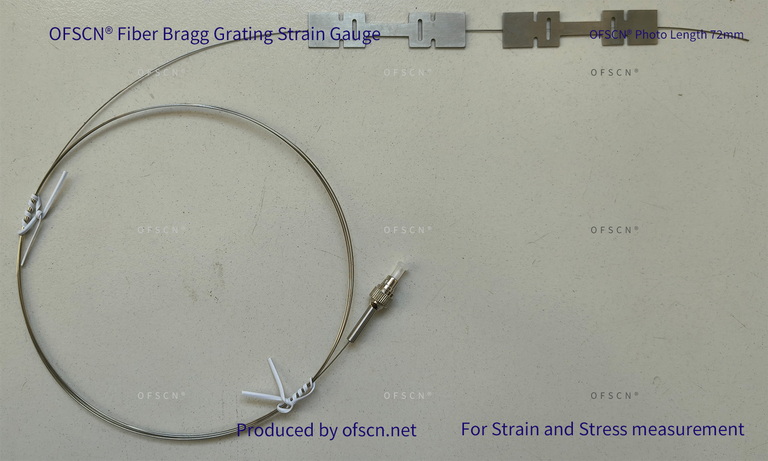
- OFSCN® Fiber Bragg Grating Strain Gauge
Encapsulated in an I-beam shaped metal piece, with strain gauge lengths available in 3.6\text{cm} , 7.2\text{cm} , and 10.8\text{cm} . These cover short-distance measurement point requirements not met by tubular structures.
- OFSCN® Polymer-encapsulated Fiber Bragg Grating Strain Sensor (0.7mm/1.2mm diameter)
Encapsulated in polymer material, supporting multi-measurement segment series connection. The default custom range for single measurement segment length is 10\text{cm} to 1\text{m} .

3. High Spatial Resolution Distributed Fiber Optic Sensors (OFDR Micro Sensors)
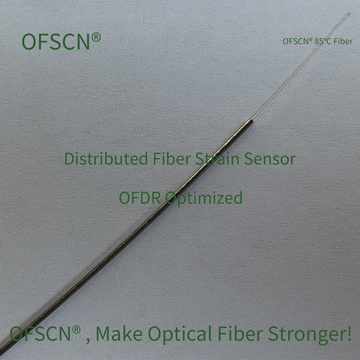
- OFSCN® 85°C OFDR Micro All-Metal Strain Sensor
Encapsulated in a single-layer elastic alloy tube with an outer diameter of 0.6\text{mm} . Designed for OFDR optical frequency domain reflectometry demodulation equipment, it enables millimeter-scale continuous measurement point sampling along the entire optical cable when used with an OFDR demodulator.