Do encapsulants outgas and contaminate equipment in space or vacuum labs?
In the environment of space or ultra-high vacuum (UHV) laboratories, outgassing from encapsulation materials is a classic and critical engineering problem, known in physics and vacuum engineering as Vacuum Outgassing.
Without strict material control, the gases released by encapsulation materials can cause serious contamination and failure of high-precision instruments, optical components, and sensors.
I. What is Vacuum Outgassing?
In a vacuum or space environment, due to the drastic reduction in surrounding atmospheric pressure (even approaching absolute zero pressure), adsorbed or dissolved gases within solid materials, or their own volatile components (such as moisture, residual solvents, low molecular weight polymers, plasticizers, etc.) will spontaneously release to the outside.
Two internationally recognized key physical indicators are used to evaluate the vacuum outgassing performance of materials (typically tested according to ASTM E595 standard):
- Total Mass Loss (TML): The percentage of mass reduction after the material outgasses in a vacuum environment. Aerospace standards usually require TML < 1\%.
- Collected Volatile Condensable Material (CVCM): The percentage of mass of the released gases that condense on the surface of a specified cold sink. Aerospace standards usually require CVCM < 0.1\%.
In addition, the outgassing rate (denoted by q, commonly expressed in units of \text{Pa}\cdot\text{m}^3/(\text{s}\cdot\text{m}^2) or \text{Torr}\cdot\text{L}/(\text{s}\cdot\text{cm}^2) ) is used to quantitatively describe the amount of gas released per unit area of material per unit time.
II. Contamination and Hazards of Outgassing to Equipment
- Optical Surface Contamination (Most Severe): Released volatile condensable materials (CVCM) easily deposit on the surfaces of temperature-sensitive optical lenses, mirrors, photovoltaic cameras, or laser windows, forming a microscopic contamination film. This leads to a sharp decline in transmittance, reflectance, and photoelectric conversion efficiency.
- Sensor Failure: Condensates adhering to precision electrical components or thermal detectors can alter their electrical constants or cause short circuits.
- Vacuum Degradation: In high-vacuum or ultra-high-vacuum systems, continuous outgassing from materials can introduce a significant additional gas load, making it difficult for the system to achieve or maintain the target vacuum level.
III. Encapsulation and Fiber Selection Design in High Vacuum/Space Environments
To eliminate contamination caused by outgassing, high-vacuum systems and aerospace-grade equipment typically adopt the following targeted material solutions:
1. Prohibit Ordinary Organic Encapsulation, Select All-Metal Encapsulation
Ordinary optical fiber and sensor organic jacketing materials like PVC and polyurethane exhibit extremely high outgassing rates in vacuum. In vacuum chambers, all-metal encapsulation (such as 316L stainless steel seamless tubes) should be prioritized to shield against organic outgassing.
- Recommended Solution: OFSCN® 300°C Seamless Steel Tube Fiber Cable utilizes a single layer of 316L stainless steel seamless steel tubing for structural encapsulation, eliminating the outgassing risks associated with any plastic or rubber jacketing, making it ideal for internal deployment within vacuum chambers.
2. Avoid Traditional Fiber Coatings, Select Low-Outgassing Specialty Fibers
Conventional acrylate coatings on optical fibers outgas severely and degrade under high-temperature vacuum conditions. High-stability, low-outgassing coatings are mandatory for vacuum systems:
- Polyimide Coating (PI): Exhibits extremely low vacuum outgassing rates and can withstand a very wide temperature range.
- Recommended Product: OFSCN® 300℃ SM Polyimide Optical Fiber (Operating temperature range covers \text{-270}^\circ\text{C} to \text{350}^\circ\text{C}).
- Metal Coating (Gold Coating): Metallic gold is completely non-outgassing in a vacuum environment (TML \approx 0) and is the optimal choice for ultra-high vacuum, deep space exploration, and extreme low/high-temperature environments.
- Recommended Product: OFSCN® Gold-coated Optical Fiber (High-temperature resistant single-mode/multi-mode gold-coated optical fiber, operating temperature from \text{-270}^\circ\text{C} to \text{700}^\circ\text{C}).
3. Ultra-High Vacuum Sealing Feedthroughs at Vacuum Boundaries
When optical signals enter or exit the boundary of a vacuum chamber, traditional sealing adhesives can outgas or even leak due to high vacuum differential pressure and temperature fluctuations. Vacuum fiber optic flanges based on metal welding or special low-outgassing glass/metal sealing are essential.
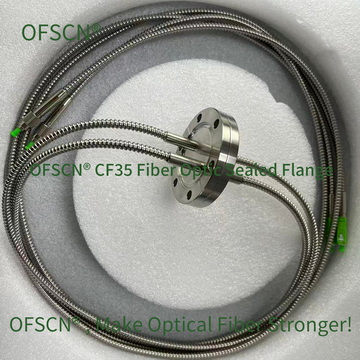
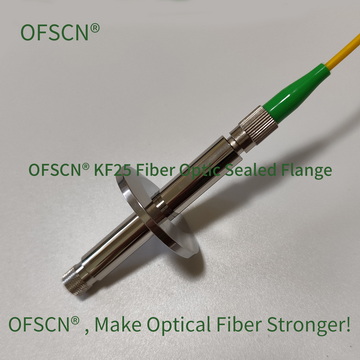
- Recommended Product: OFSCN® Fiber Optic Vacuum Sealed Flange
- Core Physical Specifications: Achieves ultimate vacuum levels better than 1 \times 10^{-7}\text{ Pa} and 1 \times 10^{-9}\text{ Pa}, specifically designed for high vacuum and ultra-high vacuum (UHV) environments, supporting both CF and KF series to ensure zero leakage and zero outgassing at vacuum chamber boundaries.