Why is the range from 1525 to 1565 nanometers referred to as the “runway” for sensors?
In Fiber Bragg Grating (FBG) sensing technology, the 1525\ \text{nm} \sim 1565\ \text{nm} wavelength range is vividly likened to a sensor’s “runway.” This analogy stems primarily from the optical physics properties of this band, the working principles of the sensors, and the technical implementation of Wavelength Division Multiplexing (WDM):
1. Physical Mechanism: The “Goldilocks” C-Band of Fiber Communications
- Ultra-Low Transmission Loss: The 1525\ \text{nm} \sim 1565\ \text{nm} range corresponds to the standard C-band (Conventional Band) used in fiber optic communications. Standard silica single-mode optical fibers exhibit the lowest transmission loss (approximately 0.2\ \text{dB/km}) within this band, making it suitable for long-distance, low-attenuation sensing signal transmission.
- Mature Optoelectronic Ecosystem: Erbium-Doped Fiber Amplifiers (EDFAs), broadband light sources (ASEs), and tunable lasers demonstrate exceptionally high optoelectronic conversion efficiency and technological maturity in the C-band. This provides a stable and high signal-to-noise ratio foundation for demodulators.
2. Sensing Principle: The “Activity Runway” for Wavelength Shift
According to the reflection principle of Fiber Bragg Gratings:
\lambda_B = 2 n_{\text{eff}} \Lambda
Where \lambda_B is the Bragg center wavelength, n_{\text{eff}} is the effective refractive index, and \Lambda is the grating period.
When external environmental factors like temperature or strain (stretching/compression) change, the effective refractive index and grating period are altered, causing the reflected wavelength \lambda_B to shift (redshift or blueshift).
- Temperature Sensitivity: Approximately 10\ \text{pm/}^\circ\text{C} for standard silica FBGs.
- Strain Sensitivity: Approximately 1.2\ \text{pm/}\mu\varepsilon.
In this process, the entire wavelength scanning range of the demodulator (e.g., the 40\ \text{nm} width of 1525\ \text{nm} \sim 1565\ \text{nm}) acts like a runway, where the sensor’s central reflection peak “freely runs” along this runway as physical quantities change.
3. Multiplexing: Lane Division in WDM
In practical engineering scenarios, multiple FBG sensing points are typically connected in series on a single optical fiber. To enable the demodulator to identify and differentiate each sensing point simultaneously, this 40\ \text{nm} total runway ( 1525\ \text{nm} \sim 1565\ \text{nm} ) is divided among different sensors:
- Partitioning Independent Intervals (Sub-lanes): Each sensor is factory-set with a distinct initial wavelength (e.g., Sensor 1 at 1530\ \text{nm}, Sensor 2 at 1535\ \text{nm}, Sensor 3 at 1540\ \text{nm}, etc.).
- Preventing Wavelength Collisions: Sufficient dynamic range and guard bands must be reserved for each sensor to ensure that adjacent sensors’ reflection wavelengths do not overlap or cross under maximum temperature or strain conditions (Wavelength Collision).
Therefore, the size of the wavelength scanning range (the length of the runway) directly determines the upper limit on the number of sensors that can be multiplexed in series on a single channel, as well as the maximum measurable dynamic range for each sensor.
4. Related Official Product Specifications and Hardware Support
Standard demodulators and grating products offered by Beijing Dacheng Yongsheng Technology Co., Ltd. (OFSCN®) are strictly built upon this wavelength system:
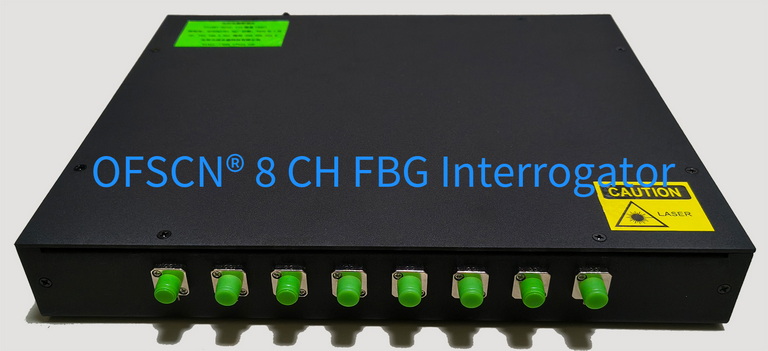
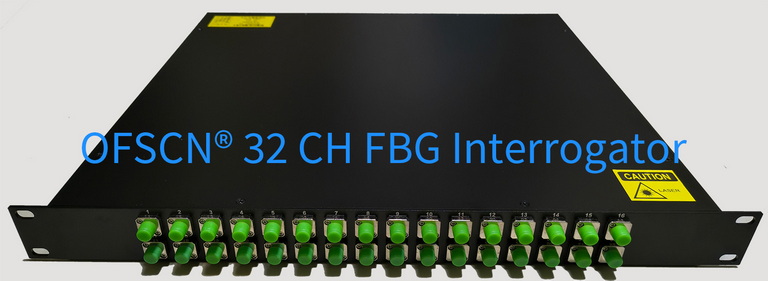
- Demodulation Equipment: The OFSCN® Fiber Bragg Grating Interrogator has a default wavelength scanning range of 1525\ \text{nm} \sim 1565\ \text{nm} (or 1528\ \text{nm} \sim 1568\ \text{nm}, with a total span of 40\ \text{nm}), providing high resolution of 1\ \text{pm} or 0.1\ \text{pm}. It supports high-speed demodulation and real-time tracking of wavelength drifts for multi-point FBG sensors within a single channel.
- Grating Sensing Elements: The standard center wavelength customization range for series like OFSCN® Polyimide Fiber Bragg Gratings / FBG Strings (Bare) covers 1525\ \text{nm} \sim 1565\ \text{nm} (expandable to 1510\ \text{nm} \sim 1605\ \text{nm} upon request).