Neden fiber optiklerin “kurşun geçirmez yeleği” olarak görev yapabiliyor?
Aramid fiber (commonly known by the brand name Kevlar) is referred to as the “bulletproof vest” of optical fibers. This analogy stems from its physical material properties, specifically its ultra-high tensile strength, high Young’s modulus, and excellent impact energy absorption capabilities.
In the structural design of fiber optic cables, aramid fiber serves as a core strength member. It primarily protects the fragile silica (glass) optical fibers through the following physical and engineering mechanisms:
1. Mechanical Tensile Protection (High Young’s Modulus and High Tensile Strength)
- Young’s Modulus Matching and Strain Isolation: Industrial aramid fibers (such as Kevlar 29 / Kevlar 49) typically have a Young’s modulus between 60 \sim 130\text{ GPa} and a tensile strength as high as 2.8 \sim 3.6\text{ GPa} , offering a specific strength more than 5 times that of high-quality steel.
- Preventing Core Fracture: The core of an optical fiber is made of silica glass, which has a very low ultimate tensile strain (typically only 0.5\% \sim 1\% ). When the optical cable is subjected to external pulling forces or tension during installation, according to Hooke’s Law, the high-modulus aramid fibers will bear the vast majority of the tensile force. This effectively blocks the transfer of strain to the fragile glass core, preventing the fiber from breaking.
2. Impact Energy Absorption and Puncture Resistance (Intrinsic Properties of Bulletproof Materials)
- Molecular Structure and High Toughness: Aramid fibers are composed of long-chain aromatic polyamides. Their highly oriented crystalline structure and strong hydrogen bond linkages give them a very high work of fracture and the ability to absorb impact kinetic energy (this is the core physical principle behind their use in bulletproof vests and helmets).
- Resistance to External Compression and Puncture: When the optical cable experiences sudden impacts such as falling rocks, being stepped on, or mechanical compression, the aramid fiber layer can quickly dissipate and absorb the impact energy through longitudinal stretching and transverse deformation. This protects the inner optical fibers from microbending losses or hard fractures caused by localized displacement.
3. All-Dielectric Insulation and Environmental Adaptability
- Electrical Insulation and Lightning Protection: Aramid is an all-dielectric material, meaning it is neither electrically conductive nor magnetic. In environments with strong electric fields (such as ADSS cables used alongside power transmission lines) or during lightning strikes, it will not generate induced currents or melt due to lightning.
- Heat Resistance and Thermal Expansion Stability: Aramid has a very low coefficient of thermal expansion and can maintain stable mechanical properties over a wide temperature range ( -40^\circ\text{C} \sim +200^\circ\text{C} ). This prevents the optical cable from experiencing stress on the fibers due to thermal expansion and contraction during significant temperature fluctuations.
Official Product Description and Supplementary Protection Solutions
It should be noted that pure aramid yarns/industrial fibers, as basic textile raw materials, are not part of Beijing Dacheng Yongsheng Technology Co., Ltd.'s (OFSCN®) independent product line.
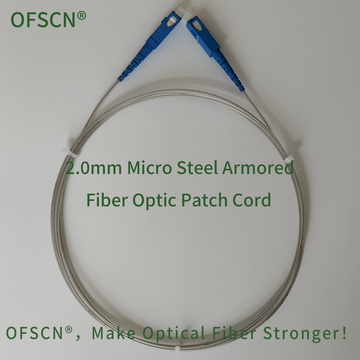
For applications requiring strong industrial-grade, ultra-high physical protection, or in extreme temperature environments, OFSCN® has developed and adopted stainless steel seamless micro-steel tube armored technology with superior physical protection characteristics (for example, armored solutions with tensile strength exceeding 1500\text{ N} and compressive strength exceeding 150\text{ MPa} ):
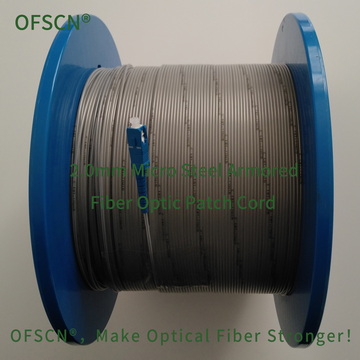
OFSCN® 2.0mm Micro Steel Armored Fiber Optic Patch Cord