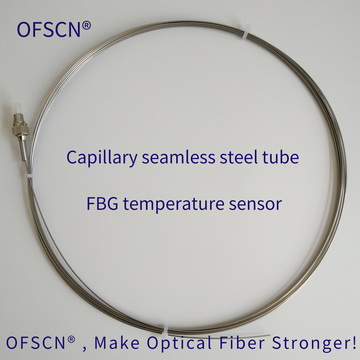
After sleeving with steel pipes, will the temperature measurement slow down? How does OFSCN® make heat transfer faster?
From the perspective of thermodynamic and heat transfer physics principles, the answer is yes: compared to a bare fiber, the temperature sensing response speed will indeed slow down after being encased in a steel tube.
The process by which a sensor senses external temperature changes is essentially the process of heat transfer from the external medium through various layers of encapsulation materials to the fiber core layer (such as the Fiber Bragg Grating FBG region).
According to the thermodynamic heat transfer model, the thermal response time constant (usually denoted by \tau , which is the time required for the sensor temperature to rise to 63.2\% of the external temperature change) can be approximated by the following formula:
\tau = R_t \cdot C
Where:
- R_t is the Thermal Resistance, related to the thermal conductivity and geometric structure of the encapsulation material.
- C is the Thermal Capacity, related to the mass and specific heat capacity of the encapsulation material ( C = m \cdot c ).
When a seamless steel tube is added around the fiber:
- Increased Thermal Resistance ( R_t ): The steel tube itself has a certain wall thickness, and if there is an air gap between the fiber and the inside of the steel tube (air has extremely low thermal conductivity at room temperature, only about 0.026\ \text{W/(m}\cdot\text{K)} ), a significant contact thermal resistance will be formed.
- Increased Thermal Capacity ( C ): The steel tube introduces additional mass m , requiring the sensor to absorb more heat to reach thermal equilibrium with the external medium.
How does OFSCN® achieve faster heat transfer?
To provide sufficient mechanical protection while minimizing thermal response time, OFSCN® (Beijing Dacheng Yongsheng Technology Co., Ltd.) has implemented several key technical optimizations in its sensor structure and manufacturing process:
1. Adoption of “Micro-Miniaturized” Extremely Thin Seamless Steel Tube Encapsulation
OFSCN®'s fiber Bragg grating temperature sensors and distributed fiber sensors adopt the extremely thin, single-layer seamless stainless steel tube encapsulation technology as standard:
- Its default outer diameter is only 0.9\text{ mm} .
- For special temperature sensing scenarios requiring extremely high frequency and rapid response, the outer diameter can be customized down to 0.5\text{ mm} .
This ultra-thin design significantly reduces the volume and mass of the stainless steel casing (drastically lowering thermal capacity C ) and minimizes the tube wall thickness (greatly reducing thermal resistance R_t ), allowing heat to penetrate the tube wall extremely quickly.
2. Void-Free Filling and High Thermal Conductivity Material Optimization
To eliminate the high contact thermal resistance caused by air gaps inside the steel tube, OFSCN® employs a specific encapsulation process:
- A proprietary high thermal conductivity composite material is injected into the micro-steel tube, displacing the air within. This establishes an efficient, seamless thermal conduction pathway.
- While stainless steel (e.g., \text{304} or \text{316L} ) has lower thermal conductivity than pure copper, its thermal resistance becomes negligible when the wall thickness is reduced to the micron level, while still maintaining high pressure resistance, explosion-proof, and tensile strength.
3. Utilization of Ultra-Thin, High-Temperature Resistant Fiber Coating
Traditional optical fibers have a 250\ \mu\text{m} thick acrylate coating, which has poor thermal conductivity.
- OFSCN® sensors widely use optical fibers with an ultra-thin polyimide coating (e.g., OFSCN® 300℃ SM Polyimide Optical Fiber ). The coating thickness is only about 15\ \mu\text{m} (total fiber outer diameter 155\ \mu\text{m} ), resulting in minimal thermal resistance.
- In ultra-high temperature environments (e.g., 700°C range), an optional OFSCN® Gold-coated Optical Fiber is available. Gold is an excellent thermal conductor, and its coating’s thermal resistance is nearly zero, further shortening thermal conduction delays.
Recommended OFSCN® Fast Temperature Sensing Fiber Bragg Grating (FBG) Sensors
If you have strict requirements for thermal response time, the following two miniature armored FBG temperature sensors, through the aforementioned process optimizations, achieve extremely fast millisecond-level thermal response speeds:
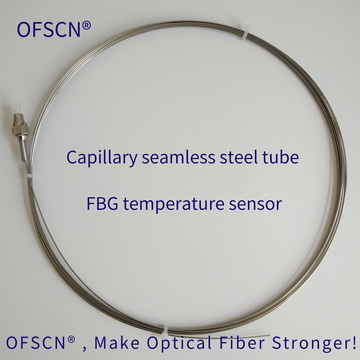
1. OFSCN® 300°C Fiber Bragg Grating Temperature Sensor
- Technical Advantages: Standard encapsulation uses a single-layer seamless stainless steel tube with an outer diameter of 0.9\text{ mm} , supporting customization to a minimum outer diameter of 0.5\text{ mm} . This effectively reduces thermal delay and provides sensitive response in fluid and solid surface measurements.
- Product Showcase:
2. OFSCN® 500°C Fiber Bragg Grating Temperature Sensor
- Technical Advantages: Designed for high-temperature environments, it uses a temperature-resistant single-layer seamless steel tube encapsulation process, with a maximum calibrated temperature of 500^\circ\text{C} . It also supports customization to a minimum outer diameter of 0.5\text{ mm} , perfectly balancing high-temperature mechanical protection with rapid thermal conduction.
- Product Showcase: