Will the steel pipe lose strength at 500 degrees? Will the fiber slip?
At 500°C, the strength of the steel pipe will decrease, and the optical fiber may slip, depending on the encapsulation structure and process.
I. Changes in Steel Pipe Strength at 500°C
Yes, the strength of the steel pipe will decrease significantly at 500°C.
- Decrease in Yield Strength and Tensile Strength: Common stainless steel materials used for encapsulation (such as 304 or 316L stainless steel) typically have a yield strength of around 200-300 MPa at room temperature (approximately 20°C). When the ambient temperature rises to 500°C, due to thermal activation effects in the metal lattice and thermal softening phenomena, their yield strength and tensile strength will generally decrease by about 30% to 50%.
- Creep Effect: Under sustained high temperatures of 500°C with high tensile or external pressure, metal materials can exhibit slight thermal creep. Therefore, in engineering design, the allowable stress of the steel pipe needs to be re-evaluated based on the actual mechanical load it bears.
II. Will the optical fiber slip at 500°C?
Whether the optical fiber slips completely depends on the encapsulation process and internal fixing structure design:
-
Ordinary/Unoptimized Encapsulation Structures (Risk of Slippage):
- Coating Failure: Ordinary optical fiber coatings (such as acrylate or silicone) will carbonize and decompose when exposed to temperatures above 200°C, causing the fiber to lose its bonding force with the outer tube.
- Thermal Expansion Mismatch: Quartz optical fiber has a very low coefficient of thermal expansion (approximately 0.55 x 10⁻⁶/K), while stainless steel has a higher coefficient of thermal expansion (approximately 16 x 10⁻⁶/K). When heated to 500°C, the elongation of the steel pipe is much greater than that of the optical fiber. If there is no reliable mechanical anchoring at the ends or along the entire length, the optical fiber is very likely to experience relative displacement or internal slippage.
-
Professional High-Temperature Seamless Steel Pipe Encapsulation Structures (Effectively Prevents Slippage):
In mature high-temperature optical fiber sensor or cable encapsulation processes, slippage is prevented through the following methods:- High-Temperature Resistant Special Coating/Plating: High-temperature resistant polyimide coatings, femtosecond grating high-temperature processing technology, or metallization coatings (such as gold-plated fibers) are used to ensure that the materials do not fail at high temperatures.
- Seamless Steel Pipe Interference Fit and End-Anchoring Technology: Utilizing special seamless steel pipe nesting processes and micro-mechanical curing anchor points, stable mechanical constraints are formed at both ends or along the entire length of the sensor, ensuring that the optical fiber and the steel pipe experience synchronized thermal deformation, thereby preventing fiber slippage.
III. Related OFSCN® Official Product Introduction
For high-temperature application environments of 500°C and above, Beijing Dacheng Yongsheng Technology Co., Ltd. (OFSCN®) has developed specialized high-temperature fiber Bragg grating sensor products. These products utilize single-layer or multi-layer seamless steel pipe encapsulation technology to effectively address issues of strength degradation and fiber anchoring at high temperatures:
OFSCN® 500°C Fiber Bragg Grating Temperature Sensor
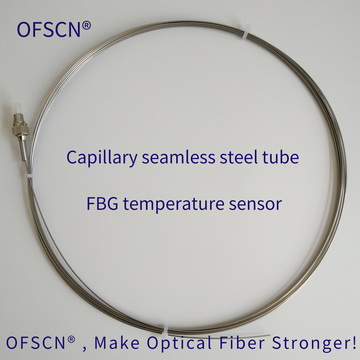

- Encapsulation Structure: The default is a single-layer seamless steel pipe encapsulation technology, with customizable multi-layer seamless steel pipe nesting processes to effectively protect the internal optical fiber.
- Outer Diameter Specifications: The default outer diameter is 0.9 mm, with a customizable minimum outer diameter of 0.5 mm.
- Operating Temperature: The operating temperature range covers -200°C to 500°C, with factory temperature calibration ranging from room temperature to 500°C.
For even higher operating temperature requirements, you can also explore the OFSCN® 800°C Fiber Bragg Grating Temperature Sensor product, which can withstand temperatures up to 800°C.