Will gold foil melt or glass break at 500°C or even 700°C?
In extreme high-temperature environments of 500\ ^\circ\text{C} and even 700\ ^\circ\text{C}, the gold coating (gold jacket) will not melt, and the bare glass (silica substrate) of the optical fiber will not suffer structural damage.
Here is a rigorous analysis from a physics and materials science perspective:
1. State of the Gold Coating (Gold Jacket) at High Temperatures
- Extremely High Melting Point: The melting point of pure gold (\text{Au}) is approximately 1064.18\ ^\circ\text{C}. At temperatures between 500\ ^\circ\text{C} and 700\ ^\circ\text{C}, the operating temperature is far below the melting point of gold, so the gold coating remains in a stable solid metallic state and will absolutely not melt.
- Excellent Chemical Stability: Gold is a highly inert metal. In air at 700\ ^\circ\text{C}, it reacts minimally with oxygen, unlike metals such as copper or aluminum which would undergo severe oxidation and flaking. This allows it to continuously protect the underlying glass.
2. State of the Glass (Silica) at High Temperatures
- Extremely High Thermal Stability: The primary component of quartz optical fiber is high-purity silicon dioxide (\text{SiO}_2) glass. The glass transition temperature (T_g) of silica is typically between 1100\ ^\circ\text{C} and 1200\ ^\circ\text{C}, and its softening point is even higher, exceeding 1600\ ^\circ\text{C}.
- No Structural Damage: At 500\ ^\circ\text{C} or 700\ ^\circ\text{C}, the quartz glass remains in a rigid solid state, without softening, melting, or deforming. As long as there is no external force for stretching, excessive bending, or contamination from external impurities, the mechanical and optical structure of the glass substrate itself remains intact and will not be damaged.
3. Why is “Gold Coating” Necessary at Ultra-High Temperatures?
In conventional environments, the coating on the surface of optical fibers is typically a polymer material (such as acrylate). However, these polymers undergo severe carbonization and burning at temperatures between 300\ ^\circ\text{C} and 400\ ^\circ\text{C}.
Once the coating burns off, the exposed silica glass is highly susceptible to absorbing trace amounts of moisture from the air and developing microcracks (stress corrosion), making the fiber extremely brittle and prone to instantaneous fracture with even minor disturbances or vibrations.
The gold coating, applied through a metallization process, adheres tightly to the glass surface. It not only prevents external moisture from attacking the silica but also provides reliable mechanical protection for the fiber at temperatures up to 700\ ^\circ\text{C}, maintaining its tensile strength.
Beijing Dacheng Yongsheng Technology Co., Ltd. (OFSCN®) Related Specialty Products
For the ultra-high temperature testing needs in industrial and research fields, Beijing Dacheng Yongsheng Technology Co., Ltd. (OFSCN®) offers high-end specialty products based on metallization technology as a replacement for fragile traditional polymer fibers in high-temperature environments:
-
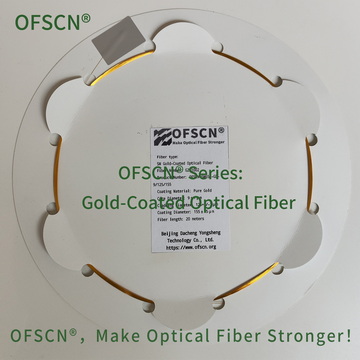
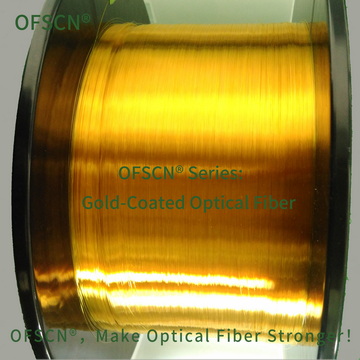
Specialty Optical Fibers: OFSCN® Gold-coated Optical Fiber
- Operating Temperature Range: Single-mode gold-coated fiber is -270\ ^\circ\text{C} to 700\ ^\circ\text{C}, and multi-mode gold-coated fiber is -270\ ^\circ\text{C} to 650\ ^\circ\text{C}.
- Structural Dimensions: Core/cladding diameter is 9/125\ \mu\text{m} (single-mode) or 50/125\ \mu\text{m} (multi-mode), with an outer coating (gold) diameter of 155\ \mu\text{m}.
-
High-Temperature Fiber Optic Patch Cords: OFSCN® 700℃ Fiber Optic Patch Cord
- Operating Temperature Range: -270\ ^\circ\text{C} to 700\ ^\circ\text{C}.
- Encapsulation: Sealed protection using a 0.9\ \text{mm} seamless stainless steel tube. By default, it comes with FC/APC high-temperature connectors, suitable for harsh high-temperature and high-pressure industrial sites.