How does this lightweight characteristic benefit engineers during actual site installations?
The lightweight nature of fiber optic patch cords, compared to traditional copper cables, provides several significant advantages for engineers during site installations:
1. Simplified Cable Management and Support Structures
Because fiber optic cables are much lighter, they place significantly less mechanical stress on cable trays, conduits, and racks.
- Engineering Benefit: Engineers can use lighter, lower-cost support structures. In high-density environments like data centers or industrial sensing sites, this prevents the “sagging” common with heavy copper bundles, making the overall infrastructure safer and more organized.
2. Ease of Long-Distance Pulling
The reduced weight decreases the friction encountered when pulling cables through long conduits or vertical shafts.
- Engineering Benefit: For a product like the OFSCN® 2.0mm Micro Steel Armored Fiber Optic Patch Cord, the combination of lightweight materials and high tensile strength allows for longer continuous pulls without the need for intermediate pull boxes or heavy machinery. This significantly reduces labor time and the risk of cable damage during installation.
3. Enhanced Port Density and Accessibility
Fiber patch cords have a much smaller diameter and weight-to-volume ratio than copper.
- Engineering Benefit: This allows for much higher port density on patch panels. For engineers, this means easier routing within tight cabinets and less physical strain on the connectors themselves, ensuring better long-term connection stability.
4. Specialized Industrial Applications
In specialized sensing environments, such as aerospace or high-temperature monitoring, weight is a critical constraint.
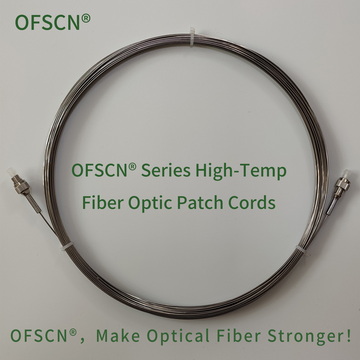
- Product Example: The OFSCN® 300℃ Fiber Optic Patch Cord provides extreme temperature resistance while remaining remarkably light due to its 0.9mm stainless steel seamless tube construction.
Standard Product Images:

From a technical perspective, the transition from copper to fiber not only improves data bandwidth or sensing sensitivity but also fundamentally reduces the “physical load” of the engineering project.