OFSCN® how does it strengthen the connection between the connector and the jumper body to prevent “severing the head from the body”?
In fiber optic communication and fiber optic sensing engineering, the connector joint is indeed recognized as the most fragile and mechanically failure-prone area. To understand how OFSCN® Beijing Dacheng Yongsheng Technology Co., Ltd. overcomes this pain point and prevents “separation” (i.e., disconnection between the connector and the patch cord body), we first need to analyze its failure mechanism from a physical and mechanical structural perspective, and then elaborate on OFSCN®'s targeted engineering solutions.
I. Why are the joints of traditional high-strength patch cords the most prone to failure?
- Stress Concentration at the Rigid-Flexible Transition Interface
Fiber optic connectors (such as FC, SC, ST, etc.) are composed of metal or ceramic ferrules and metal components, belonging to a completely rigid structure; whereas the patch cord body, for ease of routing and bending resistance, is a flexible or semi-rigid structure. When the patch cord is subjected to bending, stretching, twisting, or vibration, all mechanical stresses concentrate sharply at this singularity where the rigid and flexible parts meet. - Force Bypass Failure and Fiber Breakage
In ordinary patch cords, the connection between the tensile member (like Kevlar aramid or the outer jacket) and the connector’s metal housing is often achieved merely by adhesive bonding or simple soft plastic sleeve crimping. When the patch cord is subjected to strong external pulling force, the tensile force cannot be effectively transmitted through the tensile member to the connector housing. This causes the mechanical stress to act directly on the fragile internal silica glass fiber, instantly leading to shear fracture of the fiber at the rear of the ferrule.
II. OFSCN®'s High-Strength Connector Reinforcement and Anti-Fracture Technology
Beijing Dacheng Yongsheng Technology Co., Ltd. (OFSCN®) has developed high-strength armored patch cords and fiber optic sensing products that ensure the physical integrity of the connector and the body through the following key technologies, completely eliminating the risk of “separation”:
1. All-Metal Mechanical Fixed Connection and Force Bypass Technology
This is the core mechanism to prevent connector detachment. Inside OFSCN® high-strength patch cords, seamless stainless steel tubes and twisted steel wire ropes are used as the armor and core tensile members.
- Physical Crimping and Cold Working Hardening Lock:
During processing, the internal seamless stainless steel tube (with a wall thickness typically between 0.2mm and 0.3mm) and high-strength steel wires are mechanically crimped and riveted to the metal boot holder of the connector using specialized high-precision fixtures, forming an all-metal mechanical connection. - Stress Bypass Transmission:
When the patch cord is subjected to extreme external pulling force, due to the physical locking of the steel tube, steel wires, and connector metal housing into a rigid whole, all axial tensile forces are directly transmitted and released through the metal components. The internal optical fiber is in a completely loose and free state within the seamless steel tube, requiring no axial tensile load.
2. Gradient Stress Relief and Strain Relief Sleeve
To address the bending fatigue issue at the rigid-flexible transition, OFSCN® has designed a smooth stress transition structure at the rear of the connector:
- Multi-Layer Sleeve for Gradual Release:
At the interface between the metal connector and the body, a highly elastic transition protective sleeve is incorporated by default (e.g., some products include a 10cm protective sleeve). - Control of Minimum Bend Radius:
This structure restricts sharp bending angles at the base of the connector, uniformly dispersing the bending stress, which would otherwise concentrate at a single point, over a longer distance. This effectively prevents micro-bending losses and fatigue fractures of the optical fiber caused by sharp bends at the connector root.
III. OFSCN® High-Strength Patch Cord Products and Specifications
Based on the engineering principles described above, OFSCN® has launched the following industrial-grade high-strength patch cord products with industry-leading tensile performance. You can refer to their official specifications and structures:
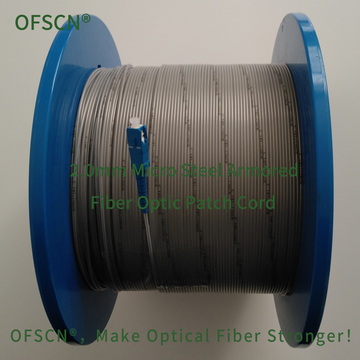
1. OFSCN® 2.0mm Micro Steel Armored Fiber Optic Patch Cord
This product uses a 0.6mm seamless stainless steel tube encapsulation, protected by an outer jacket, and its connectors have undergone extreme tensile strength enhancement design.
- Tensile Strength: >1500N (equivalent to a limit tensile force of approximately 150kg)
- Compressive Strength: >150Mpa
- Structural Components: Fiber optic connector, PVC jacket, 0.6mm seamless stainless steel tube, and optical fiber.

2. OFSCN® 3.0mm Steel Wire Rope Fiber Optic Patch Cord
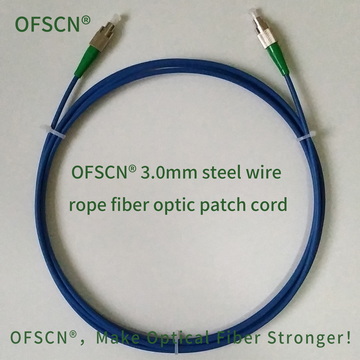
This patch cord adds a twisted stainless steel wire structure outside the seamless steel tube, specifically designed for extremely harsh environments and frequent dragging applications such as industrial settings and field exploration.
- Tensile Strength: >1200N
- Compressive Strength: >200Mpa
- Structural Components: Fiber optic connector, PE jacket, 0.45mm twisted stainless steel wire structure, 0.9mm seamless stainless steel tube, and optical fiber.

3. OFSCN® 2.0mm Steel Wire Rope Fiber Optic Patch Cord
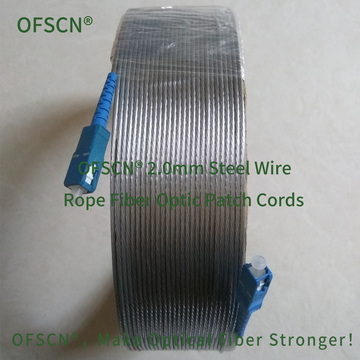
Features an all-metal structure design, eliminating resin or plastic outer jackets. The stainless steel wires and seamless steel tube are directly exposed, providing extremely high mechanical hardness and excellent temperature resistance.
- Structural Components: Fiber optic connector, 0.6mm galvanized steel wire twisted structure, 1.0mm seamless stainless steel tube, and optical fiber.

Through this robust design of integrally and fully metal-locking the tensile reinforcement elements with the connector housing, OFSCN® patch cords ensure that the connectors remain firmly anchored to the patch cord body even under severe dragging, trampling, or mechanical stretching, completely mitigating the risks of fiber breakage and connector detachment.