In a gas station or chemical plant, will the jumper’s sheath be dissolved by chemical solvents?
Whether the outer sheath of ordinary fiber optic patch cords will be dissolved by chemical solvents at gas stations, chemical plants, or petrochemical sites mainly depends on the type of material used for the sheath and the type of chemical solvent it comes into contact with.
I. Physical and Chemical Behavior of Common Sheath Materials in Chemical Solvents
-
Ordinary PVC Sheath (Polyvinyl Chloride)
- Risk of dissolution and swelling: High.
- Principle: Ordinary fiber optic patch cords (such as OFSCN® Standard Fiber Patch Cord) typically use PVC as their outer sheath. PVC material has poor resistance to non-polar or weakly polar organic solvents (such as gasoline, diesel, benzene, toluene, xylene, ketones, and certain ester solvents). When PVC comes into long-term contact with or is immersed in gasoline and chemical solvents in chemical plants, solvent molecules penetrate the polymer chains, causing significant swelling, softening, and even localized dissolution of the sheath. This not only compromises the physical protection of the internal optical fibers but can also lead to micro-bending losses or even breakage of the optical fibers due to altered stress.
-
PE Sheath (Polyethylene)
- Risk of dissolution and swelling: Medium-low, but still present.
- Principle: Polyethylene (PE) has good resistance to acids, alkalis, and polar solvents, and has some resistance to hydrocarbon solvents like gasoline in the short term (e.g., the PE sheath used in OFSCN® 3.0mm Steel Wire Rope Fiber Optic Patch Cord). However, PE can still undergo slow swelling and performance degradation when immersed in certain high-concentration organic solvents for extended periods.
-
LSZH Sheath (Low Smoke Zero Halogen Polyolefin)
- Risk of dissolution and swelling: Medium-high.
- Principle: LSZH sheaths contain a large amount of inorganic flame retardant fillers, and their base material has limited resistance to strong organic solvents. They are prone to swelling and cracking under the attack of chemical solvents.
II. Industrial-Grade Solution: All-Metal Encapsulation Without Plastic Sheath
In environments with highly corrosive organic solvents, such as gas stations, oil wells, or chemical plants, to completely avoid the problem of sheath dissolution or swelling, the plastic outer sheath is typically omitted, and an all-metal armored stainless steel seamless steel tube structure is used instead. Stainless steel (e.g., 304 or 316L material) is chemically inert in gasoline, diesel, and most organic solvents, and will not dissolve or swell.
For these harsh chemical environments, Beijing Dacheng Yongsheng Technology Co., Ltd. (OFSCN®) offers the following professional-grade products and technical solutions:
1. All-Metal Structure Tensile and Compression-Resistant Patch Cord
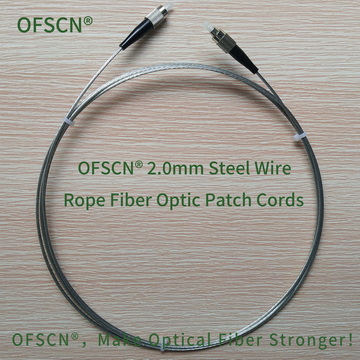
OFSCN® 2.0mm Steel Wire Rope Fiber Optic Patch Cord
This patch cord features an all-metal structure without a plastic outer jacket, consisting of fiber optic connectors, a 0.6\text{ mm} galvanized steel wire stranded structure, a 1.0\text{ mm} stainless steel seamless steel tube, and optical fibers. As there is no organic polymer plastic on the outer layer, it offers absolute corrosion resistance and anti-dissolution capabilities against gasoline and various hydrocarbon solvents found in chemical plants.
2. Seamless Steel Tube Encapsulated Special High-Temperature/Corrosion-Resistant Patch Cords
For more extreme chemical and temperature environments, a series of special patch cords encapsulated directly by a 0.9\text{ mm} stainless steel seamless steel tube can be used. These also have no plastic outer sheath and are resistant to any organic solvent erosion:
- 120℃ Class: OFSCN® 120℃ Fiber Optic Patch Cord, using high-temperature resistant polyacrylate optical fiber internally.
- 200℃/300℃ Class: OFSCN® 200℃ Fiber Optic Patch Cord and OFSCN® 300℃ Fiber Optic Patch Cord, which combine a 0.9\text{ mm} stainless steel seamless steel tube with polyimide (PI) coated optical fibers. Polyimide not only has excellent temperature resistance (up to -270\ ^\circ\text{C} to 300\ ^\circ\text{C}) but also exhibits extremely high chemical stability against organic solvents such as gasoline, and strong acids and alkalis.


- 700℃ Class: OFSCN® 700℃ Fiber Optic Patch Cord, encapsulated by a stainless steel seamless steel tube and gold-coated fiber, offering extremely strong chemical stability.
III. Summary and Engineering Recommendations
- Ordinary Patch Cords (PVC/LSZH Sheath): Do not expose directly to or drop into gasoline or chemical solvents in chemical plants, as they will be damaged by physical swelling in a short period.
- Emergency Handling for Temporary Contact: If accidentally dropped into gasoline, remove it immediately, clean with isopropyl alcohol (IPA) or anhydrous ethanol, and dry thoroughly. However, if soaked for a prolonged period causing the material to become sticky or soft, it must be replaced.
- Long-Term Cabling Recommendations for Chemical Plants/Gas Stations: It is recommended to use OFSCN® Special Fiber Optic Patch Cords encapsulated by 304 or 316L stainless steel seamless steel tubes without plastic sheaths, fundamentally eliminating the physical defect of polymer materials being dissolved by chemical solvents.