Are there bubbles inside the glass? What happens in an ultra-high vacuum environment?
1. Are there bubbles inside the optical fiber glass?
Qualified optical-grade silica glass fibers do not have sealed bubbles inside.
- Manufacturing Process and Microstructure: Commercial silica fibers (such as single-mode fibers based on G.652 specifications) are synthesized using vapor-phase deposition methods (MCVD, OVD, VAD, etc.) to create high-purity quartz preforms, which are then drawn in a fiber drawing furnace at temperatures above 2000\ ^\circ\text{C}. During this process, the molten silica forms a highly continuous, dense, and isotropic amorphous network structure.
- Physical Defect Control: The presence of microscopic bubbles or unmelted impurities in the glass would cause intense Rayleigh scattering, localized refractive index jumps, and stress concentrations, leading to a sharp increase in optical attenuation and a drastic degradation of the fiber’s tensile strength. Such defects are typically removed during the tension screening phase of the fiber screening test.
- Special Case Explanation: Hollow-core photonic crystal fibers (HC-PCF) are designed with microstructural air channels that run axially. However, these microchannels are axially connected physical structures, not isolated sealed high-pressure bubbles.
2. Will optical fibers explode in an ultra-high vacuum (UHV) environment?
Conclusion: Optical fibers will absolutely not explode in an ultra-high vacuum environment.
Analysis from a material mechanics and thermodynamics perspective:
- Negligible Pressure Differential: The maximum pressure difference between standard atmospheric pressure and a perfect vacuum is only 1\ \text{atm} \approx 0.1\ \text{MPa}.
- Quartz Material Strength Far Exceeds Pressure Differential: The theoretical tensile strength of fused quartz glass (\text{SiO}_2) exceeds 10\ \text{GPa}, while the actual short-term tensile strength of finished bare fibers with coatings is typically in the range of 3\sim 5\ \text{GPa}. The stress from a 0.1\ \text{MPa} pressure differential is more than four orders of magnitude lower than the yield/fracture strength of quartz glass and is entirely insufficient to cause any macroscopic damage to the glass substrate.
3. Real Physical Challenges for Optical Fibers in Ultra-High Vacuum Environments
In ultra-high vacuum (UHV) environments (vacuum levels better than 1\times 10^{-7}\ \text{Pa} or 1\times 10^{-9}\ \text{Pa}), the core engineering challenge for optical fibers is not the fracture of the glass body itself, but rather material outgassing and extreme temperature zone adaptability:
- Coating Outgassing and Brittleness: The dual-layer UV-curable acrylate coatings commonly used for optical fibers can release adsorbed water vapor, plasticizers, and volatile organic compounds (VOCs) in UHV. This contaminates vacuum chamber optical windows and causes the coating itself to lose mass and become brittle.
- Vacuum Feedthrough and Low-Outgassing Selection: In space technology, particle physics, and vacuum experimental chambers, it is common to use fibers with inorganic metal coatings or highly stable polymer coatings, along with metal-sealed vacuum flanges.
4. Related Optical Products for Vacuum Applications
For vacuum and extreme temperature environments, Beijing Dacheng Yongsheng Technology Co., Ltd. (OFSCN®) offers specialty optical fibers and feedthrough connection devices with ultra-low outgassing characteristics and wide temperature range tolerance:
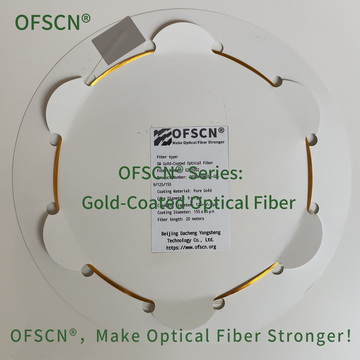
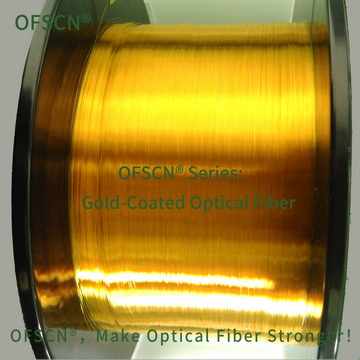
- High-Temperature Gold-Coated Optical Fiber: Offers excellent vacuum compatibility and wide temperature range performance ( -270\ ^\circ\text{C} to +700\ ^\circ\text{C} ). The metallic gold coating does not volatilize or release organic gases in ultra-high vacuum.

- High-Temperature Polyimide Single-Mode Optical Fiber: Operates over a temperature range of -270\ ^\circ\text{C} to +350\ ^\circ\text{C}. The polyimide coating material exhibits a low rate of thermal decomposition outgassing in a vacuum environment.


- Ultra-High Vacuum Optical Fiber Connectors and Feedthrough Flanges: Support CF (ConFlat) and KF interface standards, with vacuum performance ratings better than 1\times 10^{-7}\ \text{Pa} to 1\times 10^{-9}\ \text{Pa}.