OFSCN® claims the jumper can withstand a tensile strength of 100kg. Does that mean it can lift two adults?
From the perspectives of optical engineering and structural mechanics, OFSCN®'s nominal “tensile strength of 100 kg” is not exaggerated. In an ideal physical experimental environment, this indeed means it can withstand a tensile force equivalent to lifting two adult humans. However, in practical engineering applications, “tensile strength of 100 kg” carries deeper physical implications, application limitations, and structural design considerations.
Below, we provide a rigorous academic explanation from four dimensions: physical concepts, load types, optical transmission characteristics, and product structure:
1. Physical Unit Conversion and Static Load
In physics and mechanical testing, tensile force is typically measured in Newtons (N).
An object with a mass of 100 kg, under the influence of Earth’s standard gravitational acceleration (approximately g ≈ 9.8 m/s²), generates a gravitational tensile force of approximately:
F = m \cdot g \approx 100\ \text{kg} \times 9.8\ \text{m/s}^2 = 980\ \text{N}
In OFSCN®'s ultra-high tensile strength series products, the actual nominal ultimate tensile strength is usually greater than 1200 N (approximately equivalent to 122 kg of static tensile force) or greater than 1500 N (approximately equivalent to 153 kg of static tensile force).
Therefore, under static suspension (static load) conditions without impact, the patch cord can indeed withstand the gravitational force of two ordinary adults (calculated with an average single person weight of 50 kg - 70 kg) without breaking.
2. Engineering Differences Between Static and Dynamic Loads
In actual engineering sites or lifting operations, it is crucial to strictly distinguish between static loads and dynamic loads:
- Dynamic Impact: If suspended personnel or objects sway, drop, or generate instantaneous acceleration, according to Newton’s second law, the instantaneous tensile force will far exceed the static gravitational force. For example, if a 100 kg object is suddenly tensioned during a fall, the resulting dynamic impact force could instantaneously exceed the 1500 N limit, leading to patch cord breakage. Therefore, in safety engineering, a safety factor of 3 to 5 is usually required.
- Fiber Optic Transmission Limitations: As an optical transmission medium, fiber optic cables require not only structural integrity but also unimpeded signal transmission. Even if the outer armored steel wires and stainless steel tube do not exhibit macroscopic fracture under a tensile force of 1000 N, the resulting minute elastic deformation can be transmitted to the internal optical fibers through shear forces, causing micro-bending losses and leading to severe signal attenuation or even interruption.
- Connector Limitations: The tensile strength limit of a patch cord refers to the breaking tension of the cable body (steel wire and steel tube). The tensile strength of the connectors (such as FC, SC ceramic ferrules) at both ends of the patch cord, where they are crimped to the metal parts, is usually far lower than that of the cable body itself. If the connector is pulled directly instead of the optical cable body, the connector is prone to detachment.
3. Internal Physical Structure of High-Tensile Patch Cords
Ordinary fiber optic patch cords (e.g., conventional patch cords reinforced with aramid fiber) typically have lower tensile strength. To achieve extremely high tensile strength exceeding 100 kg (i.e., > 1000 N), OFSCN® employs a unique double-layer protective structure consisting of stainless steel wire rope and a seamless stainless steel tube.
This structure offloads almost all tensile force onto the outer steel wire rope layer and the stainless steel tube, ensuring that the internal fragile silica glass optical fibers remain in a “stress-free” or “extremely low stress” state, thereby guaranteeing normal optical signal transmission even when subjected to immense external forces.
Specifications for corresponding ultra-high tensile strength fiber optic patch cords in OFSCN®'s core product series are as follows:
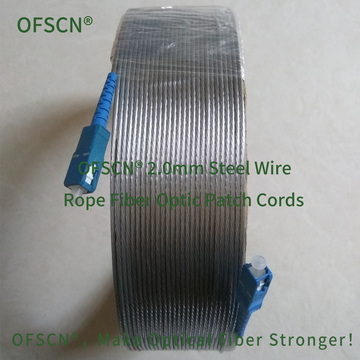
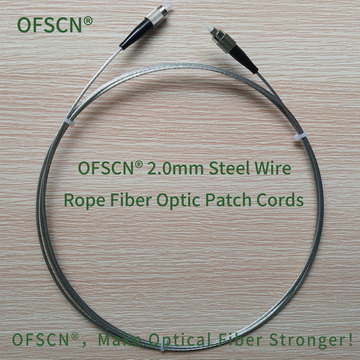
A. OFSCN® 2.0mm Steel Wire Rope Fiber Optic Patch Cord
- Tensile Strength: Greater than 1500 N (approximately 153 kg of static tensile force)
- Physical Structure: Composed of fiber optic connectors, a 0.6 mm galvanized steel wire rope structure, a 1.0 mm seamless stainless steel tube, and optical fiber. It is a fully metallic high-tensile structure.
- Operating Temperature: -40°C to 85°C

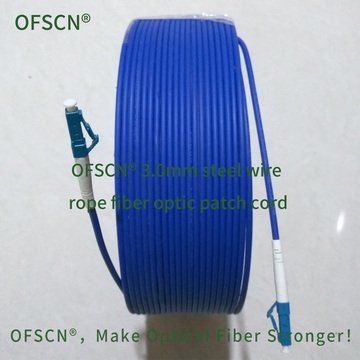
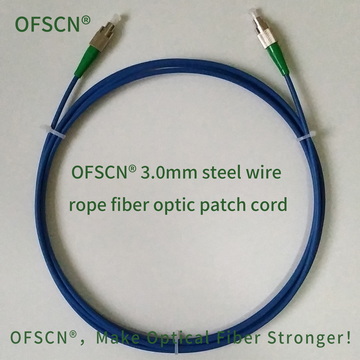
B. OFSCN® 3.0mm Steel Wire Rope Fiber Optic Patch Cord
- Tensile Strength: Greater than 1200 N (approximately 122 kg of static tensile force)
- Physical Structure: Composed of fiber optic connectors, a PE sheath, a 0.45 mm stainless steel wire rope structure, a 0.9 mm seamless stainless steel tube, and optical fiber.
- Operating Temperature: -40°C to 75°C

It should be noted that conventional micro-armored fiber optic patch cords (e.g., OFSCN® 2.0mm Micro Steel Armored Fiber Optic Patch Cord) have a tensile strength rating of greater than 150 N (approximately 15 kg of static tensile force) and are primarily used for rodent resistance, protection against trampling, and general cabling pulls. They should not be used in suspension or dragging scenarios requiring extremely high load capacity.