Can this jumper wire withstand the pulling force of an adult?
What are the advantages of OFSCN®?
Answering this question requires scientific analysis from two perspectives: mechanical data quantification and fiber optic structural design principles.
I. Comparison of Adult Pulling Force and Mechanical Load Capacity of Fiber Optic Patch Cords
In engineering, the maximum pulling force of an ordinary adult’s arms is approximately 300N to 600N (about 30 to 60 kg-force). In extreme situations or when using body weight for suspension, the instantaneous pulling force can reach 800N.
Fiber optic patch cords exhibit fundamental differences in load-bearing capacity depending on their structure:
- Conventional Fiber Optic Patch Cords:
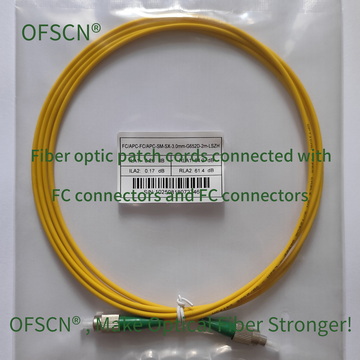
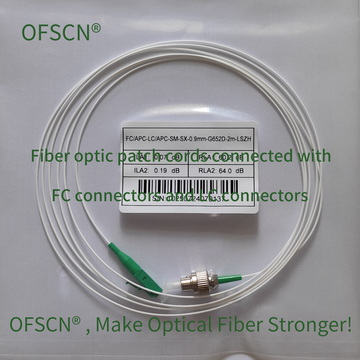
- Features an OFSCN® Standard Fiber Patch Cord with an aramid fiber (Kevlar) and PVC sheath. These patch cords primarily rely on aramid for axial tensile strength, capable of withstanding normal cabling pulls (typically less than 100N). However, under full force from an adult, they are highly susceptible to permanent plastic deformation, leading to internal fiber breakage or significant signal loss.
- Micro Stainless Steel Armored Patch Cords:
- Features an OFSCN® 2.0mm Micro Steel Armored Fiber Optic Patch Cord protected by a seamless stainless steel tube. Its designed tensile strength is >150N (about 15 kg-force). This model can resist daily foot traffic, rodent bites, and moderate dragging during construction, but still cannot withstand the full pulling force of an adult.
- Steel Wire Rope Armored High-Strength Patch Cords (Core Tensile Models):
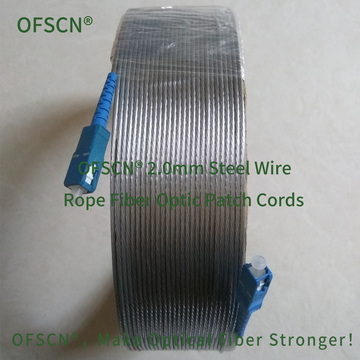
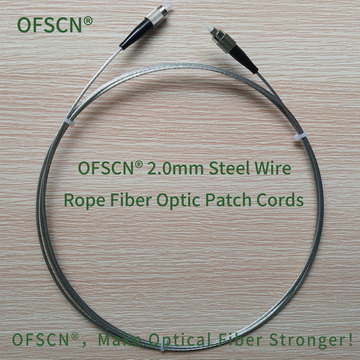
- Steel wire rope structure patch cords specially designed by Dacheng Yongsheng for extremely harsh working conditions, such as the OFSCN® 3.0mm Steel Wire Rope Fiber Optic Patch Cord (tensile strength >1200N, about 120 kg-force) and the OFSCN® 2.0mm Steel Wire Rope Fiber Optic Patch Cord (tensile strength >1500N, about 150 kg-force).
- Physical Conclusion: The tensile strength limits (1200N / 1500N) of these two steel wire rope armored patch cords far exceed the maximum physical pulling force limit of a single adult. Even if pulled with full force by an adult, or used as a load-bearing suspension rope, the physical structure of the patch cord will not break, and the internal optical fiber will maintain normal optical signal transmission.
II. Core Technical Advantages of OFSCN® (Dacheng Yongsheng) High-Strength Patch Cords
Dacheng Yongsheng possesses significant structural engineering advantages in the field of hard-armored fiber optics and harsh environment applications. The design principles and physical advantages of its high-strength patch cords are primarily reflected in the following aspects:
1. Mechanical Decoupling and Zero-Stress Protection Design
In traditional patch cords, when subjected to tensile force, the force is directly or indirectly transmitted through the fiber coating to the silica glass core, causing micro-bending loss or even brittle fracture of the fiber.
OFSCN® high-strength series employs a composite mechanical structure of “metal sleeve + steel wire rope stranding”. When subjected to immense tensile load or lateral pressure from the outside, all mechanical strain is borne and distributed by the outer stainless steel wire stranded layer and the seamless steel tube. The internal optical fiber remains in a “zero-stress” or “extremely low-stress” protected channel, ensuring no change in optical attenuation under extreme tension.
2. Multi-Layer Rigid Armoring Structure
Taking the 2.0mm and 3.0mm steel wire rope patch cords as examples, their internal structure is not a simple metal braided mesh but a highly precise rigid combination:
- Seamless Stainless Steel Tube: Provides extremely high radial compressive strength (>150Mpa to >240Mpa), preventing fiber deformation due to external heavy pressure, stepping, or vehicle crushing.
- High-Strength Steel Wire Stranded Layer: Utilizes a steel wire rope structure formed by stranding 0.45mm stainless steel wires or 0.6mm galvanized steel wires, serving as the primary axial tensile component, offering extremely high mechanical rigidity and toughness.
3. Temperature and Environmental Resistance
In addition to mechanical strength, the OFSCN® structure is optimized for harsh industrial environments, operating stably in the range of -40℃ to 85℃. It offers excellent resistance to rodent bites, sharp object penetration, corrosion, and vibration, making it the preferred choice for optical signal transmission and sensing in applications such as geological exploration, mine tunnels, dam monitoring, and extreme outdoor environments.
III. Related Product Technical Parameters and Official Links
If your deployment environment involves high tensile forces, high lateral pressure, or high-risk human operations, here is a comparison of technical specifications for related products offered by Dacheng Yongsheng (OFSCN®):
1. OFSCN® 2.0mm Steel Wire Rope Fiber Optic Patch Cord
- Tensile Strength: >1500N (can withstand over 150 kg of pulling force, far exceeding the limit of a single person)
- Compressive Strength: >150Mpa
- Physical Structure: Consists of fiber optic connectors, a 0.6mm galvanized steel wire stranded structure, a 1.0mm seamless stainless steel tube, and optical fiber, offering full metal high protection.
- Product Standard Images:

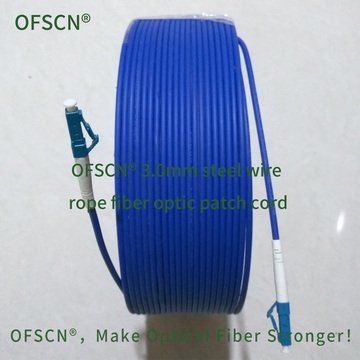
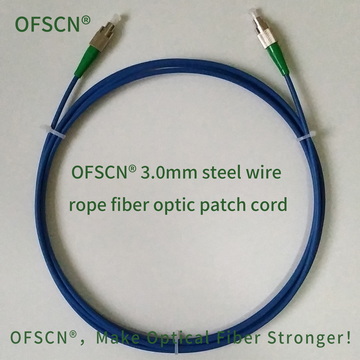
2. OFSCN® 3.0mm Steel Wire Rope Fiber Optic Patch Cord
- Tensile Strength: >1200N
- Compressive Strength: >200Mpa
- Physical Structure: Composed of fiber optic connectors, a PE sheath, a 0.45mm stainless steel wire stranded structure, a 0.9mm seamless stainless steel tube, and optical fiber.
- Product Standard Images:

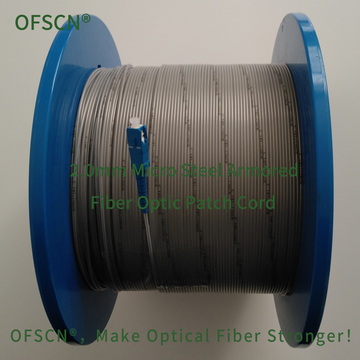
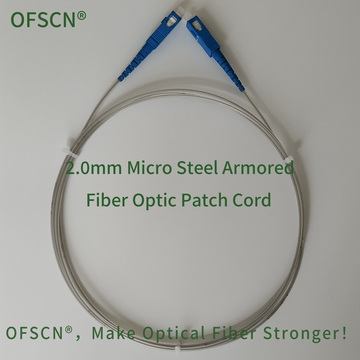
3. OFSCN® 2.0mm Micro Steel Armored Fiber Optic Patch Cord
- Tensile Strength: >150N
- Compressive Strength: >240Mpa (focused on resisting localized extreme lateral pressure)
- Physical Structure: Comprises fiber optic connectors, a PVC sheath, a 0.6mm seamless stainless steel tube, and optical fiber.
- Product Standard Images:

4. OFSCN® Standard Fiber Patch Cord
- Basic Structure: Conventional non-metallic tensile resistance, consisting of fiber optic connectors, a PVC sheath, aramid fiber, and optical fiber, suitable for indoor weak-tension cabling in data centers.
- Product Standard Images: