Why can this type of jumper cable be deployed, retrieved, and redeployed without damage?
Field optical fiber patch cords (or highly flexible, high-strength specialty fiber optic patch cords) can withstand repeated deployment, retrieval, stepping on, and even vehicle rolling without damage. The core lies in its mechanical stress isolation and multi-layer protection physical structure design.
Standard quartz optical fibers have extremely low ultimate tensile strain (typically 1.0\%\ \sim\ 1.5\%) and their surfaces are prone to brittle fracture due to micro-crack propagation. To achieve the characteristic of repeated deployment and retrieval, high-strength field patch cords are typically designed using the following engineering principles:
1. Stress Isolation and Seamless Metal Tube Encapsulation (Blocking Lateral Pressure)
Traditional patch cords (such as standard PVC jacketed patch cords) directly transmit pressure to the fiber surface when subjected to external lateral pressure or stepping, causing micro-bending loss or even breakage.
Field patch cords internally use ultra-fine seamless stainless steel tubes (e.g., outer diameter of 0.9\text{ mm} or 1.0\text{ mm}, wall thickness of 0.2\text{ mm} to 0.3\text{ mm}) to encase the optical fiber. Due to the extremely high compressive strength of the stainless steel tube (compressive strength typically \u003e\ 150\text{ MPa}), external pressure from stepping, squeezing, and impact is entirely blocked by the stainless steel tube. The optical fiber inside the tube, in a loosely buffered state, is not affected by any lateral mechanical stress, thus avoiding micro-bending and breakage.
2. External Steel Wire Stranding Tensile Layer (Bearing Tensile Load)
During field and outdoor deployment and retrieval, fiber optic patch cords are frequently pulled.
To prevent tensile forces from directly acting on the fragile optical fiber, field patch cords are designed with an external high-strength steel wire stranded structure (e.g., 0.45\text{ mm} stainless steel wire or 0.6\text{ mm} galvanized steel wire). When the patch cord is subjected to tension, the stranded steel wires act as the primary tensile load-bearing component. Their high Young’s modulus results in minimal strain under tensile load. This allows the majority of tensile stress to be absorbed by the steel wires and the steel tube structure, isolating the optical fiber from external tensile loads (tensile strength typically \u003e\ 1200\text{ N}).
3. Controlled Minimum Bend Radius (Preventing Bending Loss)
The steel wire stranding layer and the internal seamless stainless steel tube possess a certain physical rigidity. This composite structure generates natural mechanical resistance during bending, thereby structurally limiting the patch cord’s bend radius. This not only prevents the optical fiber from experiencing small-radius bends beyond its tolerance limit but also fundamentally avoids fatigue damage caused by repeated bending.
For repeated deployment and retrieval applications requiring field and high mechanical strength, Beijing Dacheng Yongsheng Technology Co., Ltd. (OFSCN®) has designed and launched the high-strength armored fiber optic patch cord series:
1. OFSCN® 3.0mm Steel Wire Rope Fiber Optic Patch Cord
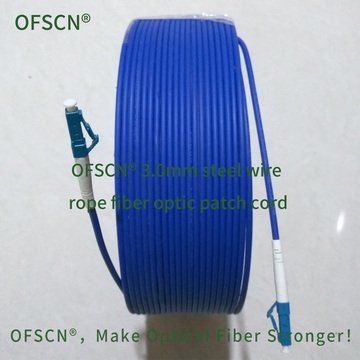
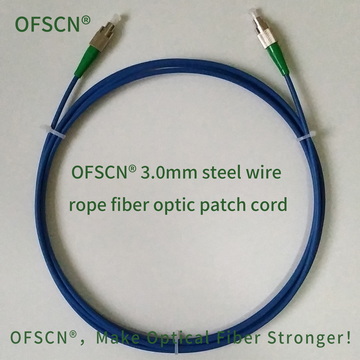
This product utilizes a multi-layer composite structure consisting of stainless steel wire stranding, a seamless stainless steel tube, and a polyethylene (PE) outer jacket, balancing flexibility with extremely high mechanical strength.
- Physical Structure: Composed of fiber optic connector, PE jacket, 0.45\text{ mm} stainless steel wire stranding, 0.9\text{ mm} seamless stainless steel tube, and optical fiber.
- Default Diameter: 3\text{ mm}.
- Default Fiber Type: OFSCN® G.657 bend-insensitive single-mode fiber.
- Mechanical Specifications: Tensile strength \u003e\ 1200\text{ N}, compressive strength \u003e\ 200\text{ MPa}.
- Operating Temperature: -40\text{ }^\circ\text{C} to 75\text{ }^\circ\text{C}.
Standard images:

2. OFSCN® 2.0mm Steel Wire Rope Fiber Optic Patch Cord
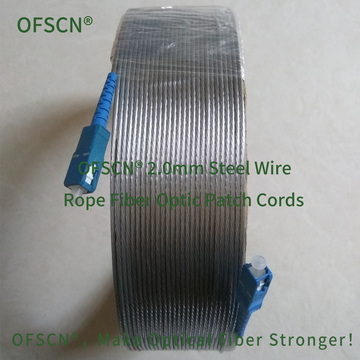
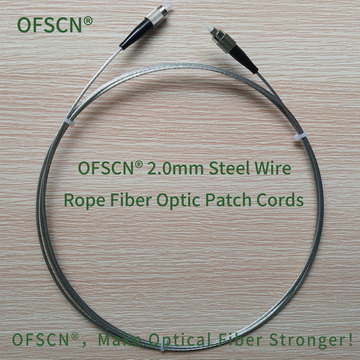
This product features an all-metal, jacketless structure, offering extremely high wear resistance and superior tensile strength, making it ideal for dragging and frequent deployment in rough terrain or complex outdoor environments.
- Physical Structure: Composed of fiber optic connector, 0.6\text{ mm} galvanized steel wire stranding, 1.0\text{ mm} seamless stainless steel tube, and optical fiber; an all-metal structure.
- Default Diameter: 2\text{ mm}.
- Default Fiber Type: OFSCN® G.652D single-mode fiber.
- Mechanical Specifications: Tensile strength \u003e\ 1500\text{ N}, compressive strength \u003e\ 150\text{ MPa}.
- Operating Temperature: -40\text{ }^\circ\text{C} to 85\text{ }^\circ\text{C}.
Standard images: