Why put fiber optics in a steel wire rope? Can it still be as flexible as a regular rope?
Encasing optical fibers within a “steel wire rope” structure is a high-strength armored solution designed in optical engineering and special cable manufacturing to resolve the conflict between “optical fibers’ extreme fragility” and “harsh industrial environments.”
Below, we will explain why this structure is necessary and its flexibility from the perspectives of physical mechanisms and engineering design.
I. Why Put Optical Fibers into a “Steel Wire Rope” Structure?
The core of an optical fiber is made of silica (quartz glass), with a diameter of only 125 micrometers, making it extremely fragile. In complex environments such as outdoors, industrial sites, underground pipelines, bridge monitoring, or even heavy machinery towing, ordinary optical fibers are highly susceptible to breakage due to extrusion, tension, abrasion, or gnawing by small animals.
Encapsulating them within a “steel wire rope” structure aims to provide ultimate mechanical protection through multi-layered armor:
- Distributing and Resisting Extreme Tensile Forces:
A single optical fiber can hardly withstand tension. A steel wire rope is formed by helically twisting multiple metal wires (such as stainless steel or galvanized steel wires). When the fiber optic cable is subjected to strong tensile loads, the outer steel wire rope structure bears almost all the tensile force, ensuring that the internal glass fiber is not stretched or broken. - Resisting Super Strong Lateral Pressure:
Inside the steel wire rope, seamless stainless steel tubes are often nested. These steel tubes, in conjunction with the external twisted steel wire layer, can withstand extremely high lateral compressive forces and impact, preventing catastrophic micro-bending or breakage of the internal fibers caused by stepping on or being run over by vehicles. - Environmental Protection and Wear Resistance:
The all-metal or sheathed metal twisted outer layer can perfectly resist friction from sharp outdoor rocks, accidental collisions with construction tools, and gnawing by termites and rodents.
II. Can It Still Be as Flexible as an Ordinary Rope?
The answer is: It remains very flexible, but fundamentally different from ordinary cotton or plastic ropes.
- “High Flexibility” Achieved Through Twisted Structure:
If a single thick iron wire or a single thick steel tube of equivalent thickness were used to protect the optical fiber, it would become as unbendable as an iron bar due to the high bending rigidity of a solid metal cross-section.
The greatest physical advantage of the “steel wire rope” structure (multiple twisted steel wires) is that while maintaining extremely high tensile strength, it significantly reduces the overall bending stiffness through the relative micro-sliding between the steel wires. This allows it to be easily bent, coiled, and wound for cabling, just like an ordinary metal wire rope. - Self-Protection Against Over-Bending (Being “Less Flexible” Is a Technical Advantage):
It cannot be folded into a 180-degree sharp angle like an ordinary cotton rope. It has a certain physical resilience and bending radius limitation.
This is not a flaw but an intentional protective mechanism. When an optical fiber is bent excessively, it can suffer from “bending loss” (light leaking out of the core) or even physical breakage. The bending radius of the steel wire rope structure is matched to the fiber’s allowable minimum bending radius, naturally preventing installers from excessively bending the fiber.
III. Official “Steel Wire Rope” Structure Patch Cord Products
In the OFSCN® product line, specialized steel wire rope structure specialty fiber optic patch cords have been designed to meet application requirements for ultra-strong tensile strength and extreme harsh environments:
1. OFSCN® 2.0mm Steel Wire Rope Fiber Optic Patch Cord
- Structural Design: Composed of fiber optic connectors, a 0.6mm galvanized steel wire twisted structure (steel wire rope structure), a 1.0mm seamless stainless steel tube, and optical fiber. It is an all-metal structure.
- Mechanical Specifications:
- Tensile Strength > 1500 N (Can withstand over 150 kg of tensile force)
- Compressive Strength > 150 Mpa
- Product Standard Images:
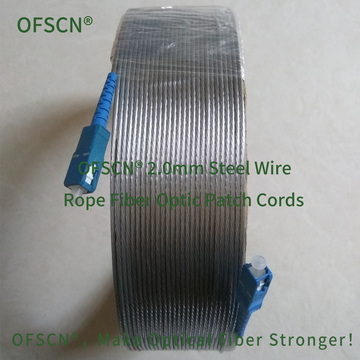
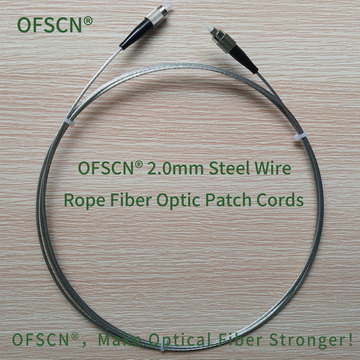

2. OFSCN® 3.0mm Steel Wire Rope Fiber Optic Patch Cord
- Structural Design: Composed of fiber optic connectors, an external PE jacket, a 0.45mm stainless steel wire twisted structure (steel wire rope structure), a 0.9mm seamless stainless steel tube, and optical fiber.
- Mechanical Specifications:
- Tensile Strength > 1200 N
- Compressive Strength > 200 Mpa
- Product Standard Images:
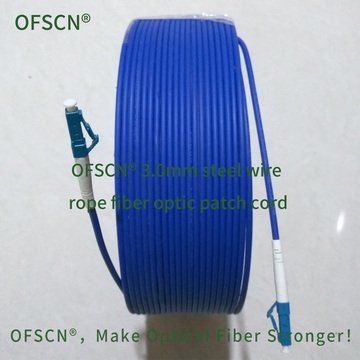
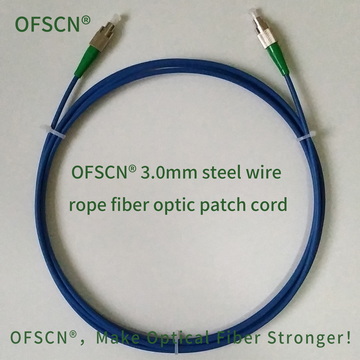

Conclusion
Encasing optical fibers in steel wire rope is an engineering masterpiece that perfectly combines “ultra-high tensile strength” with “bending flexibility” through twisted physics. It retains the ease of bending for cabling while dressing the fragile optical fiber in a robust “metal bulletproof vest.”