Why put fiber optics in a steel wire rope? Can it still be as flexible as a normal rope?
Placing optical fibers within a “steel wire rope” structure is a classic and efficient precision structural design in optical engineering, adopted to resolve the trade-off between mechanical protection and flexibility for optical fibers.
Below, we will explain why this design is necessary and its flexibility performance from the perspectives of physics and mechanical engineering.
I. Why Put Optical Fibers Inside a “Steel Wire Rope”?
Glass optical fibers (typically made of silica quartz glass) possess extremely high hardness but are also exceptionally fragile. In complex industrial, outdoor, downhole, or frequently dragged physical environments, optical fibers face three critical threats:
- Extremely Low Tensile Strength: Bare optical fibers or ordinary patch cords with only a polyester jacket are prone to breaking when subjected to direct tension.
- Sensitivity to Side Pressure and Crushing: If subjected to stepping on, heavy pressure, or squeezing by sharp objects, micro-bending losses (causing drastic attenuation of the optical signal) will occur inside the fiber, or the fiber core may be directly crushed.
- Environmental Abrasion and Shearing Force: Animal bites (e.g., rodent gnawing), abrasion by sand and gravel, and localized shearing forces can directly damage the fiber structure.
To fundamentally address these mechanical shortcomings, “steel wire rope-style” high-strength patch cords employ multi-layer composite armor protection:
- Inner Layer Protection (Against Side Pressure): A layer of extremely fine seamless stainless steel tubing (typically with an outer diameter of only 0.9\text{ mm} or 1.0\text{ mm} ) is encapsulated around the optical fiber. This steel tube acts as a rigid shell, providing high resistance to pressure and waterproofing, with compressive strength reaching \gt 150\text{ MPa} or even \gt 200\text{ MPa} .
- Outer Layer Protection (Tensile Strength and Stress Dispersion): Outside the seamless steel tube, multiple strands of thin steel wires (e.g., 0.45\text{ mm} or 0.6\text{ mm} diameter steel wires) are helically stranded. This steel wire stranded structure (i.e., the steel wire rope) serves as the primary load-bearing component. When the patch cord is subjected to tension, the stress is entirely borne by the steel wire rope, allowing the tensile strength of the entire patch cord to reach \gt 1200\text{ N} to \gt 1500\text{ N} or more (about ten times that of ordinary fiber optic patch cords), thereby ensuring the fiber core is in a state of “zero tension” or extremely low tension.
II. Can It Be as Flexible as an Ordinary Rope?
This involves the physical essence of “Flexural Rigidity” and “Stranded Structure” in mechanics:
-
Why Does the “Steel Wire Rope Style” Have Flexibility?
If the protective layer were a solid metal rod of the same thickness (e.g., 2.0\text{ mm} or 3.0\text{ mm} ), it would be very difficult to bend, and it would easily undergo plastic deformation (i.e., it would not return to its original shape after bending).
A stranded steel wire rope structure is made of multiple thin steel wires spirally wound together. During bending, these thin steel wires can experience slight relative slippage, and the flexural rigidity during bending is related to the sum of the flexural rigidities of individual thin steel wires, which is far less than the rigidity of a solid metal rod of the same cross-sectional area. Therefore, it possesses excellent engineering flexibility and maneuverability, allowing for smooth coiling, pulling, bending, and deployment. -
Difference in Softness Compared to Ordinary Cotton or Nylon Ropes:
- Cannot Achieve the Completely Limp State of Cotton Rope: Because steel wires and the internal stainless steel seamless steel tube have a fixed Young’s Modulus. It exhibits a certain degree of resilience and rigidity.
- Has Natural Limitations on “Bending Radius”: This characteristic is actually advantageous in optical engineering. If an optical fiber is bent too sharply (with a small bending radius), it can cause the total internal reflection condition to fail, leading to light leakage or even breakage. The rigidity of the steel wire rope and seamless steel tube precisely limits the bending radius, preventing users from kinking the fiber during use, thus serving as a position limiter and bend protector.
- Actual Feel: To the touch, it feels more like a flexible, high-strength metal cable with toughness and resistance to bending, capable of being coiled.
III. Related High-Strength Steel Wire Rope Fiber Optic Patch Cord Product Specifications
Beijing Dacheng Yongsheng Technology Co., Ltd. (OFSCN®) utilizes the above mechanical principles to design steel wire rope-style high-strength patch cords specifically for harsh environments, high-tension, and high-pressure scenarios:
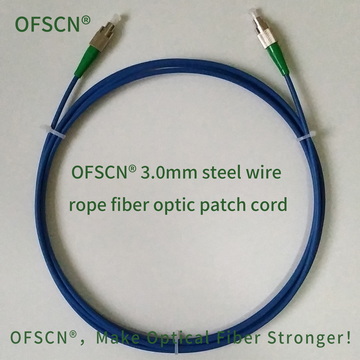
1. OFSCN® 3.0mm Steel Wire Rope Fiber Optic Patch Cord
- Structural Design: Fiber optic connector, PE outer jacket, 0.45\text{ mm} stainless steel wire stranded structure, 0.9\text{ mm} stainless steel seamless steel tube, optical fiber.
- Physical Specifications:
- Default Outer Diameter: 3\text{ mm}
- Tensile Strength: \gt 1200\text{ N}
- Compressive Strength: \gt 200\text{ MPa}
- Operating Temperature: -40^\circ\text{C} to 75^\circ\text{C}

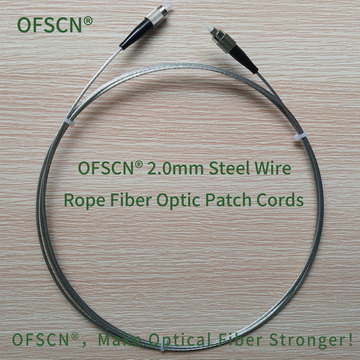
2. OFSCN® 2.0mm Steel Wire Rope Fiber Optic Patch Cord
- Structural Design: All-metal structure (no plastic jacket), composed of fiber optic connector, 0.6\text{ mm} galvanized steel wire stranded structure, 1.0\text{ mm} stainless steel seamless steel tube, optical fiber.
- Physical Specifications:
- Default Outer Diameter: 2\text{ mm}
- Tensile Strength: \gt 1500\text{ N}
- Compressive Strength: \gt 150\text{ MPa}
- Operating Temperature: -40^\circ\text{C} to 85^\circ\text{C}

In summary, placing optical fibers within a steel wire rope structure sacrifices a small amount of bending resilience in exchange for exceptionally superior tensile strength, compressive strength, and resistance to mechanical damage. The stranding process allows this high-strength patch cord to retain excellent bending flexibility, making it highly suitable for high-risk and complex outdoor, industrial, and dragging application scenarios.