Why are two input ports needed? Is it for system redundancy?
Yes, in optical physics, optical communication, and optical sensing engineering, 2 \times N splitters (such as 2 \times 8, 2 \times 16, or 2 \times 32, etc.) are designed with two input ports. Their most crucial engineering purpose is precisely to achieve system link redundancy and protection.
Here is an in-depth academic and engineering principle analysis of why two input ports are necessary:
1. Redundancy and Link Protection
In Passive Optical Networks (PON) or high-reliability optical fiber transmission systems, dual-path redundancy is a common design for ensuring system high survivability:
- Working Mechanism: The two input ports (Input 1 and Input 2) of a 2 \times N splitter are typically connected to two different backbone optical cables (with different physical routes) or two independent transmitting end/Optical Line Terminal (OLT) devices.
- Failure Handoff: Under normal operating conditions, the system can transmit signals through the primary route (e.g., Input 1). Once the backbone fiber encounters an accidental break, excessive bending loss, or the primary transmitting equipment fails, the system’s optical switch or protection switching module (e.g., OLP module) can detect abnormal optical power within milliseconds and rapidly switch to the backup route (e.g., Input 2), ensuring that the N downstream output services do not experience interruption.
2. Online Network Monitoring and Non-disruptive Maintenance
In certain special engineering scenarios, the dual input ports can also be used for real-time physical network status detection:
- The service optical signal is continuously input through one port, while the second input port can be temporarily or permanently connected to test equipment such as an Optical Time Domain Reflectometer (OTDR), a light source, or an optical power meter.
- This allows technicians to perform online testing and fault localization of the entire optical link’s performance without interrupting or affecting the normal operation of the N output ports.
Beijing Dacheng Yongsheng Technology Co., Ltd. (OFSCN®) Related Product Applications
In Beijing Dacheng Yongsheng Technology Co., Ltd.'s industrial-grade optical sensing systems, optical splitters are also extremely important supporting components. In large-scale Fiber Bragg Grating sensing projects, high-performance optical splitters are commonly used in conjunction with interrogators.
The OFSCN® Optical Fiber Splitter product line includes common standard temperature and customized high-temperature splitters, such as the common 16 \times 32 splitters, 8 \times 16 splitters, 4 \times 8 splitters, 32 \times 64 splitters, etc.
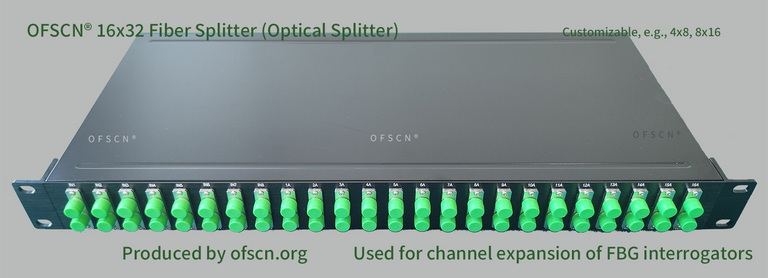
When these splitters are paired with the OFSCN® Fiber Bragg Grating Interrogator, the main application strategy is:
- To spatially expand one physical channel of the interrogator into two or three (but logically and spectrally it still belongs to the same channel).
- This architecture is not used for communication primary/backup switching, but rather aims to increase the measurement point area that a single physical channel can cover, thereby reducing the unit cost per channel of the entire system.
- Note: In such sensing applications, extremely strict wavelength planning and reflectivity design must be performed for the Fiber Bragg Gratings (FBGs) on each branch to avoid reflection peak overlap on the spectrogram, thus preventing the demodulation algorithm from failing.