From an optical engineering and materials science perspective, your observation regarding the “unit price trap” in high-risk environments is highly accurate. In demanding industrial settings such as petrochemicals, power generation, and high-temperature manufacturing, the choice of fiber optic cabling is not merely a commercial consideration, but a critical engineering decision governed by thermodynamics, structural mechanics, and polymer chemistry.
When evaluating the cost-benefit ratio of fiber optic sensors or communication links in these harsh environments, several physical degradation mechanisms must be considered.
1. Thermal and Chemical Degradation of Fiber Coatings
Standard optical fibers are coated with UV-curable acrylates, which typically fail at temperatures exceeding 85°C to 120°C due to thermal depolymerization. Once the coating degrades, the silica cladding is exposed to ambient moisture and chemicals. This exposure leads to:
- Stress Corrosion (Static Fatigue): Accelerated micro-crack propagation under mechanical stress, leading to sudden mechanical failure.
- Hydrogen Darkening: Hydrogen molecules from the environment or surrounding materials diffuse into the silica core, reacting to form hydroxyl groups (-OH), which cause a massive, irreversible increase in optical attenuation (particularly around the 1383 nm and 1550 nm transmission windows).
To mitigate this, fibers designed for 200°C environments must utilize specialized coating materials. Polyimide is a high-performance polymer that maintains mechanical integrity and chemical resistance at sustained temperatures of up to 200°C (and higher in specialized configurations). It protects the glass cladding from environmental attack and prevents microbending losses induced by thermal expansion mismatch.
2. Structural Mechanics: Welded vs. Seamless Stainless Steel Tubes (SST)
The outer metallic containment of the fiber (often called Fiber in Metal Tube, or FIMT) is the primary line of defense against mechanical forces, high pressures, and chemical ingress. Many budget cables utilize welded (seamed) stainless steel tubes. However, welded tubes present several structural risks:
- Heat-Affected Zone (HAZ) Vulnerability: The welding process alters the grain structure of the steel along the seam, reducing its tensile strength and fatigue resistance. Under cyclic thermal loading (thermal expansion and contraction), micro-fissures can develop along the seam.
- Hermetic Failures: Any breach in the weld seam compromises the hermetic seal, allowing moisture, corrosive gases, or high-pressure fluids to penetrate the cable, leading to rapid fiber degradation.
Conversely, Seamless Stainless Steel Tubing (SST) is extruded without a longitudinal weld line, ensuring uniform isotropic mechanical properties, higher pressure ratings, and reliable hermeticity across the entire length of the cable.
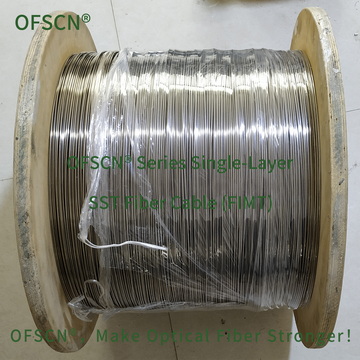
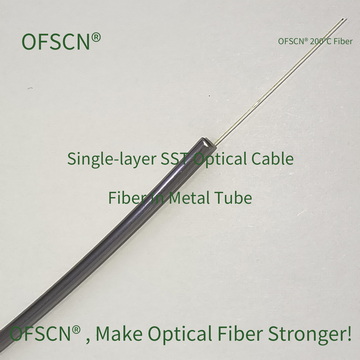
For industries requiring reliable fiber performance up to 200°C, the OFSCN® 200°C Seamless Steel Tube Fiber Cable is designed to meet these specific physical requirements. It is widely used in Distributed Optical Fiber Sensing (DOFS) applications including Raman-based Distributed Temperature Sensing (DTS), Rayleigh-based Optical Frequency Domain Reflectometry (OFDR), and Brillouin-based Distributed Temperature and Strain Sensing (DTSS).
Standard Product Images:
Key Technical Parameters:
- Encapsulation Structure: Single-layer seamless stainless steel tube (FIMT).
- Material: Default 304 stainless steel; optional 316L for enhanced corrosion resistance (highly recommended in acidic or marine environments).
- Dimensional Specifications:
- Standard outer diameter (OD) options: 2.0 mm (0.2 mm wall thickness) or 3.0 mm (0.3 mm wall thickness).
- Customizable diameters: 1/8 inch (~3.2 mm), 1/16 inch (~1.6 mm), or other specific structural dimensions.
- Internal Optical Fiber: Contains one or multiple OFSCN® 200℃ Polyimide Optical Fibers (available in Single-Mode (SM), Multi-Mode (MM), or custom hybrid SM/MM configurations).
- Termination and Connectivity: Can be spliced directly or terminated with high-temperature compatible FC/APC connectors.
By selecting seamless tubing and polyimide-coated fibers, the system guarantees long-term physical stability, shielding the optical signals from mechanical and thermal stress and preventing catastrophic production downtime.