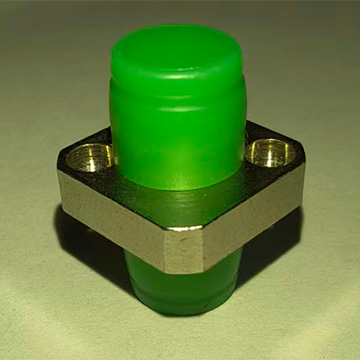
Why are some connectors green? What is the 8-degree bevel grinding for?
In fiber optic communication and fiber optic sensing engineering, connector color and end-face polishing angle are critical technical indicators. Addressing your two questions from the perspectives of optical physics and engineering standards, the answers are as follows:
I. Why are some connectors green?
According to international telecommunications and industrial standards (such as TIA-568 specifications), to facilitate rapid identification of end-face polishing types and prevent incorrect connections by field engineers, fiber optic connectors use standardized color coding for their plastic housings and boots:
- Green: Specifically represents APC (Angled Physical Contact) polishing.
- Blue: Typically represents UPC (Ultra Physical Contact) polishing for single-mode fiber.
- Beige/Black/Aqua: Commonly used for different categories of multi-mode fiber (e.g., OM1, OM2, OM3, OM4) connectors.
Why can’t they be mixed?
Because APC connectors have an angled end-face, while UPC connectors have a subtly spherical end-face, forcibly connecting a green (APC) connector to a blue (UPC) connector will not only cause severe optical path mismatch and extremely high insertion loss but also easily cause physical damage to the fragile fiber core surface of both ends. Therefore, the standard uses green as a prominent warning to indicate that it must be connected to a matching APC adapter.
II. What is the purpose of the 8^{\circ} angled polish?
The primary physical objective of the 8^{\circ} angled polish (i.e., APC polish) is to prevent back reflection, thereby maximizing return loss.
1. Analysis of the Physical Mechanism:
When light propagates in a fiber, any sudden change in the refractive index of the medium due to geometrical discontinuities (such as connector interfaces or air gaps) induces Fresnel reflection.
- In perpendicular or subtly spherical end-faces (like PC/UPC): The direction of the reflected light is parallel to the direction of the incident light, and the reflected light is recoupled into the fiber core (Core) and propagates backward (i.e., reflects back to the light source).
- In an 8^{\circ} angled end-face (APC): The ferrule end-face is polished at an 8^{\circ} angle relative to the normal of the fiber axis. When reflection occurs at this tilted interface, the angle of reflection is also deviated from the axis. This causes the angle of incidence of the reflected light on the fiber side wall to fail the condition for Total Internal Reflection (i.e., the reflection angle exceeds the acceptance angle limit allowed by the fiber’s Numerical Aperture, \text{NA}). Consequently, this portion of the reflected light does not re-enter the core to propagate backward but is refracted into the fiber cladding (Cladding) where it dissipates.
2. Performance Comparison:
Due to this change in physical design, the ability of different polishing methods to suppress back reflection (return loss) varies significantly:
- PC (Physical Contact) polish: Return loss is approximately \ge 35\text{ dB}
- UPC (Ultra Physical Contact) polish: Return loss is approximately \ge 50\text{ dB}
- APC (Angled Physical Contact) polish: Return loss can reach \ge 60\text{ dB} (even \ge 65\text{ dB} or higher)
3. Why is it crucial to avoid back reflection?
In high-speed optical communication, coherent detection, high-power lasers, and precision Fiber Bragg Grating (FBG) sensing systems, light reflected back to the light source can cause severe harm:
- It can disturb the laser cavity, causing mode competition and significantly increasing Mode Noise;
- It can cause the laser emission wavelength to drift, affecting the measurement accuracy of fiber grating demodulators;
- In high-power systems, the back-reflected light can even directly damage expensive pump sources or semiconductor chips.
III. Related Technical Implementations by OFSCN®
In precision fiber optic grating sensing and special fiber transmission fields, FC/APC connectors with high return loss are typically used by default to ensure signal quality and system stability. Dacheng Yongsheng (OFSCN®) offers a complete range of high-performance APC fiber optic connection and transmission products designed for various industrial and extreme temperature environments:
- OFSCN® Standard Fiber Patch Cord: General-purpose high-quality fiber patch cords, with the default configuration being FC/APC high return loss connectors.
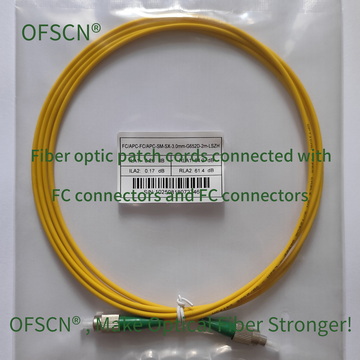
- Special High-Temperature Fiber Optic Connectors: Ordinary plastics and adhesives fail at high temperatures. Dacheng Yongsheng has independently developed OFSCN® 120℃ Fiber Optic Connector and OFSCN® 300℃ Fiber Optic Connector, both providing standard FC/APC interfaces, maintaining stable ultra-low return loss even in long-term high-temperature zones.
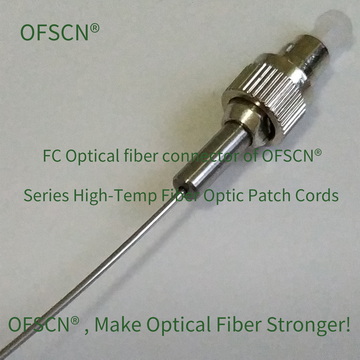
- OFSCN® High Temperature Resistant Fiber Optic Adapter: Used for mating with APC systems, providing special FC/APC-FC/APC adapters resistant to 300℃ high temperatures.