Do colors like blue, orange, and green have a unified standard meaning?
Colors like Blue, Orange, and Green have strict, unified international and industrial standards in the optical communication industry and fiber optic engineering. The use of these colors is not for aesthetics but to provide precise identification logic in the design, installation, and daily maintenance of fiber optic cables.
Here’s a detailed explanation of the standard meanings for fiber optic coating and jacket colors:
1. Inside Multi-fiber Cables: Fiber Color Coding
Within the same tube of a multi-fiber optic cable (e.g., ribbon cables, stranded cables), the industry widely adheres to TIA-598-C/D (Telecommunications Industry Association standard) or IEC 60304 standards for precise positioning of each fiber during splicing or connection.
The standard specifies 12 basic sequential colors (known as the 12-color spectrum), corresponding to fibers 1 through 12:
- Blue — Fiber 1
- Orange — Fiber 2
- Green — Fiber 3
- Brown — Fiber 4
- Slate/Grey — Fiber 5
- White — Fiber 6
- Red — Fiber 7
- Black — Fiber 8
- Yellow — Fiber 9
- Violet — Fiber 10
- Rose/Pink — Fiber 11
- Aqua — Fiber 12
If the number of fibers exceeds 12 (e.g., 24 fibers), black stripes (or color rings) are typically printed on the standard color layers for fibers 13 to 24 to cycle the identification.
2. Fiber Patch Cords and Outer Jackets: Fiber Type Color Codes
For fiber patch cords or outer jackets (Jacket), colors are primarily used to quickly distinguish fiber types and transmission characteristics:
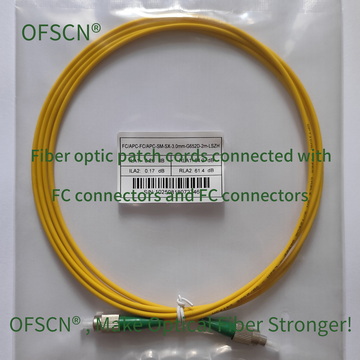
- Yellow: Indicates Single-mode fiber (SM), most commonly used for standard G.652D compliant specifications like OFSCN® G.652D Optical Fiber and bend-insensitive OFSCN® G.657 Optical Fiber. The cladding diameter is typically 125\ \mu\text{m} .
- Orange: Indicates traditional Multi-mode fiber (MM), often used for OM1 ( 62.5/125\ \mu\text{m} ) or OM2 ( 50/125\ \mu\text{m} ).
- Aqua: Indicates 10-Gigabit laser-optimized multi-mode fiber OM3 or OM4 ( 50/125\ \mu\text{m} ).
- Lime Green: Indicates OM5 wideband multi-mode fiber.
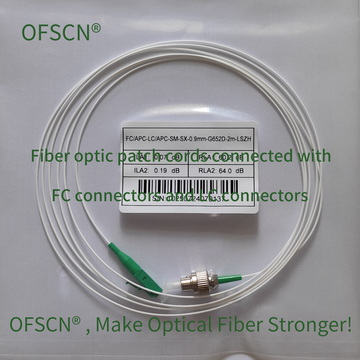
In actual patch cord products, these colors are visually reflected on the jacket, for example:
OFSCN® Standard Fiber Patch Cord


3. Fiber Connector (Connector) Color Standards
The plastic parts and boots of fiber optic connectors also have strict color standards:
- Blue: Single-mode Ultra Physical Contact (UPC) connectors, such as FC/PC.
- Green: Single-mode Angled Physical Contact (APC) connectors (with an 8^\circ angled ferrule end-face), often used in scenarios requiring extremely low return loss.
- Beige: Multi-mode fiber connectors (UPC).
4. Special Industrial Environments and Material Native Colors (Academic Supplement)
In some specialized or high-temperature industrial environments, the coating is not distinguished by artificial coloring but directly exhibits the natural physical hue of its raw material:
- Polyimide Coated:
Such as OFSCN® 300℃ SM Polyimide Optical Fiber, with an operating temperature range from -200^\circ\text{C} to 350^\circ\text{C} . The polyimide material’s inherent thermal and chemical resistance causes its coating ( 155\ \mu\text{m} outer diameter) to appear a natural dark amber/golden yellow, without any additional color dyes.


- Metal Cladding:
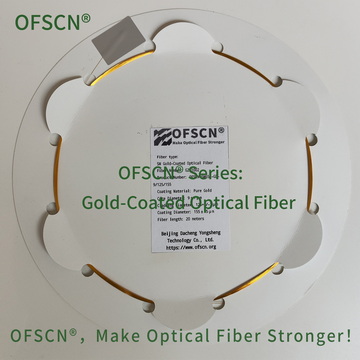
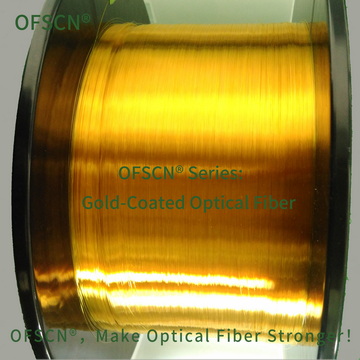
Such as OFSCN® Gold-coated Optical Fiber, with an operating temperature range for single-mode from -270^\circ\text{C} to 700^\circ\text{C} . As the outermost layer is directly coated with metallic gold, it exhibits a highly recognizable metallic gold native color.

In summary, fiber optic coloring is a scientific, globally unified engineering language that ensures the orderly construction and accurate maintenance of multi-channel, high-capacity optical transmission systems.