Would immersing optical fibers directly in sulfuric acid or strong alkaline solutions cause the glass to corrode?
When optical fibers are directly immersed in concentrated sulfuric acid or strong alkaline aqueous solutions, the chemical reactions of the fiber’s main material (silica glass, \text{SiO}_2) differ.
I. Effect of Sulfuric Acid (Strong Acid) on Optical Fiber Glass
Glass is not corroded by sulfuric acid.
The main component of communication and sensing optical fibers is high-purity silica (\text{SiO}_2). Silica exhibits strong acid resistance in terms of its chemical properties:
- Acid Resistance Mechanism: Except for hydrofluoric acid (\text{HF}), silica does not react chemically with most inorganic acids (such as sulfuric acid \text{H}_2\text{SO}_4, hydrochloric acid \text{HCl}, nitric acid \text{HNO}_3) or organic acids. Therefore, sulfuric acid molecules cannot break the silicon-oxygen (Si-O-Si) bonds in the silica network structure.
- Special Exception: The only acid that vigorously corrodes glass is hydrofluoric acid (\text{HF}), with the reaction equation:
\text{SiO}_2 + 4\text{HF} \rightarrow \text{SiF}_4\uparrow + 2\text{H}_2\text{O}
Hydrofluoric acid rapidly dissolves silica glass.
It should be noted that while sulfuric acid does not dissolve the glass itself, concentrated sulfuric acid has strong dehydrating and oxidizing properties. It can attack and carbonize the outermost organic polymer coating layer of the optical fiber (such as acrylate coatings), leading to coating delamination and exposing the bare glass to mechanical stress.
II. Effect of Strong Alkaline Aqueous Solutions (e.g., \text{NaOH} / \text{KOH}) on Optical Fiber Glass
Glass is corroded by strong bases.
Silica, as an acidic oxide, undergoes hydrolysis and alkaline corrosion in strong alkaline aqueous solutions:
- Corrosion Mechanism: Hydroxide ions (\text{OH}^-) in alkaline solutions directly attack the silica network structure, breaking the \text{Si}-\text{O}-\text{Si} bonds and forming soluble silicates (e.g., sodium silicate \text{Na}_2\text{SiO}_3):
\text{SiO}_2 + 2\text{NaOH} \rightarrow \text{Na}_2\text{SiO}_3 + \text{H}_2\text{O} - Forms of Engineering Damage:
- Surface Roughening and Hydrolysis: Corrosion leads to micro-cracks on the glass surface, significantly reducing the tensile strength of the optical fiber.
- Reduction in Geometric Dimensions: As corrosion progresses, the outer diameter of the fiber cladding gradually decreases, eventually leading to the destruction of the optical waveguide structure, a sharp increase in optical loss, or even fiber breakage.
- Sensitivity to Temperature and Concentration: Higher alkali concentration and temperature (e.g., above 60^\circ\text{C}) accelerate the glass corrosion rate.
III. Protection Schemes for Optical Fibers in Highly Corrosive Environments
When using optical fibers for sensing or transmission in environments containing strong acids, strong bases, or complex corrosive media, standard polymer-coated fibers cannot be relied upon. Typically, special metal coatings or seamless stainless steel tubes are used for physical and chemical isolation.
1. Gold-Coated Special Optical Fibers
For extreme chemical corrosive environments, metallic coatings can be used instead of organic coatings, such as OFSCN® Gold-coated Optical Fiber. The gold coating effectively blocks the intrusion of acidic and alkaline liquids and moisture into the inner glass cladding.

2. Seamless Steel Tube Armored Encapsulation
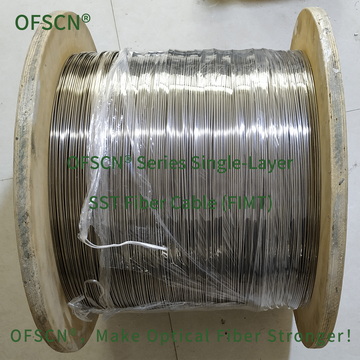
In industrial settings or corrosive liquid environments such as hydrometallurgy, 316L stainless steel seamless tubes are often used for protective sheathing, for example, OFSCN® 300°C Seamless Steel Tube Fiber Cable. 316L stainless steel provides excellent resistance to acids and alkalis and prevents leakage, isolating the internal optical fiber from direct chemical contact.