With so much salt in the sea air, would the fiber coating rust and corrode like metal?
From the perspective of materials science and chemical physics principles, optical fibers and their conventional coatings do not “rust” in a seaside salt spray environment like metals do.
The specific reasons and analysis of the physicochemical mechanisms in a salt spray environment are as follows:
1. Intrinsic Material Properties of Optical Fibers (Silicon Dioxide)
The core and cladding of optical fibers are primarily composed of high-purity silicon dioxide ( \text{SiO}_2 , i.e., fused silica).
- No Electrochemical Corrosion Mechanism for Metals: “Rusting” is essentially an electrochemical oxidation-reduction reaction (galvanic corrosion) that occurs in iron or metal alloys in the presence of water and oxygen. Fused silica is a non-metallic inorganic oxide with extremely stable chemical bonds. At room temperature, it does not react chemically with sodium chloride ( \text{NaCl} ), water, or oxygen in salt spray.
2. Material Properties of Optical Fiber Coatings
The protective coatings on the outside of optical fibers vary depending on the application and are mainly categorized into polymer coatings and metallic coatings:
-
Polyacrylate Coating:
Commonly found on standard communication and sensing fibers (e.g., OFSCN® G.652D Optical Fiber ), this type of organic polymer material possesses excellent resistance to acid, alkali, and salt spray corrosion and does not rust.
-
Polyimide Coating:
Often used for high-temperature and industrial-grade specialty fibers (e.g., OFSCN® 300℃ SM Polyimide Optical Fiber ), it exhibits extremely high chemical inertness, resistance to chemical solvents, and salt spray erosion. The chemical structure of the coating remains intact even after prolonged exposure to marine salt spray.
-
Gold-coated Metallic Coating:
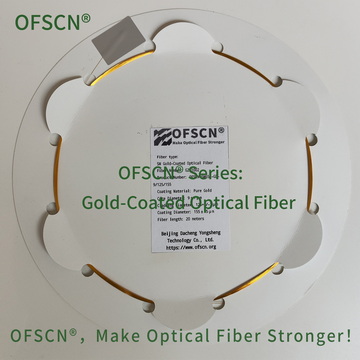
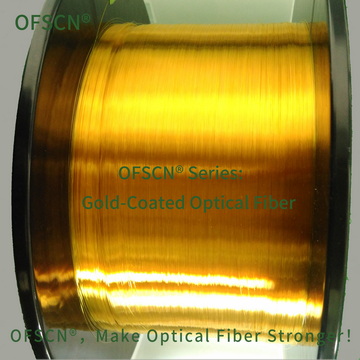
Specialty ultra-high-temperature fibers (e.g., OFSCN® Gold-coated Optical Fiber ) utilize metallic gold as a protective layer. Because gold ( \text{Au} ) is a noble metal with extremely high chemical stability and a very high standard electrode potential, it does not undergo oxidation or corrosion in a salt spray environment.




3. Actual Physical Hazards in Salt Spray Environments: Stress Corrosion and Water Molecule Permeation
Although optical fibers and their coatings do not “rust,” it is still important to be aware of the following physical effects in high-humidity, high-salt marine environments:
- Water Molecule Permeation and Static Fatigue of Glass:
While polymer coatings are corrosion-resistant, they are not 100% impermeable to microscopic water molecules. When water molecules permeate to the surface of the silicon dioxide at a microscopic level, if the fiber is subjected to significant bending or tensile mechanical stress ( \sigma > 0 ) for extended periods, the water molecules can hydrolyze the \text{Si}-\text{O}-\text{Si} bonds at the glass surface’s microcracks (stress corrosion mechanism). This accelerates the propagation of microcracks and reduces the long-term mechanical lifespan of the fiber. - Structural Encapsulation Requirements:
In harsh marine and salt spray engineering applications, bare fibers typically require tight-buffered encapsulation within seamless stainless steel tubes or engineered plastic outer jackets. This serves to prevent moisture ingress and reduce stress concentration.