What are the special material requirements for fiber optics used by the sea?
In environments with high salt spray and humidity, such as seaside or oceanic coastal areas, ordinary fiber optic and cable materials are highly susceptible to physical damage and chemical corrosion. To ensure the long-term stability of fiber optic sensing and communication systems, optical cables have strict technical requirements for material selection and structural design:
1. Anti-Salt Spray and Anti-Pitting Requirements for Armoring Materials
The air in seaside areas contains a high concentration of chloride ions (\text{Cl}^-). Ordinary carbon steel and even standard 304 stainless steel are prone to electrochemical corrosion and localized pitting and crevice corrosion in salt spray environments.
- Material Selection: Corrosion-resistant armoring materials must prioritize the use of 316\text{L} stainless steel containing molybdenum (\text{Mo}). Molybdenum significantly enhances the stability of the passivation film, greatly improving resistance to chloride ion corrosion.
- Extreme Corrosion Environments: In intertidal zones or harsh composite environments with strong acids, alkalis, and high salinity, high nickel-chromium-molybdenum alloys such as 825 Alloy (Incoloy 825) should be used.
2. Hermetic Sealing and Hydrogen/Water Barrier Requirements
The ingress of water vapor and salt spray onto the fiber surface can lead to silanol reactions, accelerating stress corrosion and crack propagation in silica fibers, thus reducing their mechanical strength. Simultaneously, water vapor can induce hydrogen aging, increasing fiber attenuation.
- Fused In Mass Tubing (FIMT): Compared to traditional welded or longitudinally seamed steel tubes or crevice-wrapped armoring, the use of single or double-layer Seamless Steel Tube structures provides 100\% physical hermetic isolation, completely preventing the intrusion of water vapor, salt spray, and other harmful external gases.
3. Requirements for Outer Sheathing and Fiber Coating
- Outer Sheath Material: The outer layer of the optical cable typically requires a high-density polyethylene (HDPE), polyvinyl chloride (PVC), or polyethylene (PE) sheath that is resistant to ultraviolet (UV) radiation and salt spray aging, to prevent damage from sea wind exposure and mechanical abrasion.
- Fiber Coating: Depending on temperature resistance and environmental stress requirements, the internal optical fiber can be coated with acrylate, polyimide, or a metallic coating to ensure stable optical performance even under micro-bending and stress.
Related OFSCN® Official Product Introductions
Within the Beijing Dacheng Yongsheng Technology Co., Ltd. (OFSCN®) product portfolio, we offer highly reliable products based on seamless steel tube encapsulation for seaside, high salt spray, and special corrosive environments:
1. OFSCN® 85°C Seamless Steel Tube Fiber Cable
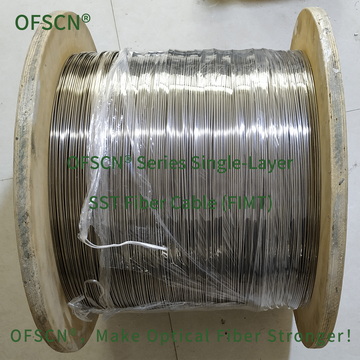
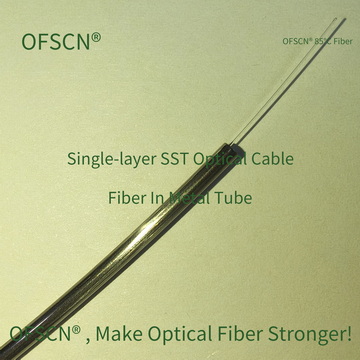
This cable utilizes a single layer of seamless steel tube encapsulation. The default material for the seamless steel tube is 316\text{L} stainless steel. It is designed for communication and distributed fiber optic sensing (DTS/OFDR/BOTDA) in low to medium temperature coastal environments, offering excellent salt spray resistance and hermetic water barrier properties.

2. OFSCN® 300°C Seamless Steel Tube Fiber Cable
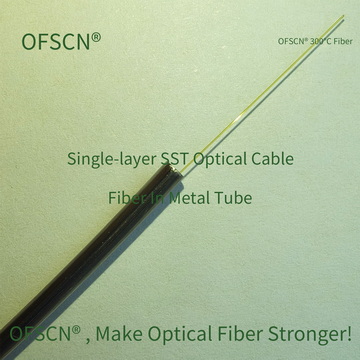
This cable is encapsulated in 316\text{L} stainless steel seamless steel tubes by default and contains high-temperature resistant polyimide optical fibers. It not only resists salt spray corrosion but can also withstand harsh temperature environments ranging from -200^\circ\text{C} to 300^\circ\text{C}.

3. OFSCN® Double-Layer High-Temperature Downhole Fiber Optic Cable
This cable employs a double-layer nested seamless steel tube encapsulation technology. The default encapsulation material is 316\text{L} stainless steel, with an option for 825 Alloy material. It is specifically designed for extremely harsh subsea, downhole, and high-pressure corrosive environments, offering exceptional mechanical pressure resistance and long-term salt spray corrosion resistance.
