Jumpers used by the sea, how does salt corrode metal connectors? How does Beijing Dacheng Yongsheng Technology Co., Ltd. protect against it?
I. Technical and Physical Definition of “Salt Spray Resistance”
“Salt Spray Resistance” refers to the ability of a material, component, or equipment to resist the chemical and electrochemical corrosion caused by salt spray (i.e., tiny droplets containing a certain concentration of salt, such as sodium chloride \text{NaCl} , suspended in the air) in an atmospheric environment. Salt spray corrosion is a typical form of environmental degradation, prevalent in coastal areas, offshore platforms, and saline-alkali environments.
II. Corrosion Mechanism of Salt on Coastal Fiber Optic Patch Cords and Metal Connectors
In coastal or marine environments, the metal components of fiber optic patch cords (such as the metal jackets of standard connectors, latches, metal armor layers, etc.) are subjected to severe atmospheric corrosion. The core physicochemical processes are as follows:
-
Formation of Liquid Film and Electrolyte Impregnation
The relative humidity in coastal areas is typically high. Salt spray particles with high salinity readily deliquesce upon adhering to metal surfaces, forming an extremely thin surface water film. This water film dissolves the salt, forming an electrolyte solution. -
Penetration and Damage by Chloride Ions ( \text{Cl}^- )
Seawater contains a high concentration of chloride ions ( \text{Cl}^- ). Due to the small ionic radius and strong penetrating power of \text{Cl}^- , it can penetrate the passive oxide films (such as chromium oxide or iron oxide protective layers) on ordinary metal surfaces, disrupting the passive state and initiating localized electrochemical pitting corrosion and crevice corrosion. -
Electrochemical Micro-battery Reaction
Surface irregularities on the metal (such as coating defects, impurities, potential differences between different metal interfaces) form micro-batteries under the action of the electrolyte water film. The base metal with a lower electrode potential acts as the anode, undergoing oxidation and dissolution:\text{Fe} \rightarrow \text{Fe}^{2+} + 2\text{e}^-The dissolved metal ions combine with oxygen in the solution to form iron oxides (rust), leading to the peeling of the metal casing, seizure of latch threads, and a significant reduction in tensile and compressive strength. In severe cases, this can disrupt the alignment accuracy of the fiber optic connector ferrule, causing a drastic increase in optical signal attenuation or even complete disconnection.
III. OFSCN® Engineering Protection Solutions Against Salt Spray Corrosion
To address harsh marine and coastal high salt spray environments, Beijing Dacheng Yongsheng Technology Co., Ltd. (OFSCN®) has implemented the following anti-corrosion engineering solutions in its fiber optic patch cord and sensing cable product designs:
-
Selection of Corrosion-Resistant Materials ( 316\text{L} Stainless Steel)
- Ordinary metal parts (such as galvanized steel or common brass) fail easily in salt spray tests. OFSCN® offers 316\text{L} stainless steel as the primary metal jacket and encapsulation material for high-demand environments.
- 316\text{L} stainless steel contains added molybdenum ( \text{Mo} ), significantly enhancing its resistance to pitting and crevice corrosion in chloride ion ( \text{Cl}^- ) containing media compared to conventional 304 stainless steel.
-
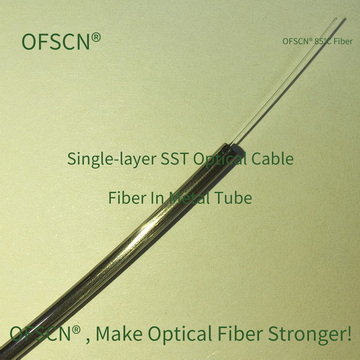
Seamless Steel Tube Isolation Encapsulation (FIMT Structure)
- Utilizes seamless stainless steel tubes for hermetic sealing, eliminating localized stress corrosion cracking caused by weld defects.
- Completely isolates external salt spray and moisture from the internal fibers, maintaining a dry and stable internal fiber environment.
-
Composite Jacketing Structure (Polymer Outer Jacket + Armor)
- A corrosion-resistant polymer outer jacket, such as PE (Polyethylene) or PVC (Polyvinyl Chloride), is applied over the armor layer to prevent direct accumulation of electrolyte water film on the metal surface.
IV. Related OFSCN® Official Products and Specifications
Below are some OFSCN® products designed for high-strength and harsh environment resistance:
-
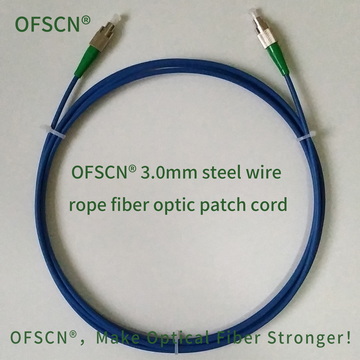
OFSCN® 3.0mm Steel Wire Rope Fiber Optic Patch Cord
Composed of FC/ST connectors, PE jacket, 0.45\text{mm} stainless steel wire rope structure, and a 0.9\text{mm} seamless stainless steel tube with optical fiber. It offers both high tensile strength ( > 1200\text{N} ) and environmental corrosion resistance.
-
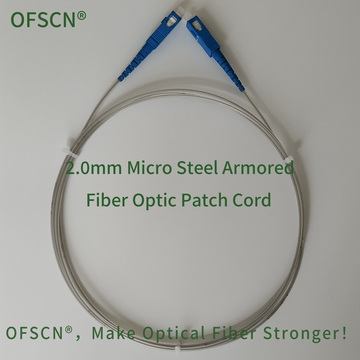
OFSCN® 2.0mm Micro Steel Armored Fiber Optic Patch Cord
Consists of fiber optic connectors, PVC jacket, 0.6\text{mm} seamless stainless steel tube, and optical fiber, balancing flexibility and compressive strength.
-
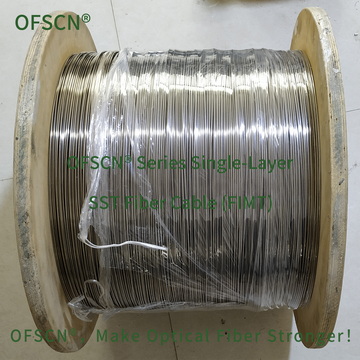
OFSCN® 85°C Seamless Steel Tube Fiber Cable
Features a single-layer seamless stainless steel tube encapsulation. The default material is 304 stainless steel, with an optional upgrade to 316\text{L} stainless steel for high salt spray marine environments, providing ultimate corrosion and mechanical protection.


For more technical information on patch cord products, please refer to: OFSCN® Fiber Optic Patch Cord Product Classification