I’ve heard rats like to gnaw on things. Can exposed fiber optic cables be bitten off in the ceiling?
Yes, bare fibers and fibers with only a general plastic sheath are easily bitten and broken by rats in concealed spaces such as ceilings.
I. Analysis of Physical and Engineering Structure
-
Mechanical Fragility of Bare Fibers and Plastic Sheaths
The main body of an optical fiber is composed of high-purity silica glass. The core diameter of a standard single-mode fiber is typically 9\ \mu\text{m}, with a cladding diameter of 125\ \mu\text{m}. The outermost layer is coated with only a polymer layer (such as acrylate) with an outer diameter of 255\ \mu\text{m}. Even common 0.9\ \text{mm} tight-buffered fibers or 2.0\ \text{mm} / 3.0\ \text{mm} PVC/PE sheathed cables have outer materials made of soft organic polymers. -
Biting and Destruction Mechanism of Rodents
The incisors of rodents (like rats) grow continuously throughout their lives, requiring them to constantly gnaw on hard objects to shorten their teeth. Their incisors have strong biting force and concentrated cutting power. Materials such as polyvinyl chloride (PVC), polyethylene (PE), or acrylate do not provide mechanical resistance to rodent teeth. Rats can shred the plastic outer jacket and bite through the fragile glass core inside in a matter of seconds. -
Engineering Solutions for Rodent Proofing
In environments prone to rodent infestation, such as building ceilings, utility trenches, outdoor areas, and industrial pipelines, relying on chemical repellents (which degrade easily) or ordinary plastic sheaths cannot provide long-lasting and reliable protection. Effective engineering protection measures involve using a hard metal armor layer (such as seamless stainless steel tubing or a steel wire stranded structure) to create a physical mechanical barrier.
II. Official Rodent-Proof Armored Products and Technical Specifications
OFSCN® offers fiber optic patch cords and cables designed for high mechanical strength requirements and rodent-prone environments, featuring micro stainless steel seamless steel tubes and steel wire stranded armor structures:
1. OFSCN® 2.0mm Micro Steel Armored Fiber Optic Patch Cord
OFSCN® 2.0mm Micro Steel Armored Fiber Optic Patch Cord
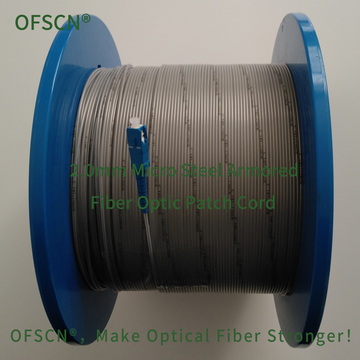
- Structural Composition: Consists of fiber optic connectors (FC, ST, LC, SC, etc.), a PVC sheath, a 0.6\ \text{mm} stainless steel seamless steel tube, and the optical fiber.
- Physical Properties: Tensile strength > 150\ \text{N}, Compressive strength > 240\ \text{MPa}.
- Rodent-Proof Features: The internal seamless stainless steel tube completely isolates the internal optical fiber from physical damage by rodent teeth.
2. OFSCN® 3.0mm Steel Wire Rope Fiber Optic Patch Cord
OFSCN® 3.0mm Steel Wire Rope Fiber Optic Patch Cord
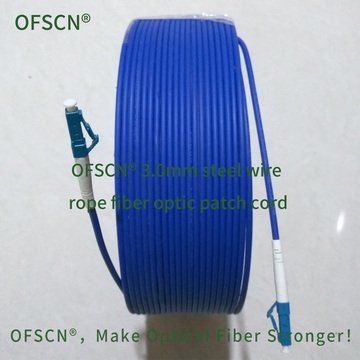
- Structural Composition: Consists of fiber optic connectors, a PE sheath, a 0.45\ \text{mm} stainless steel wire stranded structure, a 0.9\ \text{mm} stainless steel seamless steel tube, and the optical fiber.
- Physical Properties: Tensile strength > 1200\ \text{N}, Compressive strength > 200\ \text{MPa}.
- Rodent-Proof Features: Utilizes a “dual-layer metal armor” (stainless steel wire stranding + seamless stainless steel tube) for enhanced tensile pull-out and bite-and-crush resistance.
3. OFSCN® 85°C Seamless Steel Tube Fiber Cable
OFSCN® 85°C Seamless Steel Tube Fiber Cable
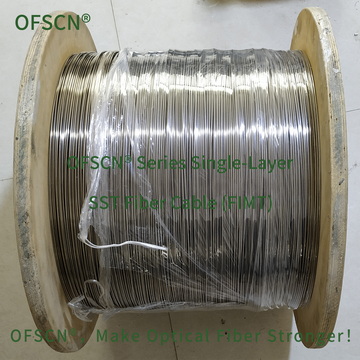
- Structural Composition: Encased in a single layer of 304 or 316L stainless steel seamless steel tubing. The default outer diameter of the steel tube is 2.0\ \text{mm} (wall thickness 0.2\ \text{mm}) or 3.0\ \text{mm} (wall thickness 0.3\ \text{mm}).
- Rodent-Proof Features: The all-metal rigid outer casing structure is impenetrable to rodent teeth, making it suitable for communication cabling and distributed optical fiber sensing (DAS/DTS/BOTDA) systems.