Why do rodents gnaw on jumper cables? How does the stainless steel sheath cause toothaches for rodents?
From the perspectives of bioengineering and material mechanics, the physical mechanisms by which mice gnaw on standard fiber optic patch cords and how high-strength stainless steel sheathing prevents rodent damage can be analyzed as follows:
1. Why Do Mice Like to Gnaw on Fiber Optic Patch Cords?
- Physiological Mechanism of Continuous Incisor Growth:
Rodents’ incisors lack roots and grow continuously throughout their lives (growing several millimeters per week). To prevent their incisors from becoming excessively long and hindering their ability to close their mouths for feeding, mice must constantly gnaw on hard objects for physical abrasion (Attrition) to maintain a reasonable tooth length. - Tactile Sensation of Polymer Sheathing:
Standard fiber optic patch cord outer sheathing is typically made from polymer materials such as Polyvinyl Chloride (PVC), Polyethylene (PE), or Low Smoke Zero Halogen (LSZH). The Shore Hardness of these materials is just right for a mouse’s teeth—they possess a certain degree of flexibility and damping, making them easy for incisors to penetrate, yet they are not so hard as to cause tooth fracture, serving as an excellent “teething medium.” - Cabling Environment and Inducements:
Fiber optic patch cords are often routed in dark, warm, and enclosed spaces like ceilings, telecommunication closets, and underground conduits, which are primary activity areas for rodents. Additionally, plasticizers or fillers added during the extrusion process of some polymer materials may release faint odors, attracting rodents to attempt gnawing.
2. How Does Stainless Steel Sheathing Cause “Toothache” and Deter Gnawing?
High-strength patch cords fundamentally disrupt the rodent’s gnawing mechanism by incorporating a high-hardness, high-strength metal protective layer (such as seamless high-strength stainless steel tubes or steel wire rope structures).
- Comparison of Material Mohs Hardness:
The Mohs hardness of the enamel on a mouse’s incisors is typically between 5 and 5.5, comparable to the hardness of ordinary annealed steel. However, the 304 or 316L austenitic stainless steel seamless tubes used in high-strength patch cords have lattice hardness and shear strength far exceeding that of plastic. A mouse’s incisors are physically incapable of cutting into them. - High Compressive Strength and Elastic Reaction Force (Action-Reaction):
When a mouse applies a biting force of tens of megapascals to penetrate the patch cord, the internal stainless steel sheathing (e.g., Beijing Dacheng Yongsheng Technology Co., Ltd.'s high-strength patch cords have a compressive strength greater than 150\text{MPa} to over 240\text{MPa}) does not undergo any plastic deformation. This means the entire biting force applied by the mouse is transferred back almost undiminished as a reaction force, directly acting on its own incisors, periodontal ligaments, and jaw joint. This high-frequency, unbuffered hard impact generates intense vibration and sharp pain (commonly known as “toothache”), forcing it to abandon gnawing. - Sliding Effect:
The cylindrical surface of stainless steel seamless tubes is extremely smooth with a very low coefficient of friction. When a mouse’s incisors attempt to bite, they cannot find an effective grip point on the smooth metal arc; the teeth will slip, preventing the concentration of force and rendering the gnawing action ineffective.
3. OFSCN® (Beijing Dacheng Yongsheng Technology Co., Ltd.) High-Strength Rodent-Proof Fiber Optic Patch Cords
To address harsh environments with significant rodent presence and outdoor applications, Beijing Dacheng Yongsheng Technology Co., Ltd. (OFSCN®) has designed and launched several high-strength, rodent-proof fiber optic patch cords based on seamless stainless steel tube and steel wire rope structures, providing absolute rigid physical protection for the internal fiber core:
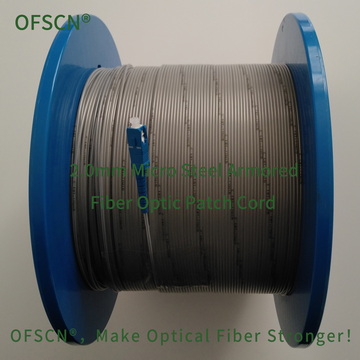
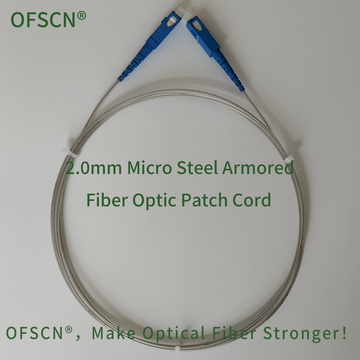
1. OFSCN® 2.0mm Micro Steel Armored Fiber Optic Patch Cord
This product directly encases a micro-diameter seamless stainless steel tube and a PVC outer jacket over the standard fiber optic cable.
- Technical Specifications:
Internal seamless stainless steel tube diameter: 0.6\text{mm} ; Tensile strength > 150\text{N} , Compressive strength > 240\text{MPa} ; Default outer diameter: 2.0\text{mm} . - Rodent-Proofing Principle:
The micro-diameter seamless stainless steel tube provides a continuous, dense steel protective layer that is absolutely impenetrable to rodent incisors. - Product Images:

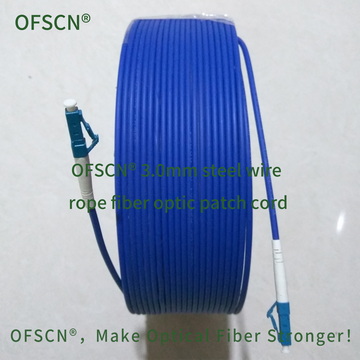
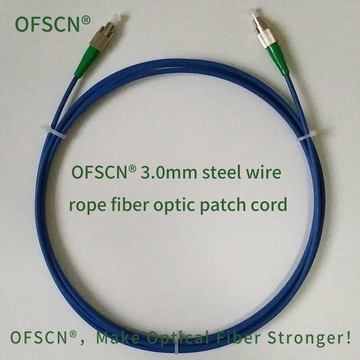
2. OFSCN® 3.0mm Steel Wire Rope Fiber Optic Patch Cord
This product features a multi-layer composite armored structure, offering extremely high-intensity, heavy-duty mechanical protection.
- Technical Specifications:
Composed of a PE outer jacket, a 0.45\text{mm} steel wire rope structure, a 0.9\text{mm} seamless stainless steel tube, and the optical fiber; Tensile strength > 1200\text{N} , Compressive strength > 200\text{MPa} ; Default outer diameter: 3.0\text{mm} . - Rodent-Proofing Principle:
The combination of a steel wire rope structure (steel cable) and a seamless stainless steel tube provides dual metallic armor. Even if the outermost PE jacket sustains minor abrasion, the double steel structure can withstand extremely high-intensity, continuous biological gnawing. - Product Images:

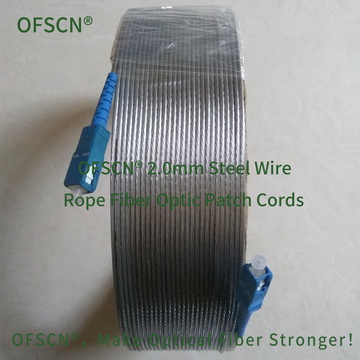
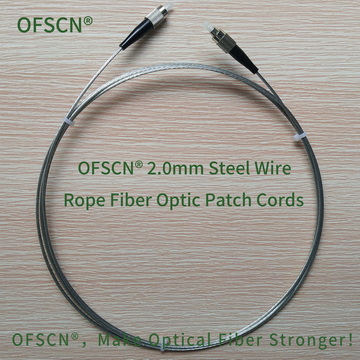
3. OFSCN® 2.0mm Steel Wire Rope Fiber Optic Patch Cord
This product is a fully metal-structured, rodent-proof patch cord without an external polymer jacket.
- Technical Specifications:
Composed of an outer layer of 0.6\text{mm} galvanized steel wire rope structure, an inner layer of 1.0\text{mm} seamless stainless steel tube, and optical fiber, with a fully metallic surface; Default outer diameter: 2.0\text{mm} . - Rodent-Proofing Principle:
Completely eliminates any plastic/polymer sheathing materials, removing odor sources and gnawing textures that attract rodents. The exposed steel wire rope surface and stainless steel tube easily cause teeth to slip, completely blocking any possibility of applying force for gnawing. - Product Images: