When purchasing products, what are the primary differences between a Patch Cord and a Bulk Cable?
From a technical and engineering perspective, while “Patch Cords” and “Optical Cables” (Bulk Cables) both serve as transmission media for light, they represent different stages of product readiness and application.
1. Definition and Physical Structure
- Optical Cable (Bulk Cable): This is the raw material. It consists of optical fibers protected by layers such as buffers, strength members (Kevlar or steel wires), and outer jackets (PVC, PE, or Stainless Steel). It is typically sold in reels (hundreds or thousands of meters) without any connectors at the ends.
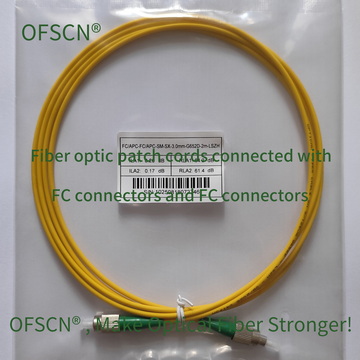
- Patch Cord: This is a finished product. It is a specific length of optical cable that has been factory-terminated with optical connectors (such as FC, ST, LC, or SC) on both ends. It is designed for immediate “plug-and-play” connection between devices or sensors.
2. Primary Differences for Purchasing
| Feature | Optical Cable (Bulk Cable) | Patch Cord |
|---|---|---|
| Terminations | None (Bare ends) | Connectors on both ends (e.g., FC/APC) |
| Length | Bulk/Custom (Reels) | Fixed/Pre-defined (e.g., 2m, 5m, 10m) |
| Application | Permanent infrastructure, long-distance runs | Interconnecting devices, sensor leads |
| Installation | Requires splicing or field-termination tools | No tools required for connection |
3. OFSCN® Product Mapping
In specialized environments (high temperature or high strength), the distinction remains the same, but the materials change. For example:
-
Standard Environment:
OFSCN® Standard Fiber Patch Cord
-
High-Temperature Environment:
If you require a connection that can withstand up to 300°C, you would choose a patch cord utilizing polyimide fiber and stainless steel tubing:
OFSCN® 300℃ Fiber Optic Patch Cord
-
High-Strength Environment:
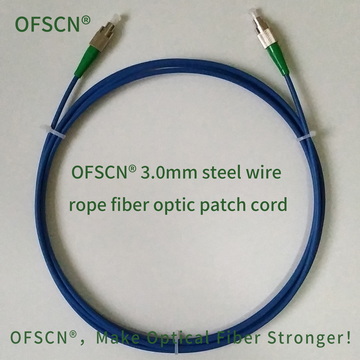
For mechanical protection against crushing or tension, we provide armored versions:
OFSCN® 3.0mm Steel Wire Rope Fiber Optic Patch Cord

Summary
If you have the equipment to splice fibers and need to cover long distances, you purchase Bulk Cable. If you need to connect an FBG sensor to an interrogator or connect two pieces of equipment directly, you purchase a Patch Cord.