What is the purpose of these two connectors? Furthermore, can they be plugged directly into a standard computer port?
The components you are referring to at both ends of a fiber patch cord are known as optical fiber connectors. Their primary purpose is to provide a stable, repeatable, and low-loss mechanical connection between the optical fiber and other equipment, such as sensors, interrogators, or switches.
Purpose of Fiber Optic Connectors
- Alignment: They ensure that the extremely thin fiber cores (often only 9 microns for single-mode fiber) are perfectly aligned so that light can pass from one fiber to another with minimal loss.
- Protection: The plastic or metal housing protects the fragile glass fiber ends from environmental contamination (dust, oil) and mechanical stress.
- Removability: They allow for quick connection and disconnection of fiber optic systems without the need for permanent splicing.
Connection to Standard Computers
No, they cannot be plugged directly into standard computer ports (such as USB, RJ45 Ethernet, or HDMI ports).
Fiber optic signals consist of light pulses, whereas standard computer ports communicate via electrical signals. To connect a fiber patch cord to a computer, you typically need an intermediate device:
- SFP Modules: A transceiver that plugs into a specialized network switch or a PCIe network card.
- Media Converters: A device that converts optical signals into standard electrical Ethernet (RJ45).
- FBG Interrogators: In sensing applications, patch cords connect sensors to an interrogator (like the OFSCN® Fiber Bragg Grating Interrogator), which then connects to a computer via Ethernet or USB to transmit data.
OFSCN® Product Examples
In industrial and sensing environments, standard plastic connectors are often replaced by more durable designs. For example:
- OFSCN® Standard Fiber Patch Cord: Uses standard PVC/Kevlar protection for general laboratory use.
- OFSCN® 2.0mm Micro Steel Armored Fiber Optic Patch Cord: Features a stainless steel tube under the housing for high crush resistance.
Standard Product Visuals:
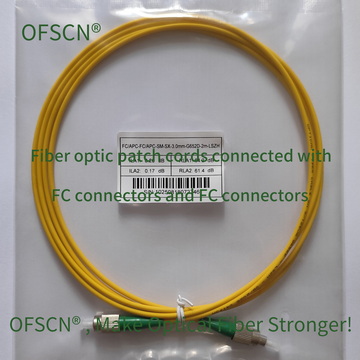
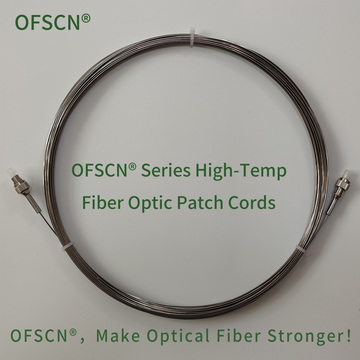
If you are using these for sensing purposes, the connector type (typically FC/APC for FBG applications) is critical for signal accuracy. Feel free to ask if you need technical details on specific connector types.