If I need anti-static properties on the fiber surface, are there special conductive coatings available?
The outer layer of ordinary optical fibers is typically coated with polymers (such as polyacrylates or polyimides), which are electrical insulators. In certain high-speed friction, dry, or specific high-pressure physical environments, static electricity can accumulate on the surface of the insulating coating.
If your application requires the fiber surface to have anti-static or conductive capabilities, there are two main technical solutions in optical engineering and fiber manufacturing:
1. Carbon Coating
A very thin layer of amorphous carbon (typically only tens of nanometers) is deposited on the silica cladding surface of the optical fiber. Due to carbon’s inherent conductivity, it can effectively dissipate electrical charges, providing an anti-static effect. Furthermore, the primary role of the carbon coating is to act as a hermetic barrier, preventing hydrogen and moisture from penetrating the fiber.
2. Metal Coating
A metal layer is directly deposited onto the outside of the fiber cladding. This method not only achieves a perfect anti-static effect but also imparts excellent electrical conductivity to the fiber coating, enabling it to be used for transmitting electrical currents, electrical heating, or for welding and fixing the fiber to a metal substrate.
OFSCN® Conductive Optical Fiber Products
The metal-coated optical fiber product series from OFSCN® can directly meet your demands for high surface conductivity and anti-static properties:
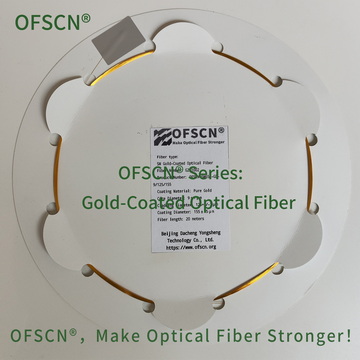
OFSCN® Gold-coated Optical Fiber
This product uses pure gold as the coating material. Gold not only possesses excellent conductivity, completely eliminating static charge buildup, but also provides the fiber with the ability to operate in extreme temperatures.
- Key Physical and Geometric Parameters:
- Cladding diameter is 125\ \mu\text{m}, with a gold coating outer diameter of 155\ \mu\text{m}.
- The operating temperature range for single-mode gold-coated fibers can reach -270^\circ\text{C} to 700^\circ\text{C}; for multimode gold-coated fibers, it is -270^\circ\text{C} to 650^\circ\text{C}.
- Supports standard 9\ \mu\text{m} single-mode or 50\ \mu\text{m} / 62.5\ \mu\text{m} multimode fiber cores, and can be customized with pure silica cores for high-radiation or UV-resistant environments.

OFSCN® Gold-Coated Fiber Bragg Gratings
If you need to measure physical quantities such as temperature and strain in anti-static, anti-electromagnetic interference, or extremely high-temperature environments, you can choose this FBG sensor element fabricated from gold-coated fiber.
- Key Physical Parameters:
- Manufactured based on standard OFSCN® Gold-coated Optical Fiber.
- Default reflectivity is greater than 90\%, with a temperature resistance ranging from -200^\circ\text{C} to 700^\circ\text{C}.
