Is the gold or aluminum plating on optical fibers for aesthetics or sensing?
Metal coating on optical fibers (such as gold, copper, or aluminum plating) is by no means for aesthetic purposes, but entirely driven by stringent physical, engineering, and sensor performance requirements.
The outermost layer of standard optical fibers is typically coated with polymeric materials (like acrylate or polyimide). However, in extreme sensing scenarios such as industrial, aerospace, and downhole applications, these materials face physical limitations. Replacing the polymer coating with a high-purity metal coating primarily addresses several key physical and engineering challenges:
1. Extreme Temperature Resistance (Wide Temperature Range Tolerance)
Standard acrylate coatings typically have a maximum operating temperature of around 85\ ^\circ\text{C}, beyond which they carbonize and decompose. Even high-temperature resistant polyimide coatings have a limit of approximately 300\ ^\circ\text{C} for long-term exposure.
Metal coatings, conversely, possess very high or low melting points and excellent physical stability. Gold-coated optical fibers, for instance, can operate stably over an extremely wide temperature range, from cryogenic lows to high temperatures ( -270\ ^\circ\text{C} to 700\ ^\circ\text{C} ), making them indispensable materials for aerospace, metallurgy, and nuclear industries operating in extreme temperature environments.
2. Perfect Hermetic Sealing & Hydrogen Resistance
In high-pressure, corrosive media environments found in oil and gas wells, geothermal development, or deep-sea applications, water and hydrogen molecules are extremely small and can easily penetrate polymer coatings to diffuse into the quartz glass fiber (silica). This can lead to the expansion of micro-cracks on the fiber surface (reducing tensile strength) or cause severe “hydrogen-induced darkening,” resulting in optical signal attenuation and disruption of sensing or communication.
Metal coatings (especially gold and aluminum) provide true hermetic sealing, completely blocking the ingress of water, oxygen, and hydrogen molecules, thereby ensuring the long-term mechanical strength and optical performance of the fiber in high-temperature, high-pressure, and hydrogen-rich environments.
3. High Strain-Transfer Efficiency
For high-precision stress or strain measurements using Fiber Bragg Gratings (FBG) or distributed fiber optic sensors (e.g., based on OFDR, BOTDR/COTDR technologies), the fiber coating lies between the external structure and the fiber core.
Traditional polymer coatings have a low elastic modulus and are prone to “creep” or “shear slippage” under stress or at high temperatures, leading to hysteresis and errors in the measured strain. Metal coatings (like copper, gold, or aluminum) are rigid, have a high elastic modulus, and do not exhibit creep relaxation at elevated temperatures. They can transfer mechanical deformation from the external structure to the fiber core with 100% efficiency, ensuring exceptionally accurate sensor response.
4. Solderability & All-Metal Packaging (Adhesive-Free)
When packaging bare optical fibers into sensor housings made of stainless steel, alloys, or other metals, the use of organic adhesives like epoxy resins can lead to degradation and failure under high temperatures or humidity. Metal-coated fibers, however, can be directly joined to metal tubes via brazing, explosive welding, or laser welding, enabling true adhesive-free, fully rigid all-metal structure sensor packaging.
Within the core product portfolio of Beijing Dacheng Yongsheng Technology Co., Ltd. (OFSCN®), several industry-leading metal-coated optical fibers and core sensing components have been developed based on these physical properties.
Official OFSCN® Core Related Products:
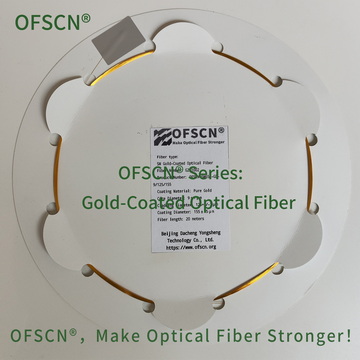
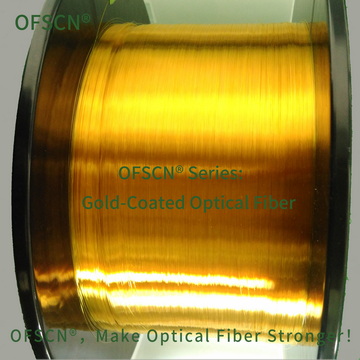
1. OFSCN® Gold-coated Optical Fiber
This product is a highly reliable, high-temperature resistant single-mode/multi-mode gold-coated optical fiber. The single-mode gold-coated fiber is produced based on standard G.652D optical fiber preform, offering a wide operating temperature range from -270\ ^\circ\text{C} to 700\ ^\circ\text{C} . The multi-mode gold-coated fiber operates within a temperature range of -270\ ^\circ\text{C} to 650\ ^\circ\text{C} . The fiber core diameter is 9\ \mu\text{m} (single-mode), with a cladding diameter of 125\ \mu\text{m} , and the gold coating brings the outer diameter to 155\ \mu\text{m} .

2. OFSCN Gold-Coated Fiber Bragg Gratings / FBG Strings (Bare)
These are high-temperature resistant Fiber Bragg Gratings or grating strings (Bare FBG) fabricated directly onto the aforementioned gold-coated optical fibers. They can withstand operating temperatures up to -200\ ^\circ\text{C} to 700\ ^\circ\text{C} , perfectly combining the excellent physical sensing accuracy of gratings with the extreme temperature resistance of gold-coated fibers, making them suitable for applications in metallurgy, petrochemicals, and other extreme environments.

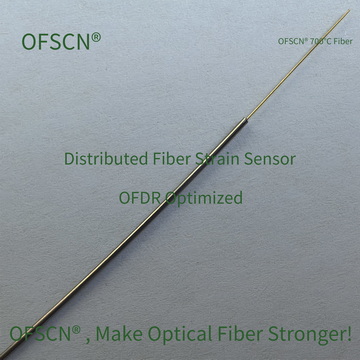
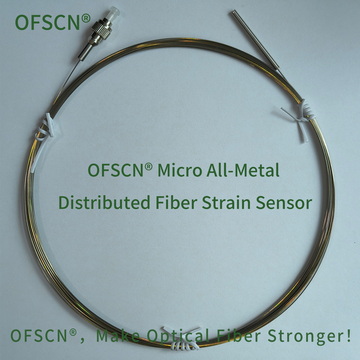
3. OFSCN® 700°C OFDR Micro All-Metal Strain Sensor
This is a micro all-metal strain sensor based on OFDR (Optical Frequency Domain Reflectometry) technology. It is packaged within a single-layer elastic alloy tube (outer diameter of only 0.6\ \text{mm} ) and its core medium is the OFSCN® Gold-coated Optical Fiber . This sensor can withstand temperatures up to 700\ ^\circ\text{C} and is primarily used for high-spatial-resolution distributed fiber strain and stress measurements in ultra-high temperature environments.
In summary, gold, aluminum, or copper plating on optical fibers represents the most effective physical and material approach to achieving “high-temperature resistance, long lifespan, non-aging, and high precision” sensing and transmission in extremely harsh operating conditions.