For example, one end is round (FC) and the other is square (SC). Does this kind of jumper cable exist?
Physical Concepts and Engineering Principles
Yes, this type of fiber optic patch cord with different connectors on each end not only exists but is also very common in optical communication and fiber optic sensing engineering.
In optoelectronic engineering, these patch cords are often referred to as Conversion Patch Cords or Hybrid Patch Cords.
1. Physical Structure and Transmission Principles
The core of a fiber optic patch cord is the internal silica glass fiber (for example, the core diameter of standard single-mode fiber is typically only 9\ \mu\text{m} , with a Mode Field Diameter \text{MFD} \approx 9.2\ \mu\text{m} ), which guides the optical signal. The connectors at both ends of the patch cord essentially provide high-precision mechanical positioning and physical alignment to couple the light from the fiber into optoelectronic devices (such as light sources, fiber optic demodulators, optical power meters) or other fibers without loss.
The external shape of the connector (such as FC threaded round head, SC plug-in square head, LC small square head, ST bayonet round head) and the end-face polishing type (such as \text{PC} Physical Contact with a micro-convex spherical surface, \text{APC} 8^\circ Angled Physical Contact surface) do not affect the light-guiding characteristics within the fiber. Therefore, installing connectors of different shapes and specifications on both ends of the same fiber is entirely feasible in terms of physical and optical principles and is part of standardized production.
2. Common Application Scenarios
- Interface Conversion:
Many high-precision optical testing instruments and fiber Bragg Grating (FBG) demodulators have flange interfaces of the FC type (especially \text{FC/APC} interfaces, which have extremely low return loss to minimize reflection noise). Commonly used network devices, switches, or fiber distribution boxes often use SC or LC interfaces. In such cases, a conversion patch cord with a round head (FC) on one end and a square head (SC/LC) on the other can perfectly solve the problem of incompatible interfaces. - System Cascading:
When physically connecting sensors, instruments, or terminal boxes from different manufacturers, hybrid patch cords are often used to achieve a smooth transition between different physical interfaces.
Related OFSCN® Products
As a professional manufacturer of fiber optic sensors, OFSCN® offers various fiber optic patch cords and fiber optic sensors that support customization of connector types on both ends and asymmetrical (hybrid) configurations:
1. OFSCN® Standard Fiber Patch Cord
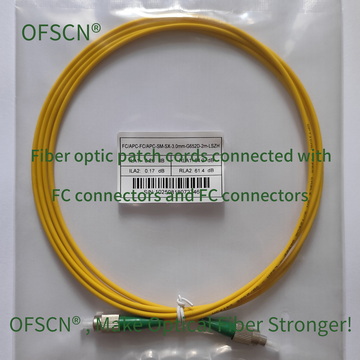
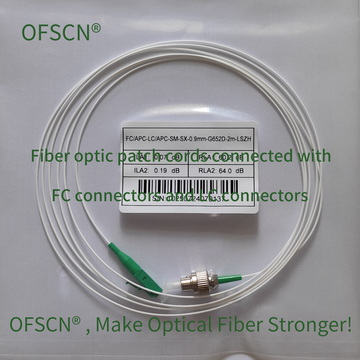
This is a standard indoor fiber optic patch cord. Its fiber connectors can be configured with different types (such as FC, SC, LC, ST, etc.) on the first and second ends according to actual engineering needs, and the end-face can be selected as \text{PC} or \text{APC} .
- Product Standard Images:
- FC-FC (Dual Round Head) Example:
- FC-LC (One Round Head, One Small Square Head) Hybrid Conversion Patch Cord Example:
- FC-FC (Dual Round Head) Example:
2. OFSCN® 2.0mm Steel Wire Rope Fiber Optic Patch Cord
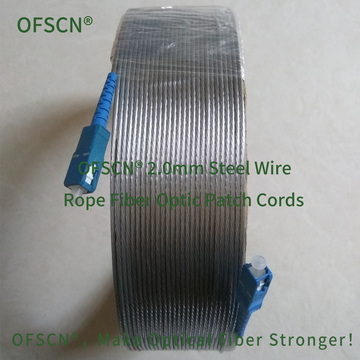
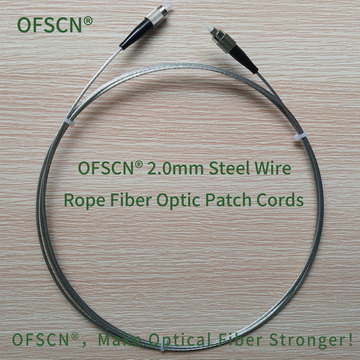
For industrial harsh environments requiring high tensile and compressive protection, OFSCN® provides all-metal armored steel wire rope fiber optic patch cords. These patch cords also support customization of different connectors (such as FC, ST, SC) and can be configured in hybrid combinations according to interface requirements.
- Product Standard Images:
- SC-SC (Dual Square Head) Example:
- FC-FC (Dual Round Head) Example:
- Armored Fiber Optic Patch Cord Structure:
- SC-SC (Dual Square Head) Example:

Whether in standard laboratory environments or special environments such as high and low temperatures, the connector types on both ends of fiber optic patch cords can be custom-made asymmetrically according to the actual physical interfaces.