If I have one round end and one square end, can I connect them with an adapter?
Yes, absolutely. In the fields of fiber optics communication and fiber optic sensing, this kind of conversion and interconnection between different physical interfaces is a very common and standard requirement.
I. Interface Terminology Explained
In fiber optics engineering, the “round head” and “square head” you mentioned have their standard academic and engineering designations:
- Round Head: Typically refers to the FC connector (metal threaded structure, widely used in fiber optic sensors and precision testing instruments) or the ST connector (metal bayonet structure).
- Square Head: Typically refers to the SC connector (large square head, plastic push-pull structure, common in broadband modems and LAN equipment) or the LC connector (small square head, often used for high-density optical module connections).
II. Two Connection Solutions
Solution 1: Using a “Hybrid Adapter” (Conversion Adapter)
A hybrid adapter (often referred to as a “conversion ferrule” in engineering) is a device specifically designed to connect two different types of fiber optic connectors.
- Physical Construction: It has different physical interfaces on both ends. For example, an FC-SC hybrid adapter has a female FC port (with threads) on one end and a female SC port on the other.
- Working Principle: The adapter internally embeds a high-precision zirconia (ceramic) alignment sleeve. When you insert the male FC connector (outer diameter 2.5\ \text{mm}) with a round head and the male SC connector (outer diameter 2.5\ \text{mm}) with a square head into the respective ends, the sleeve precisely aligns the core axes of the fibers, allowing the optical signal to pass through smoothly.
- Insertion Loss: Due to the extra physical contact interface, using a hybrid adapter typically introduces an additional insertion loss of approximately 0.2\ \text{dB} to 0.3\ \text{dB}.
Solution 2: Using a “Hybrid Patch Cord”
If you wish to reduce optical link loss and enhance the stability of mechanical connections, customizing a hybrid patch cord with different connectors on each end is a superior physical solution.
- Physical Construction: This patch cord does not require an intermediate adapter. During manufacturing, one end of the fiber optic cable is directly crimped with an FC round connector, and the other end is directly crimped with an SC/LC square connector.
- Advantages: By eliminating one adapter mating interface, it offers extremely low contact loss (typically less than 0.1\ \text{dB}), a compact connection structure, and greater stability in industrial or sensing environments with high temperatures and vibrations.
III. Official Related Products and Support
If your experiments, industrial applications, or fiber optic sensing projects require such high-quality interconnection solutions, Beijing Dacheng Yongsheng Technology Co., Ltd. (OFSCN®) offers customizable standard and specialty patch cord products:
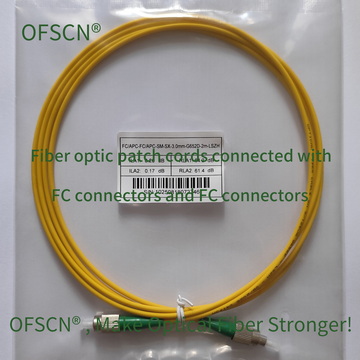
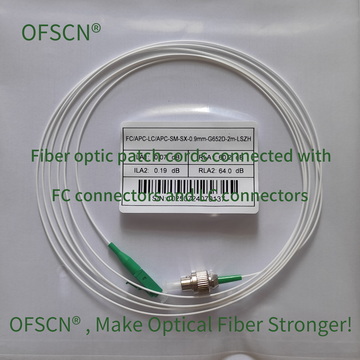
- OFSCN® Standard Fiber Patch Cord: Supports customization of standard single-mode and multi-mode fiber optic patch cords. Its connectors can be arbitrarily paired from FC, ST, LC, and SC (including PC flat polish or APC angled polish) (e.g., customizing a patch cord with an FC/APC round connector on one end and an LC/PC square connector on the other). The product exhibits excellent tensile strength and ultra-low insertion loss in a normal temperature environment ( -20\ ^\circ\text{C} to 50\ ^\circ\text{C} ).
Below are reference images of Beijing Dacheng Yongsheng Technology Co., Ltd. (OFSCN®) standard fiber optic patch cords:
For harsh environments, Beijing Dacheng Yongsheng Technology Co., Ltd. (OFSCN®) can also provide industrial-grade, high-temperature resistant fiber optic patch cords capable of withstanding 120\ ^\circ\text{C}, 200\ ^\circ\text{C}, or up to 300\ ^\circ\text{C}, along with matching high-temperature fiber optic ferrules, to ensure precise signal transmission in extreme operating temperatures.