The house is cracked. How can fiber optics measure the crack width in millimeters?
In Structural Health Monitoring (SHM) and building safety monitoring engineering, the measurement of crack opening displacement (in millimeters or micrometers) using optical fibers (specifically Fiber Bragg Grating, or FBG sensors) is not achieved by simply adhering the fiber to the surface like a ruler. Instead, it relies on a physical process described as ‘Force-Displacement Transmission – Photoelastic Effect – Wavelength Drift Demodulation’.
The underlying measurement principles and engineering implementation mechanisms are as follows:
I. Measurement Principle: Calculating Displacement from Crack Opening
1. Cross-Crack Bridging and Force-Displacement Conversion
When measuring cracks, the sensor is installed using a “two-end anchoring, middle-spanning” approach:
- The two ends of the sensor are firmly fixed onto stable substrates on either side of the crack using dedicated mounting brackets or structural adhesive. The gauge section spans the crack, with an initial gauge length of L between the two fixed points.
- When the wall experiences forces, settlement, or temperature differentials causing displacement \Delta L (i.e., the crack opens by several millimeters), the distance between the two fixed points changes. This induces axial tension or compression in the protected optical fiber within, resulting in macroscopic physical strain \varepsilon:\varepsilon = \frac{\Delta L}{L}Therefore, the displacement \Delta L = L \times \varepsilon .
2. Physical Optical Response of Fiber Bragg Grating (FBG)
The core region of the optical fiber is imprinted with a Fiber Bragg Grating (FBG). The grating satisfies the Bragg reflection condition:
\lambda_B = 2 n_{\text{eff}} \Lambda
Where:
- \lambda_B is the reflected Bragg center wavelength;
- n_{\text{eff}} is the effective refractive index of the fiber core;
- \Lambda is the grating period.
When the cross-crack displacement pulls the fiber, inducing axial strain \varepsilon, the grating period \Lambda elongates. Simultaneously, due to the photoelastic effect, the effective refractive index n_{\text{eff}} changes. The wavelength shift \Delta\lambda_B caused by strain follows this linear relationship:
\Delta\lambda_B = \lambda_B (1 - P_e) \varepsilon
Here, P_e is the effective photoelastic coefficient of the fiber (typically around 0.22 for silica fibers).
3. Spectral Demodulation and Displacement Output
Light from a broadband light source enters the sensor via a transmission fiber. Only the wavelength \lambda_B that satisfies the reflection condition is reflected back to the Fiber Bragg Grating demodulator.
- The demodulator captures the wavelength shift \Delta\lambda_B in real-time with a wavelength resolution as high as picometers (1\ \text{pm} = 10^{-3}\ \text{nm} = 10^{-12}\ \text{m}).
- The sensing system directly calculates the crack displacement using a first-order displacement calibration coefficient K (typically in units of \mu\text{m/pm} or \text{mm/pm}), determined during factory calibration:\Delta L = K \cdot \Delta\lambda_BThis allows for precise measurement of whether the crack has opened by a few micrometers or several millimeters.
II. Temperature Compensation Mechanism
Environmental temperature variations also cause thermal expansion of the optical fiber and induce the thermo-optic effect, leading to a temperature-induced wavelength shift \Delta\lambda_{B, T}. In long-term monitoring of building structures, to eliminate the interference of environmental temperature differences (e.g., diurnal or seasonal variations) on displacement measurements, a fiber Bragg grating temperature sensor without mechanical strain is typically deployed alongside the displacement sensor. Differential temperature compensation is then applied to ensure that the measured displacement is purely due to mechanical crack changes in the building structure.
III. Official Related Products
In practical engineering monitoring, the official product used for measuring cracks and micro-displacements is:
OFSCN® Fiber Bragg Grating Displacement Sensor

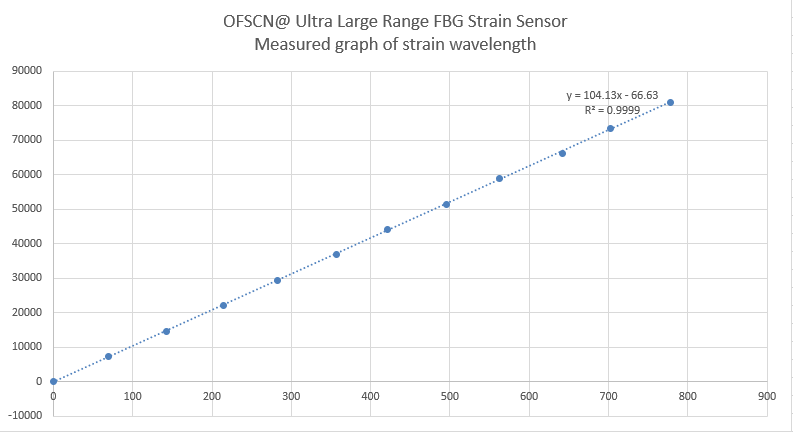
Technical Characteristics and Parameter Specifications:
- Physical Correspondence Mechanism: This displacement sensor is an application for extracting strain parameters, with the relationship being \text{Displacement} = \text{Total Length} \times \text{Strain}. It is calibrated for displacement versus wavelength directly at the factory.
- Calibration Formula: The displacement-wavelength calibration formula is first-order, with units of \mu\text{m/pm} or \text{mm/pm}.
- Range and Structure: For monitoring millimeter-level displacements like cracks, it is often produced using single-point Fiber Bragg Gratings encapsulated in ultra-wide range structures. The structure is robust, offering excellent long-term zero-point stability and resistance to harsh environments.