For example, one end circular (FC) and the other square (SC)—do these “hybrid” patch cords exist?
Yes, “hybrid” patch cords with different connectors on each end (such as FC to SC) definitely exist and are a standard customization option.
Technically, there is no physical requirement for both ends of a fiber optic patch cord to be the same. The fiber inside is a continuous light-carrying medium; the connectors at the ends are simply mechanical interfaces used to align and connect that fiber to different types of equipment or adapters.
At OFSCN (DCYS), we provide various types of patch cords that support hybrid configurations to meet different engineering requirements.
Technical Capabilities
- Interface Types: You can combine different standard interfaces such as FC (Circular), SC (Square), LC (Small Square), or ST (Bayonet).
- Polishing Types: You can also specify the polish for each end, such as PC/UPC (Blue/Grey) or APC (Green, angled). For example, an FC/APC to SC/UPC hybrid patch cord is quite common in FBG sensing applications where the interrogator uses FC/APC but the local network uses SC.
- Fiber Types: These hybrid configurations can be applied to Single-mode (SM), Multi-mode (MM), or Polarization Maintaining (PM) fibers.
Recommended Products
Depending on your application environment, you can choose from the following OFSCN® patch cord series:
-
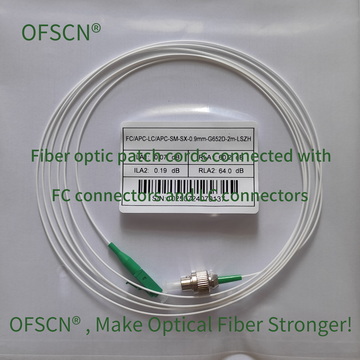
OFSCN® Standard Fiber Patch Cord: Suitable for general laboratory or indoor environments (-20℃ to 50℃).
- Standard Image: https://www.ofscn.org/images/36/20201103-360/OFSCN-Patch-Cord-FC-LC-02.jpg (Example of an FC to LC hybrid)
-
OFSCN® 2.0mm Micro Steel Armored Fiber Optic Patch Cord: Features a stainless steel tube for added mechanical protection, ideal for engineering sites.
-
OFSCN® High-Temperature Fiber Optic Patch Cords: For extreme environments (up to 300°C or even 700°C), we utilize polyimide or gold-coated fibers with customized metal connectors.
If you have a specific requirement regarding the fiber type or the operating temperature, please let me know, and I can suggest the most appropriate technical specifications.