cmh
Last Updated: 19 October 2025
Whether you're building a data center, deploying a telecom network, or integrating a high-precision fiber optic sensing system, a high-quality fiber patch cord is crucial for ensuring the pure transmission of your signal. The OFSCN® brand of standard fiber patch cords, offered by Beijing Dacheng Yongsheng Technology Co., Ltd. (DCYS), has become a trusted choice in the industry, thanks to its high-quality fiber and precision connectors.
This is a companion discussion topic for the original entry at https://www.ofscn.org/encyclopedia/455-standard-fiber-patch-cord-01.html
This is a comprehensive guide for selecting fiber patch cords. As an OFSCN® pre-sales engineer, I would like to provide technical supplements regarding the specific configurations available for the OFSCN® Standard Fiber Patch Cord to help users match these components to their specific system requirements.
Technical Specifications and Selection Criteria
When integrating these patch cords into optical communication or sensing systems, several key physical parameters must be considered:
- Connector Precision: While the standard offering includes FC, ST, LC, and SC connectors, the choice between PC (Physical Contact) and APC (Angled Physical Contact) is critical. For sensing systems—particularly those using Fiber Bragg Gratings (FBG)—APC connectors are recommended to minimize back-reflection, which can introduce noise into the signal.
- Fiber Type Matching:
- The standard model utilizes OFSCN® G.652D Optical Fiber, which is the industry standard for long-haul communication and general sensing.
- For applications involving tight bends (such as inside compact enclosures), we can provide versions using OFSCN® G.657 Optical Fiber, which offers significantly lower macro-bending loss.
- Environmental Durability: The standard PVC jacket is rated for temperatures between -20°C and 50°C. If your environment exceeds these limits, specialized high-temperature versions or armored structures (like the OFSCN® 2.0mm Micro Steel Armored Fiber Optic Patch Cord) should be evaluated to ensure mechanical protection of the fiber core.
Product Visuals
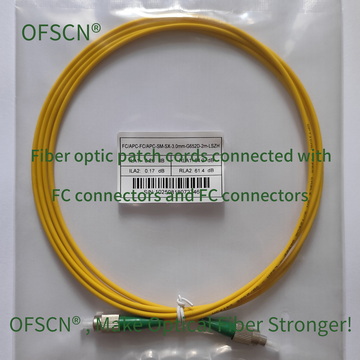
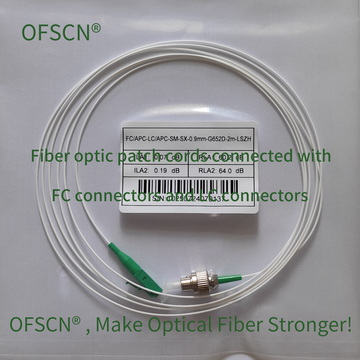
Below are the standard configurations for these patch cords:
If you are designing a system for high-stress environments or specific wavelength ranges (such as Polarization Maintaining requirements), please provide details regarding your operating temperature and required tensile strength so we can suggest the appropriate fiber cladding and jacket material.