Why does the speed of light change when the temperature changes? Is this the principle of temperature measurement?
This is a profound question that gets to the very essence of fiber optic sensing. The answer is yes: a change in temperature does indeed alter the speed at which light propagates within an optical fiber, and this is precisely the core physical principle behind many fiber optic temperature measurement technologies (especially Fiber Bragg Grating temperature sensing).
Here is a rigorous academic analysis, from physical mechanisms to engineering applications:
I. Why Does the Speed of Light Change with Temperature?
The speed of light v in a medium (such as the core of a silica optical fiber) is determined by the classical physics formula:
v = \frac{c}{n}
Where:
- c is the speed of light in a vacuum (a constant).
- n is the refractive index of the medium (for optical fibers, this typically refers to the effective refractive index of the core, n_{\text{eff}} ).
When the temperature T changes, the microscopic state of the fiber material (such as electron energy band structure, lattice vibrations, and polarizability) is altered, leading to a change in the medium’s refractive index n . This physical phenomenon is known as the Thermo-optic Effect.
We use the Thermo-optic Coefficient \frac{dn}{dT} to quantitatively describe the rate of change of the refractive index with temperature:
For fused silica (silica) fibers, the thermo-optic coefficient is positive, approximately 1.1 \times 10^{-5}\ \text{K}^{-1} . This implies that:
- When the temperature increases, the refractive index n of the optical fiber will increase.
- According to the speed formula, as the refractive index n increases, the speed of light v within it will slow down (decrease) accordingly.
- When the temperature decreases, the refractive index n decreases, and the speed of light v will speed up.
II. Is This the Principle of Temperature Measurement?
Yes, this is precisely the core working mechanism of fiber optic temperature sensing.
Take the Fiber Bragg Grating (FBG) temperature sensor, which is widely applied in industry and research, as an example. Its temperature sensing principle is entirely based on this physical effect.
The Bragg wavelength (center wavelength of reflection) of a Fiber Bragg Grating is given by the formula:
\lambda_B = 2 n_{\text{eff}} \Lambda
Where:
- n_{\text{eff}} is the effective refractive index of the fiber core.
- \Lambda is the grating period (i.e., the spatial pitch of the grating fringes).
When the ambient temperature changes by \Delta T , it affects this wavelength from two physical dimensions:
- Thermal Expansion Effect: The fiber physically deforms due to heat, causing the grating period \Lambda to lengthen. Its influence is determined by the coefficient of thermal expansion \alpha .
- Thermo-optic Effect: The refractive index n_{\text{eff}} changes accordingly (i.e., the speed of light changes, thereby altering the phase condition). Its influence is determined by the thermo-optic coefficient \xi = \frac{1}{n_{\text{eff}}} \frac{dn_{\text{eff}}}{dT} .
Ultimately, the physical relationship between the wavelength shift \Delta \lambda_B and the temperature change \Delta T is:
\Delta \lambda_B = \lambda_B ( \alpha + \xi ) \Delta T
Key Quantitative Analysis:
In standard silica single-mode optical fibers:
- The coefficient of thermal expansion \alpha is approximately 0.5 \times 10^{-6}\ \text{K}^{-1} .
- The thermo-optic coefficient \xi is approximately 6.7 \times 10^{-6}\ \text{K}^{-1} .
It can be seen that **the thermo-optic coefficient \xi is an order of magnitude larger than the coefficient of thermal expansion \alpha **. In the total wavelength shift caused by temperature, the thermo-optic effect (i.e., the change in refractive index/speed of light) contributes about 80\% to 90\% of the sensitivity. Therefore, the physical process of temperature changing the speed of light forms the primary temperature sensing mechanism for fiber optic grating temperature sensors.
III. Official OFSCN® (Dacheng Yongsheng) Products Based on This Principle
Beijing Dacheng Yongsheng Technology Co., Ltd. has leveraged the thermo-optic effect in silica optical fibers to develop multiple professional-grade Fiber Bragg Grating temperature sensors that can precisely detect wavelength shifts caused by temperature changes.
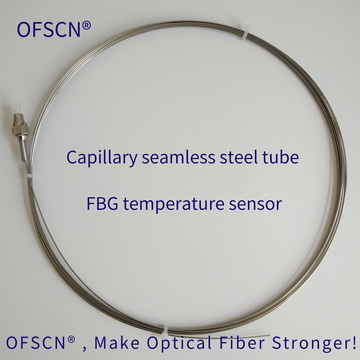
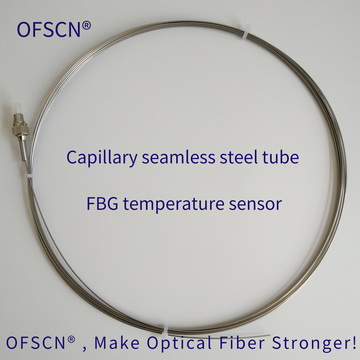
These sensors utilize precise seamless steel pipe encapsulation technology, which eliminates external stress interference on the optical fiber, leading to more accurate and stable temperature measurements:
1. OFSCN® 100°C Fiber Bragg Grating Temperature Sensor
- Applicable Temperature Range: -40\text{°C} to 100\text{°C}
- Product Images:

2. OFSCN® 300°C Fiber Bragg Grating Temperature Sensor
- Applicable Temperature Range: -200\text{°C} to 300\text{°C}
- Product Images:
3. OFSCN® 500°C Fiber Bragg Grating Temperature Sensor
- Applicable Temperature Range: -200\text{°C} to 500\text{°C}
- Product Images:
4. OFSCN® 800°C Fiber Bragg Grating Temperature Sensor
- Applicable Temperature Range: -270\text{°C} to 800\text{°C}
- Product Images:
In summary, the change in the phase velocity of light within a medium due to temperature is an extremely elegant physical law of nature, and fiber optic sensing technology is one of its most successful engineering applications.