Why does the refractive index of a material change with temperature? Is this the fundamental reason for grating thermometry?
Hello! I am happy to answer your questions about the basic physical principles of Fiber Bragg Grating (FBG) sensing technology.
What is the “Thermo-optic Effect”?
The Thermo-optic Effect refers to the phenomenon where the refractive index (n) of a substance changes with temperature (T). From a microscopic physical perspective, the refractive index of a material depends on the polarizability and density of its internal dipoles. When the temperature rises, the thermal motion of atoms intensifies, causing a drift in the material’s electronic band structure (bandgap changes), thereby altering the material’s ability to interact with light, which is manifested as a change in refractive index.
In the field of fiber optic sensing, the change is typically quantified by the Thermo-optic Coefficient:
\xi = \frac{1}{n} \frac{dn}{dT}
Why Does Refractive Index Change with Temperature?
For silica optical fibers (silicon dioxide), the fundamental reasons for the refractive index changing with temperature mainly include:
- Change in electronic polarizability: As temperature rises, the internal band structure of the material changes, leading to an enhanced polarization response to light of specific wavelengths.
- Density change (thermal expansion effect): An increase in temperature causes a slight expansion of the volume, reducing the number of particles per unit volume, which usually leads to a decrease in refractive index.
However, in silica fibers, the change in electronic polarizability is dominant, so their refractive index generally increases with rising temperature.
Is This the Fundamental Reason for Grating Thermometry?
Yes, but to be precise, the thermo-optic effect is the primary reason for Fiber Bragg Grating (FBG) thermometry, although not the only one.
The formula for the center reflection wavelength (Bragg wavelength) of an FBG is:
\lambda_B = 2 \cdot n_{eff} \cdot \Lambda
Where n_{eff} is the effective refractive index and \Lambda is the grating period.
When the temperature changes, the shift in wavelength is composed of two parts:
- Thermo-optic effect: Causes a change in the effective refractive index n_{eff} (contributing about 95% of the wavelength shift).
- Thermal expansion effect: Causes the physical length of the optical fiber to elongate, changing the grating period \Lambda (contributing about 5% of the wavelength shift).
Since the contribution of the thermo-optic effect is much greater than that of the thermal expansion effect, we can say that the temperature drift of the refractive index is the core physical basis for the high-sensitivity temperature sensing of Fiber Bragg Gratings.
DCYS (OFSCN) Related Products:
Based on the principles described above, Beijing Dacheng Yongsheng Technology Co., Ltd. has developed several high-precision temperature sensors. For example:
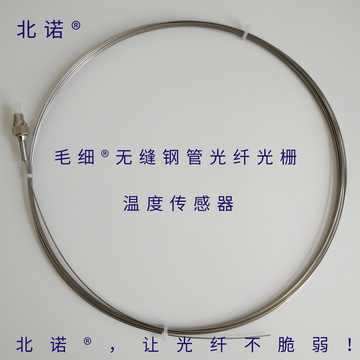
- OFSCN® 300°C Fiber Bragg Grating Temperature Sensor - All-Metal Encapsulation
This product utilizes all-metal encapsulation technology to fully leverage the thermo-optic sensitivity of silica fibers while maintaining long-term stability in environments up to 300°C.

If you would like to understand how these physical properties translate into actual industrial measurement accuracy, please feel free to discuss further.