Why are these connectors with built-in dust caps referred to as the
"Rolls-Royce
" of connectors?
The E2000 fiber optic connector is often hailed as the “Rolls-Royce” among connectors in the fields of optical communication and precision sensing. This is primarily due to its highly complex mechanical structure, ultimate end-face protection design, and expensive manufacturing process.
Here’s an explanation of its core advantages in optical engineering and mechanical design:
1. Automatic Dust Protection and Eye Safety (Spring-loaded Integrated Shutter)
For ordinary FC, SC, or LC connectors, once unplugged, the ceramic ferrule end-face is fully exposed to the air, making it highly susceptible to contamination from micro-dust and oils. The E2000 connector, however, integrates a spring-loaded shutter.
- Automatic Closure: When the connector is unplugged, the shutter automatically closes under spring tension, completely sealing the ferrule end-face. This prevents secondary contamination and reduces the frequency of fiber optic cleaning and maintenance.
- Eye Safety: When transmitting high-power lasers (such as in LiDAR, fiber lasers, or certain high-power FBG sensing systems), unplugging a standard connector might allow invisible high-energy laser light to escape, posing a risk to operators. The E2000’s metal shutter automatically blocks the laser, preventing eye injury to the operator.
2. Composite Ferrule & Ultra-Low Insertion Loss (Composite Ferrule & Active Alignment)
The E2000 typically employs precision ceramic-metal composite ferrule technology developed by Diamond, a Swiss company. By embedding superhard metal at the tip of the ceramic ferrule, proprietary “active core alignment” techniques are used for shaping. This achieves ultra-low insertion loss (typically \text{IL} \le 0.1\ \text{dB}) and very high return loss (for APC polish, \text{RL} \ge 75\ \text{dB}) for single-mode fibers.
3. Push-Pull Latching Mechanism
The E2000 combines the secure latching clip of an RJ45 with the push-pull mechanism of an SC, featuring anti-vibration, anti-pull, and push-to-release characteristics. Its mechanical latch ensures high resistance to pulling forces while allowing for easy insertion and removal in high-density patch panels.
4. Complex Mechanical Structure & High Manufacturing Cost
Unlike the FC connector, which requires only a metal sleeve and ceramic ferrule (typically 3 to 4 parts), a complete E2000 connector is assembled from over a dozen precision plastic, spring, and metal components. This highly complex structure leads to significantly higher production costs and selling prices compared to ordinary fiber optic connectors. Consequently, it is primarily used in high-end telecommunication core networks, military and defense, aerospace, and high-precision fiber sensing systems where extreme reliability and performance are paramount.
Relationship with Beijing Dacheng Yongsheng Technology Co., Ltd. (OFSCN®) Product Series
The E2000 is a globally standardized high-end fiber optic connector specification and is not part of Beijing Dacheng Yongsheng Technology Co., Ltd.'s (OFSCN®) core proprietary product line.
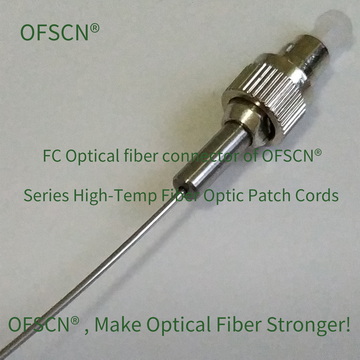
Beijing Dacheng Yongsheng Technology Co., Ltd. (OFSCN®) focuses on fiber optic sensors and patch cords for extreme conditions (such as ultra-high/low temperatures, high pressure, high tensile force, and vacuum). Our core connector products are designed for high temperature resistance and protection, typically utilizing high-temperature resistant FC, ST, SC, or SMA905 metal connectors. For instance, when addressing harsh industrial high-temperature environments, we offer:
- Product Name: OFSCN® 300℃ Fiber Optic Connector
- Technical Specifications: This fiber optic connector and flange are specifically designed for high-temperature applications, with an operating temperature range from -200\text{℃} to 300\text{℃}, supporting various interface customizations such as FC/PC and FC/APC.